Joybuy Insights

Buying Felt-Tip Pens: How to Choose the Right Set for Drawing, School and Hand Lettering

Buying felt-tip pens might seem straightforward: pick a colour set, add it to your basket and you’re done. Yet pens vary considerably in how they perform. A set for a toddler, for example, doesn’t need the same tip as brush pens for hand lettering or highlighters for studying.

The main pitfalls often aren’t about the number of colours, but the finer details:

  • A large number of colours isn’t always practical. A comprehensive felt-tip pen set takes up more space and may include colours you rarely use.
  • A nice product photo tells you little about the tip. A broad tip is handy for filling areas, but less suitable for small details and writing.
  • “Washable” needs a closer look. Check whether it refers to hands, skin or fabric, and follow the product instructions. Washability doesn’t mean every stain on every material will disappear completely.
  • Not every marker works on every type of paper. Some brush pens, according to the product description, only perform well on light paper. Metallic pens, on the other hand, can look their best on coloured paper or card.

What to Look for When Buying Felt-Tip Pens

1. Choose the Tip Based on How You’ll Use It

The tip determines how much control you have and how quickly you can colour.

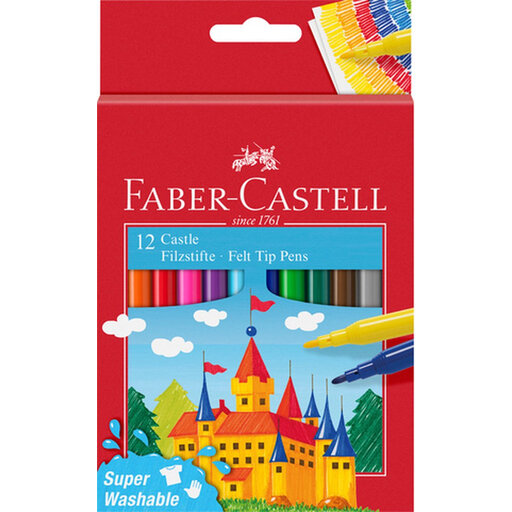
  • Sturdy, round tip: suitable for children and general colouring. The Faber-Castell set of 12 has, according to the product information, a sturdy tip and is designed for children aged 4 and above.
  • Broad and fine tip: practical when you want to fill large areas and add details. The Faber-Castell Duo felt-tip pens combine these two functions.
  • Brush tip: a flexible tip allows you to create thin and thicker lines by varying pressure and movement. This suits hand lettering, small drawings and decorative text.
  • Chisel tip: pastel highlighters with a chisel tip are suitable for narrow and broad markings. The STABILO BOSS ORIGINAL Pastel offers two writing widths of 2 and 5 mm.
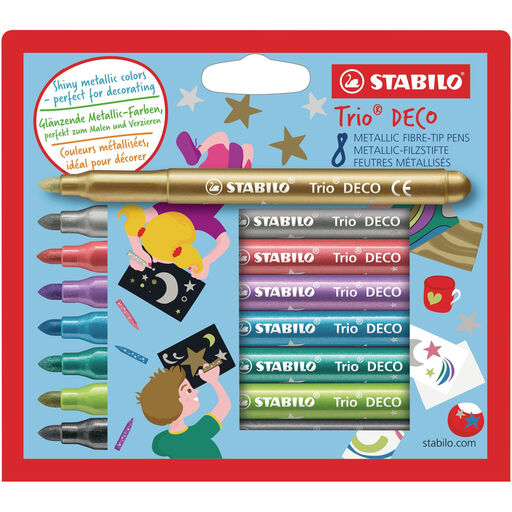
  • XL tip: handy for large colour areas. The STABILO Trio Deco has, according to the product description, a 3 mm tip.

A common mistake is buying a brush pen for a young child who mainly colours in large pictures. For that purpose, a sturdy standard tip can be easier and more durable to use.

2. Check the Ink and Washability

Look out for the following specifications:

  • Water-based: water-based ink is common for drawing pens and can work well on paper.
  • Washable: check the exact description. Some products state that the ink can be washed from hands and skin or from most fabrics.
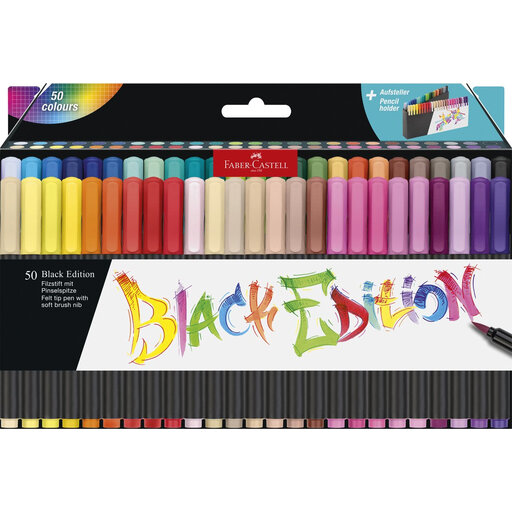
  • Light surface: the Faber-Castell Black Edition brush pens are, according to the product information, intended for light paper, not black paper.
  • Metallic effect: metallic pens can be used on white, coloured paper and card, according to the description of the STABILO Trio Deco. Store these pens lying flat when recommended.

When children are doing craft activities, have them work on a covered table. If you’re unsure about a new pen, test it first on a scrap piece of the same fabric or surface.

3. Consider Age, Certification and Contents

For children’s pens, age recommendations and safety information are important. The Faber-Castell set of 12 states a recommended minimum age of 4 years and carries an EN 71 quality label. The Black Edition set of 50 brush pens also states EN 71 and a recommended minimum age of 10 years.

A certification mark isn’t a reason to overlook other information. Also check:

  • the recommended age range;
  • the number of pens and colour distribution;
  • the presence of small parts;
  • the storage box;
  • the instructions for closing and storing;
  • the surface the ink is intended for.

For school or home use, a cardboard box is often sufficient. A larger set of 50 colours is better suited to a dedicated creative space, while a compact set is easier to take along in a school bag.
Which Set Suits Your Needs?

Suitable for: Budget-conscious beginners
Faber-Castell Felt-Tip Pens Set - 12pcs, Assorted Colours

Faber-Castell Felt-Tip Pens Set - 12pcs, Assorted Colours

Why this fits the profile: A compact set of 12 different colours for children aged 4 and above, home use and simple drawing tasks.

How this product avoids the pitfall

The number of colours remains manageable and the sturdy tip is, according to the product information, designed for use by children. The ink is described as washable from hands and skin.

Key benefit & highlights

12 colours, sturdy tip, cardboard packaging and mention of EN 71 in the product specifications.
Suitable for: Shoppers seeking top quality
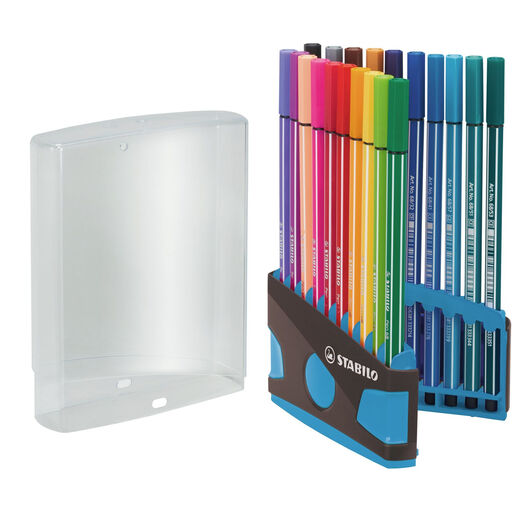
STABILO Pen 68 ColorParade Desk Set of 20

STABILO Pen 68 ColorParade Desk Set of 20

Why this fits the profile: An organised set for school pupils, students, teachers and adults who draw or write regularly.

How this product avoids the pitfall

The product information gives clear guidance on using the pens on smooth paper or card and on replacing the caps after use.

Key benefit & highlights

20 assorted colours, desk set with box and clear care instructions for caps and storage.
Suitable for: Specific use & intensive users
Faber-Castell Brush Pen Set Black Edition 50 pieces

Faber-Castell Brush Pen Set - Black Edition, 50 pieces

Why this fits the profile: For creative adults, teenagers and users who need lots of colours for hand lettering, small drawings and text.

How this product avoids the pitfall

The description explicitly states that the brush pens are intended for light paper. This makes it clear in advance which surface you should choose.

Key benefit & highlights

50 colours, brush tip for variation in line thickness and, according to the product information, washable ink based on food colourings.
Suitable for: Creative crafters
STABILO Trio Deco Metallic Fibre-Tip Pen Set

STABILO Trio Deco Metallic Fibre-Tip Pen, 8 pieces

Why this fits the profile: For children’s parties, cards, craft projects and drawings where coloured or metallic accents are desired.

How this product avoids the pitfall

The product description lists white, coloured paper and card as suitable surfaces. The storage instruction is clear: store lying flat.

Key benefit & highlights

8 metallic colours, triangular grip and an XL tip of 3 mm for larger areas.

Looking for more options?

We’ve put together a full, up-to-date list of products that fully meet these strict selection criteria and current European safety regulations.

Making Your Pens Last Longer: Practical Tips

The lifespan depends on use, tip pressure, paper and storage. These habits will help prevent them from drying out too soon:

  1. Replace every cap immediately after use. This is especially important for brush pens and drawing pens.
  2. Store metallic pens lying flat when the product instructions say so.
  3. Don’t use more pressure than necessary. A soft brush tip can become deformed by pressing too hard.
  4. Choose suitable paper. Thin paper can bleed through; smooth paper often gives a more even result.
  5. Clean the outside with a slightly damp cloth. Don’t submerge pens or plastic parts unless the manufacturer allows it.
  6. Store sets away from direct sunlight and in a dry place.

Frequently Asked Questions About Buying Felt-Tip Pens

Which felt-tip pens are suitable for children?

Look at the age recommendation, the tip and the safety information. For young children, a sturdy tip is often practical. Also check whether the set carries a mention of, for example, EN 71 or CE, and be aware of any small parts.

Can washable pens be completely removed from clothing?

You can’t guarantee that for every fabric. According to the product information for some sets, the ink is washable from hands and skin or from most fabrics. Treat a stain as quickly as possible and follow the care label on the garment.

What’s the difference between brush pens and ordinary drawing pens?

A brush pen usually has a flexible tip that allows you to create thicker and thinner lines by varying the pressure. Ordinary felt-tip pens often have a fixed, round or broad tip and are therefore easier for even colouring. The right choice depends on the activity: colouring, writing, hand lettering or crafting.
