
Player of dark night-time scenes
You want to distinguish dark fields from bright points of light. Compare the contrast and black uniformity of the exact model; RTINGS explains why both matter when using a monitor in a dark room.


For farming simulators in a dark room, OLED is worth considering if deep blacks are your priority. VA LCD is an alternative if you also need to factor in game menus that remain on screen for long periods. IPS LCD may be a better fit if you use the monitor for other computing tasks too and want to avoid the risk of OLED burn-in. Check the contrast and black uniformity of the exact model, as RTINGS recommends. Also make sure your game, computer and connection support your preferred resolution and refresh rate.
You want to distinguish dark fields from bright points of light. Compare the contrast and black uniformity of the exact model; RTINGS explains why both matter when using a monitor in a dark room.
You often keep the same map, meters or work windows on screen. As RTINGS notes, the risk of burn-in from static elements displayed for long periods is a relevant consideration with OLED; compare it with LCD alternatives.
You use your monitor for gaming as well as extended periods of computer work. Readability, adjustability and how it handles static windows can matter just as much as black levels.
Choose this if: deep blacks and bright objects against a dark background are your priorities.
Consider: keeping the same game interface on screen for long periods may make the risk of burn-in relevant.
Choose this if: dark scenes matter to you and you also want to consider an LCD panel for games with menus that stay on screen for long periods.
Consider: the panel label doesn't tell you how the exact model performs; compare contrast, black uniformity and motion handling.
Choose this if: you use the monitor for other computing tasks too and want to avoid the risk of OLED burn-in.
Consider: OLED generally delivers deeper blacks; check the black uniformity of the exact IPS model.
| What to consider | What should you check? | Who should pay particular attention? |
|---|---|---|
| Black levels in a dark room | Compare the contrast and black uniformity of the exact model, ideally with dark images featuring bright objects. | If I want to see dark areas and points of light clearly separated, I compare these features before choosing a panel. Around 36% of consumers in this group prioritise black levels. |
| Game interface displayed for long periods | Compare how you use the monitor with the care instructions and warranty terms for the exact OLED model; don't assume burn-in is covered. | When the same meters or map stay on screen for hours, I factor in the risk of OLED burn-in alongside black levels. Around 29% of consumers give static elements displayed for long periods top priority. |
| Readability and system compatibility | Check the resolution, screen size and connections, as well as the display mode supported by your computer and game. | If I also use the screen for other computing tasks, I want the resolution and connection to suit my system. Around 21% of consumers prioritise system compatibility and readability. |
| Extra horizontal screen space | Check how your own game displays the aspect ratio and whether your desk has room for the screen. | I only choose extra width if my game displays the interface the way I want and my desk can accommodate it. Around 14% of consumers give extra screen width top priority. |
Contrast and black uniformity vary from one monitor to another. The VA or IPS label alone won't tell you how the exact screen displays dark images.
Compare test results for the full model number, paying particular attention to contrast and black uniformity.
Static image elements displayed for long periods are a known risk factor for OLED burn-in, as RTINGS explains.
Consider how you use your monitor before you buy, and read the care instructions and warranty terms for the exact model.
A monitor's resolution doesn't tell you how an individual game will display its interface on a wide screen.
Check the game settings, how it displays on your system and the space available on your desk before making extra width a deciding factor.
A wider screen needs more desk space; the extra width adds little if your game doesn't display the aspect ratio as you want.
The Dell Alienware AW2725D is a QD-OLED model, whereas the Joybuy page reviewed for the AW2725DM describes an IPS model. So the specifications for one model don't automatically apply to the other.
Compare the full model number and key specifications on the manufacturer's website and the product details page.
The AW2725D is a 26.7-inch QHD QD-OLED model for those who place a high priority on black levels.
The 27-inch Odyssey G5 G55C is a curved QHD LCD model to consider if you're weighing up dark scenes and LCD use.
The MOBIUZ EX2710Q is a 27-inch QHD IPS model for mixed use.
The 34M2C3500L/00 is a 34-inch ultrawide Fast VA model for those considering extra screen width.
The 27GS95QE-B is a 27-inch QHD OLED model that can serve as a reference when comparing panel features.
These Joybuy products showcase VA, IPS and OLED options, including ultrawide models for those considering extra screen space.
 No image available
A VA option for those weighing up dark scenes and looking for extra horizontal screen space; first check how your own game handles ultrawide displays.
34 inches; VA; 3440 × 1440; 165 Hz; 1500R.
The benefit of this aspect ratio depends on how your particular game displays it.
 No image available
A curved Rapid VA option to consider if both dark scenes and game menus displayed for long periods matter to you.
27 inches; 2560 × 1440; Rapid VA; 240 Hz.
 No image available
An IPS LCD option to consider if you want to avoid the risk of OLED burn-in and use your monitor for other computing tasks too.
27 inches; QHD 2K; Mini-LED; IPS; 275 Hz.
The panel and backlighting labels don't replace checking the black uniformity of the exact model.
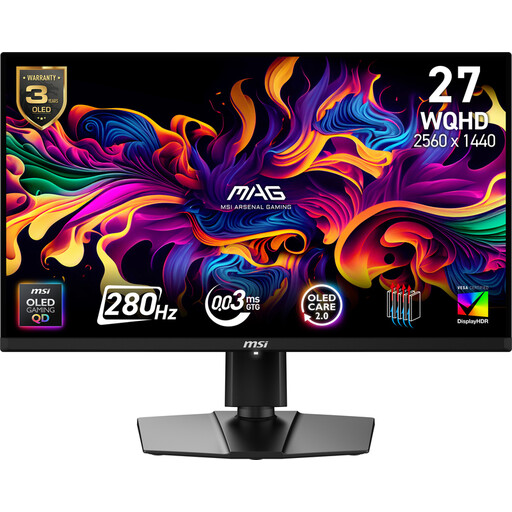 No image available
A QD-OLED option for those who value deep blacks; factor in the risk of OLED burn-in if fixed game menus stay on screen for long periods.
27 inches; WQHD; OLED; 280 Hz.
 No image available
An ultrawide OLED option for those looking for deep blacks and extra screen space; check how your game displays its interface.
34 inches; 3440 × 1440; 21:9; OLED; 240 Hz.
Repeated static images displayed for long periods make the general risk of OLED burn-in relevant.
No, not on its own. Compare your preferred resolution and refresh rate with what your computer and connection can support. The minimum requirements for Farming Simulator 25 published by GIANTS don't guarantee a specific frame rate at QHD or ultrawide resolutions.
Bear in mind the risk of burn-in from repeated static images displayed for long periods, as RTINGS explains. Check the instructions and terms for the exact model for care advice and any cover; don't assume they're the same for other OLED models.
No, not on its own. According to the European Commission, the EU energy label provides comparable energy information for displays and also shows HDR consumption. Your own costs will also depend on how long you use the monitor, your settings and your electricity tariff.
No. According to the Dutch government, there is no fixed statutory warranty period in the Netherlands. You're entitled to a product that works properly for a period that depends on what you can reasonably expect. If there's a problem, contact the seller; a manufacturer's warranty is separate.
For many consumer distance purchases, there's a 14-day cooling-off period. Check who the seller is and which terms apply to your purchase; the Dutch government lists some exceptions.