
Bakers with a crowded worktop
You want to shape and cool your raisin buns without the oven taking up almost all your workspace. Compare the external dimensions and allow for the recommended clearance.


First, choose an oven that fits safely on your worktop, with room for ventilation and for the door to open. Then compare the baking tray with the number of buns you want to bake at a time. A smaller model may leave you more room to shape the dough, while a larger cooking space could mean fewer batches. The capacity in litres doesn’t tell you how many buns will fit on the baking tray.
You want to shape and cool your raisin buns without the oven taking up almost all your workspace. Compare the external dimensions and allow for the recommended clearance.
You want to know how many shaped buns will fit on the supplied baking tray, and you may be happy to consider a larger oven if it suits the batches you bake.
You want to bake using the fan setting, while also being able to select top and bottom heat when a recipe calls for it.
First, measure the space for the oven, including room for ventilation and the open door. Then check the usable baking tray and the settings that suit your recipes.
| What to consider | What should you check? | Who is this important for? |
|---|---|---|
| Safe positioning and workspace | Measure the width and depth of the space for the oven, allow for the open door and follow the positioning instructions for the model. | If I want to shape the dough and cool the buns without losing my worktop space, I’ll prioritise the clearance needed. Around 36% of consumers are most concerned about this. |
| Space on the baking tray | Check the dimensions of the supplied baking tray and work out how many shaped buns will fit with space between them. | If I want to bake more buns in one batch, I’ll look at the tray itself rather than just the capacity in litres. Around 29% of consumers prioritise the batch size they want to make. |
| Baking settings and temperature | Check that the exact model has the fan setting you want, any alternative heating settings and the temperature range you need. | If my recipe calls for a particular heating setting, I want to be able to select it rather than rely on a different cooking method. Around 21% of consumers focus mainly on the baking settings. |
| Cleaning and service | Check the cleaning instructions, any removable parts and the model’s warranty terms. | After baking, I want to be able to remove crumbs easily and know where to find the service terms. Around 14% of consumers prioritise maintenance and service. |
The external dimensions, internal space and baking tray each answer different questions. The capacity in litres won’t tell you how many shaped buns will fit on the tray.
Measure the space available and compare the size of the baking tray before deciding how many buns you want to bake in each batch.
A smaller baking tray may mean splitting the baking into more batches, while a larger oven could take up more worktop space.
Having enough room for the oven itself doesn’t necessarily mean it can be positioned safely. It may need extra space for ventilation and to open the door.
Follow the positioning instructions for the exact model and measure the space needed for the door as well.
Extra features and the stated wattage don’t, by themselves, show how your raisin buns will turn out.
Prioritise the baking setting you need, the space on the baking tray and a suitable position for the oven. Consider any extra features separately from your baking needs.
According to Inventum, the OV207B and OV307B give you a choice between a 20-litre model and a 30-litre model.
According to the manufacturer, the Severin TO 2068 is a fan oven with a capacity of around 20 litres.
According to Princess, the Princess 112751 is a 32-litre fan oven supplied with a baking tray.
This Joybuy selection includes freestanding ovens for baking, from compact models to more spacious options. For each model, check that the baking setting and tray suit your recipe.
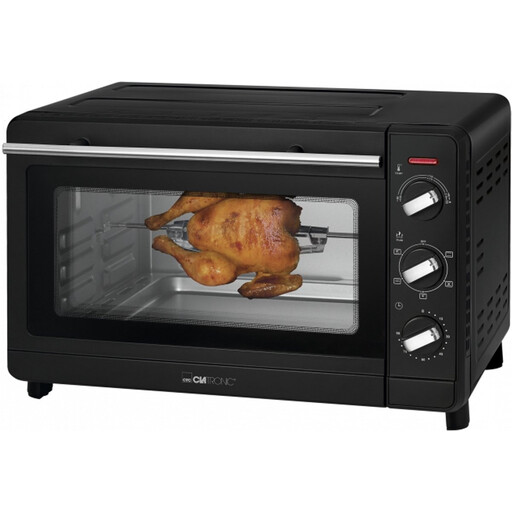 No image available
A more spacious oven to consider if you want to use top and bottom heat with air circulation when baking.
Capacity: 30 litres. The description lists a baking tray, a removable crumb tray and an adjustable temperature from 100 to 230 °C.
 No image available
Worth considering if you’re looking for an oven with convection and a larger stated capacity.
The product name lists a capacity of 45 litres and a power rating of 2000 W. The description mentions convection, top and bottom heat and an adjustable temperature.
 No image available
A more compact oven to consider if you want to factor in the space on your worktop as well as the baking setting.
Capacity: 22 litres. The description lists fan settings, an adjustable temperature up to 230 °C, an enamelled baking tray and a removable crumb tray. The user instructions specify a flat, heat-resistant surface with sufficient ventilation.
 No image available
A small model to consider if space is limited and a small baking tray suits the batch you want to make.
Capacity: 10 litres. The description lists top and bottom heat, a baking tray up to 20 cm and an adjustable temperature up to 230 °C. When planning how many buns to bake, bear the size of the tray in mind.
 No image available
An air fryer toaster oven to consider if you want to bake using air circulation and have enough room for a larger appliance.
Capacity: 30 litres. The stated external dimensions are 456 × 430 × 365 mm. The description lists a temperature range of 30–230 °C and 360° air circulation. Remember to allow for ventilation and space for the door too.
No. Focus on whether you can select the required baking setting and temperature, and whether the buns will fit on the actual baking tray. Koopmans’ recipe for cinnamon raisin buns specifies 200 °C for a fan oven and 220 °C for an electric oven; don’t assume these temperatures will work for a different recipe.
Don’t assume so. Follow the ventilation instructions for the exact model and check that there’s enough room to open the door before choosing a spot.
A manufacturer’s warranty doesn’t replace your statutory rights with the seller. According to the Dutch government, you’re entitled to a product that works properly; if a product is faulty, the seller must provide a solution. There is no fixed statutory warranty period in the Netherlands.
The NVWA states that CE marking is compulsory for electrical products, but testing is not. So the mark isn’t the same as proof of an independent product test. Check the marking and product information for the appliance on offer.
Follow the instructions for the exact model and let the appliance cool down safely first. For the OV207B, Inventum recommends cleaning with a soft, damp cloth and washing-up liquid, and lists removable parts. Princess lists a removable crumb tray for the 112751.