
Cooking for a group
You want to bake the gratin for everyone in one dish, so you’re comparing the dish size with the oven door, rack and usable oven space. Albert Heijn Allerhande gives a 20 × 30 cm dish for a recipe for four people.


First, measure your oven dish and check that it will fit through the door and sit on the oven rack; capacity in litres alone won’t tell you that. Then choose between a freestanding model, with enough safe worktop space, and a built-in oven that fits your housing and connection. For example, Albert Heijn Allerhande uses a 20 × 30 cm dish in a recipe for four people, but that example size doesn’t confirm that the dish will fit in every oven.
You want to bake the gratin for everyone in one dish, so you’re comparing the dish size with the oven door, rack and usable oven space. Albert Heijn Allerhande gives a 20 × 30 cm dish for a recipe for four people.
You’re looking for a freestanding fan oven for your worktop, so you need to check the external dimensions and placement requirements as well as the size of your dish. The manual for the specific model is your guide.
You can install a built-in oven and want to weigh up its cooking functions and cleaning options against the housing dimensions and connection requirements.
When to choose it If you don’t have a suitable oven housing and can use a suitably sized dish in a safe spot on your worktop. Inventum and Princess describe models with fan-assisted cooking and conventional top and bottom heat.
What to consider You’ll need to leave enough worktop space. Also check the exact model’s external dimensions and placement requirements.
When to choose it If you have a suitable oven housing and connection, and want to use the oven for other meals too. Bosch lists a capacity of 71 litres and 3D Hotair for the HBA514BB3; AEG lists a capacity of 72 litres for the OU5PB40WSM.
What to consider The stated capacity doesn’t confirm that your dish will fit. You’ll also need to check the model-specific installation dimensions and connection requirements.
| What to consider | What should you check? | Who needs to consider this? |
|---|---|---|
| Will the dish fit? | Measure the dish, including its handles and height, and compare it with the oven door, usable interior space and rack position. Albert Heijn Allerhande uses a 20 × 30 cm dish for a recipe for four people; use this as an example size only. | If I want to bake the gratin for everyone in one dish, I’ll first check that it really fits. Around 36% of consumers say dish fit is their top priority. |
| Cooking functions and timer | Check the functions, temperature settings and timer on the exact model. Albert Heijn Allerhande’s recipe specifies 200 °C and around an hour, but doesn’t call for a fan setting. Bosch gives 20 °C lower as a general rule of thumb when converting to fan-assisted cooking, not as a fixed setting for this gratin. | If you want to follow the recipe, it helps to have suitable temperature and time settings. Around 29% of consumers put cooking controls first. |
| Placement | For a freestanding model, check its external dimensions and placement and ventilation requirements. For a built-in model, check the specific model’s required housing dimensions and connection. | If I don’t have a suitable oven housing, a freestanding model needs to sit safely on my worktop. If I do have a housing, the built-in oven needs to fit my kitchen. Around 21% of consumers say placement is their top priority. |
| Cleaning and energy use | Check the cleaning method used by the model. Compare energy information only when the EU energy label applies to that type of oven and the figures are given on the same basis. The European Commission excludes small and portable ovens from the stated labelling scope. | If you’re mainly concerned with cleaning and running costs after your meal, compare the cleaning method and any applicable energy-use information. Around 14% of consumers say maintenance and running costs are their top priority. |
An oven’s capacity doesn’t tell you whether a dish will fit through the door or sit on the rack. For example, Albert Heijn Allerhande specifies a 20 × 30 cm dish for a recipe for four people.
Measure your own dish, including its handles, and compare its dimensions with the interior space and door of the exact model.
If the dish doesn’t fit, you may need a different one or have to cook the gratin in several batches.
Severin’s product information for the TO 2056 lists a fan function but also gives the specification ‘Fan function: no’. Don’t confuse this model with the TO 2058, which Severin lists as having a fan function.
Before buying, check the details and manual for the exact model on offer. If the information is contradictory, ask for clarification.
The European Commission excludes small and portable ovens from the stated labelling scope. This means a label for an oven within that scope isn’t necessarily comparable with a small or portable oven.
First check whether the labelling rules apply to the type you’ve chosen, and only compare energy-use figures on the same basis.
The OV457B is an example of a freestanding oven with a capacity of 45 litres, fan-assisted cooking and conventional top and bottom heat.
According to Princess, the Princess 112754 is a 45-litre freestanding oven with convection, a grill and conventional top and bottom heat.
The Bosch HBA514BB3 is a 71-litre built-in oven with 3D Hotair and conventional top and bottom heat.
According to AEG, the AEG OU5PB40WSM is a 72-litre built-in oven with multi-fan cooking and pyrolytic cleaning.
Severin lists a capacity of 42 litres and a fan function for the freestanding TO 2058.
This selection of Joybuy products includes both freestanding and built-in ovens. Choose the type that suits your worktop or oven housing, and check that your dish fits the exact model before you buy.
 Image unavailable
A built-in model to compare if your kitchen has a suitable oven housing.
The product name lists 70 l, 3 kW, Rotating Heat, grill, pizza function, AquaClean steam cleaning, timer, ECO Mode and energy class A.
 Image unavailable
A freestanding model to compare if you don’t have a suitable built-in oven housing.
The product name lists 65 l and 2000 W. Keep the ventilation openings clear during use; the product information warns that the appliance gets hot.
 Image unavailable
A built-in model to consider if it suits your kitchen’s oven housing and connection.
The product name lists 66 l, five cooking programmes, ecoClean cleaning, rapid preheating, and a stainless steel and black finish.
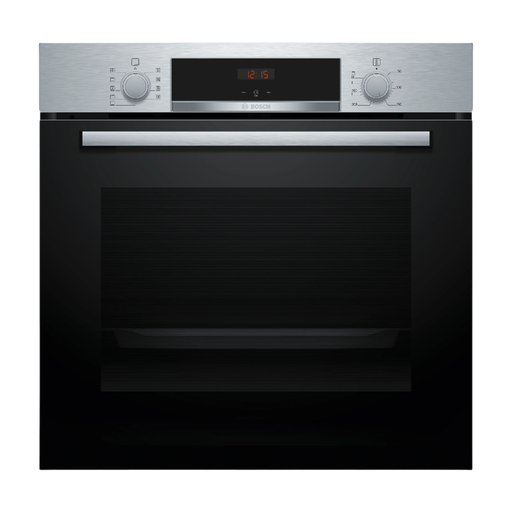 Image unavailable
A built-in model to compare if you have a suitable oven housing and want to weigh up different oven functions.
The product name lists 71 l, Hydrolysis Cleaning, Turbo Hot Air, touch controls and a maximum temperature of 275 °C.
 Image unavailable
A built-in model to compare if your kitchen has the required oven housing dimensions and connection.
The product name lists 71 l, 3D HotAir, EcoClean Direct, energy class A+ and a black finish.
No. Capacity in litres doesn’t confirm that a particular dish will fit. Albert Heijn Allerhande uses a 20 × 30 cm dish for a recipe for four people; measure your own dish, including its handles, and compare it with the oven door and usable interior space.
Not without taking the oven setting into account: Albert Heijn Allerhande’s recipe specifies 200 °C, but doesn’t call for a fan setting. Bosch gives 20 °C lower as a general rule of thumb when converting from conventional top and bottom heat to fan-assisted cooking. Follow your oven’s manual and check the gratin as it bakes.
For a freestanding oven, check its external dimensions and the placement and ventilation requirements in the manual. For a built-in model, compare its specific housing dimensions and connection requirements with your kitchen. For example, AEG lists a connected load of 3490 W for the OU5PB40WSM.
No. The European Commission excludes small and portable ovens from the stated labelling scope for domestic ovens. Check whether the rules apply to each appliance; don’t automatically assume that a small or portable oven fails to meet the rules just because it has no label.
No. According to the Dutch government, there’s no fixed statutory warranty period in the Netherlands: you’re entitled to a product that works properly for as long as you can reasonably expect it to. If a product is faulty, contact the seller; any manufacturer’s warranty is separate.