Start by considering how many twists you want to fit on your baking tray and whether you’d like to bake on several trays at once. A freestanding oven could be a good fit if you don’t have a built-in housing unit; a built-in oven may be worth considering if you often want to use several shelf levels. Also compare the space available and energy use for the way you’ll use it: a larger oven isn’t automatically more efficient for small batches.
Who is this suitable for?
Baking for a full house
You want to make several batches of twists, so you’ll want to focus on the usable baking-tray space and the shelf levels the oven actually supports. Manufacturers provide model-specific information about shelf levels, so check the details for the model you’re considering.
Baking without a built-in housing unit
You’re looking for a freestanding oven and need to weigh up its external dimensions, the space available on your worktop and the baking tray against the batch size you want to make. Be sure to follow the installation instructions for your chosen model.
Baking small batches
You don’t usually bake large quantities and want an oven that suits your typical use. Milieu Centraal recommends taking both energy consumption and oven size into account when choosing.
What should you look for when choosing?
Freestanding fan oven
A good fit if: you don’t have a suitable built-in housing unit and want a worktop model with enough usable space for your batch.
Bear in mind: check the tray size and the clearance around the appliance; according to Severin, the TO 2058 does not have a Safe Touch design.
Built-in fan oven
A good fit if: you have a suitable housing unit and regularly want to use several trays or shelf levels. Bosch states that the HBA534BS3 supports a maximum of three shelf levels; AEG states that the OU5AB2W0CK can bake with up to three trays at once.
Bear in mind: these baking capabilities are manufacturer claims for specific models, not independent tests using pastry twists. Measure the housing unit and check the trays and connection required.
Existing combination microwave with fan oven
A good fit if: you already have a suitable fan setting and baking tray; check the available space before buying a separate oven.
Bear in mind: usable tray space and the ability to bake on several levels at once vary by model. Milieu Centraal suggests that a good combination microwave with a fan oven can be a more energy-efficient baking option, but this doesn’t guarantee lower energy use for your appliance or baking session.
| What to consider |
What to look for when buying |
Who is this important for? |
| Twists per batch |
Check the usable internal dimensions and tray size, how many trays are included, and whether baking on several levels at once is explicitly supported. |
If you’re baking for guests, you’ll want to know how many twists will fit on a tray with enough space between them. Around 33% of consumers prioritise baking capacity. |
| Kitchen space |
For a built-in oven, measure the housing unit; for a freestanding model, check the external dimensions and the required clearance around it. |
If you don’t have a suitable housing unit or have limited worktop space, where the oven can go will determine which models fit in your kitchen. An estimated 27% of consumers put installation requirements first. |
| Oven settings and temperature |
Check whether the model offers a fan setting and, if needed, conventional top and bottom heat, and whether you can adjust the temperature and timer. |
If you’re following a recipe to bake twists, you’ll want to be able to match the available settings to the method. Around 20% of consumers focus mainly on baking controls. |
| Energy use for your batch |
Where possible, compare the electricity used per baking session on a like-for-like basis and take oven size into account; an energy label alone won’t settle the comparison. |
If you usually bake small batches, you’ll want to avoid choosing based only on maximum capacity. Around 20% of consumers prioritise energy use. |
For puff pastry recipes that specify conventional top and bottom heat, Voedingscentrum recommends setting the temperature around 10% lower when using a fan oven. Also check the instructions on the pastry packaging and keep an eye on how the twists are baking.
Common mistakes
-
Confusing capacity in litres with how many twists will fit at once
The capacity doesn’t tell you how much baking-tray space is available or how many trays you can use at once. For example, ETNA lists five shelf positions and one baking tray included with the OM670Ti.
Check the internal dimensions and tray size, the accessories included and the information on baking several trays at once for the exact model.
A smaller usable tray may mean you need to bake in extra batches; check whether you’ll need an additional tray for the quantity you’re making.
-
Relying on the energy label alone
The label alone won’t tell you how much energy to expect for your batch size and baking session. Milieu Centraal recommends taking the oven size and energy-use figures into account too.
Compare energy-use figures on a like-for-like basis and consider the batch size you usually bake.
-
Assuming every table-top oven stays cool on the outside
Severin explicitly states that the TO 2058 does not have a Safe Touch design. A freestanding oven must also be installed according to the instructions.
Read the safety and installation instructions for the exact model, and don’t touch hot parts without protection.
Brands to compare
Severin
Freestanding baking and toaster ovens; the TO 2058 is an example of a worktop oven with a fan setting.
- For the TO 2058, Severin lists a 42-litre capacity, four shelf positions, and top and bottom heat and fan settings that can be used separately or together.
- Severin states that this model does not have a Safe Touch design. The manufacturer marks the TO 2058 as sold out; this doesn’t tell you whether other retailers have it in stock.
Bosch
Built-in ovens; the HBA534BS3 is an example for a suitable housing unit and baking on several shelf levels.
- Bosch states that the HBA534BS3 has 3D Hotair for up to three shelf levels, as well as conventional top and bottom heat.
- The shelf-level information is a model specification and manufacturer claim, not an independent test using pastry twists.
AEG
Built-in ovens; the OU5AB2W0CK is an example for anyone wanting to use several trays at once.
- AEG states that this model can bake with up to three trays at once and has AquaCleaning.
- Check the housing unit, appliance and trays required for your kitchen. The baking claim isn’t based on an independent test using twists.
ETNA
Built-in ovens; the OM670Ti provides specific details to help you compare the housing unit and included tray.
- For this model, ETNA lists a net capacity of 72,12 litres, five shelf positions, a housing-unit size of 600 × 560 × 550 mm and one enamelled baking tray included.
- Five shelf positions don’t, by themselves, mean you can use five trays at once.
Inventum
Freestanding fan ovens; the OV307S is an example to consider when comparing more compact oven sizes.
- Inventum lists a 30-litre capacity, six programmes and a baking tray included with the OV307S.
- The manufacturer marks the OV307S as discontinued. Don’t use its model specifications as confirmation that it’s currently available to buy new.
Ovens at Joybuy
These models include freestanding fan ovens and built-in ovens for baking twists; check the available space, oven settings and included accessories for each version.
 Image unavailable
Bosch HBA514BB3 built-in oven, 71 l
Could suit you if you’re looking for a built-in oven with information about baking on several levels; first check that the housing unit is suitable for this model.
The product information lists 3D Hotair and baking on up to three levels at once. The product name lists a capacity of 71 l.
View at Joybuy
 Image unavailable
Bosch HQG572EB3 built-in oven, 71 l
One to compare if you’re looking for a built-in oven with different baking settings; check the housing-unit dimensions for your kitchen.
The product information lists 3D Hotair for up to three levels at once, conventional top and bottom heat, and steam. The product name mentions Air Fry, pyrolytic self-cleaning and a capacity of 71 l.
View at Joybuy
 Image unavailable
Severin TO 2074 freestanding oven
Could suit you if you don’t have a built-in housing unit and want a freestanding model with several baking settings.
The product information lists a 30-litre capacity, fan setting, top heat, bottom heat, combined heat and grill. The product name lists 1200 W. Place the oven on a flat, heat-resistant surface with plenty of ventilation; surfaces can become hot.
View at Joybuy
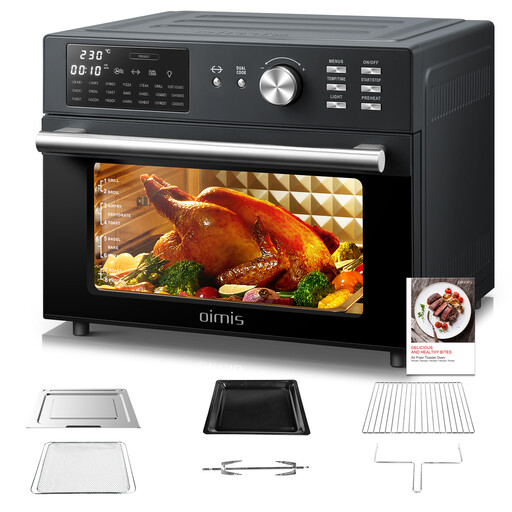 Image unavailable
OIMIS Air Fryer Toaster Oven, 30 l
A freestanding model to compare if you’re looking for a worktop oven with a baking function for twists.
The product information lists a 30-litre capacity, a baking function, 360° air circulation and six accessories. The product name mentions 21 presets and 1800 W.
View at Joybuy
 Image unavailable
Wiggo WMO-E4562H(B) freestanding mini oven, 45 litres
Could suit you if you’re looking for a freestanding model and its size and installation requirements work for your kitchen.
The product information lists convection, top heat, bottom heat, combined heat and grill. The product name mentions 45 litres, 60 cm and 3534 W.
View at Joybuy
Frequently asked questions
Which setting should you use if a recipe specifies conventional top and bottom heat?
Use conventional top and bottom heat if you’re following the recipe as written. If you choose the fan setting, Voedingscentrum recommends setting the temperature around 10% lower. Towards the end of the baking time, check that the twists are cooked through and not getting too dark.
Will every built-in oven fit your existing housing unit?
No. Compare the required housing-unit dimensions and connection for the exact model with your kitchen. For example, ETNA specifies a housing unit that is 600 mm high, 560 mm wide and 550 mm deep for the OM670Ti; these dimensions don’t automatically apply to other ovens.
Is an energy label enough to compare the energy use of a baking session?
No. Milieu Centraal also recommends comparing electricity use per session or per year. A smaller oven with a lower energy rating may use less electricity than a larger oven with a higher rating; energy use during your baking session also depends on how you use the oven.
Does an electric domestic oven need a CE marking?
CE marking is compulsory for electrical products covered by the applicable Dutch regulations. The Netherlands Food and Consumer Product Safety Authority explains the rules that apply to electrical products; check the marking and product information for the specific oven. A CE marking is not an independent assessment of baking performance.
What can you do if an oven turns out to be faulty after purchase?
If a product is faulty, the seller must provide an appropriate solution. According to the Dutch government, there is no fixed statutory warranty period in the Netherlands; what you’re entitled to expect depends, among other things, on the product, its price and the information provided at the time of sale.


