First, choose an oven that fits your baking tin and can be positioned safely. Then decide whether you’ll be making nut bread alone or cooking side dishes too. A freestanding oven doesn’t need a built-in space, while a built-in oven with several shelf levels may give you room to bake more than one thing at once. However, this doesn’t guarantee that everything will take the same time to bake. For a recipe using conventional top and bottom heat, the Netherlands Nutrition Centre advises setting the temperature about 10% lower when using a fan oven, then checking towards the end to see if it’s cooked through.
Who is this oven guide for?
Host baking a single nut loaf
You want your tin to fit and your loaf to be ready on time. Choosing the right oven setting, using a timer and checking towards the end of the baking time can all help. The Netherlands Nutrition Centre gives a baking time of 45–60 minutes for its recipe.
Cook with a small kitchen
You need to work with the worktop space available or find a suitable built-in space. Measure the area and check the internal or installation dimensions of the model you’re considering.
Cook who also bakes side dishes
You’re looking for enough space and suitable oven settings to prepare more than one dish, if possible. Having several shelf levels doesn’t automatically mean every dish will need the same baking time.
What should you look for in a fan oven for nut bread?
| What to consider |
What should you check? |
Who is this important for? |
| Oven setting and cooking through |
Check that the model has the setting used in your recipe. When converting a recipe from conventional top and bottom heat to a fan oven, the Netherlands Nutrition Centre advises setting the temperature about 10% lower. Check that the food is cooked through towards the end. |
If your main priority is making sure the nut bread cooks through without the outside getting too dark, look at the oven settings and how easily you can check the food. Around 36% of consumers put the baking result first. |
| Fit and positioning |
Measure your baking tin and the space available. For a freestanding oven, check the internal dimensions; for a built-in oven, check all the required niche dimensions. |
If your kitchen is short on space or you’re choosing between a freestanding and built-in model, you’ll want to know in advance whether both the oven and baking tin will fit. Around 29% of consumers prioritise positioning. |
| Timing and timer |
Check the controls and timer. Allow separately for preparation, any preheating, baking time and the final check. The 45–60 minutes given by the Netherlands Nutrition Centre apply to its specific recipe. |
If your friends are due to arrive soon, you’ll want to plan oven use and cooking around the time you have available. Around 21% of consumers put meal planning first. |
| Size and energy use |
Choose a capacity that suits what you usually bake, and compare energy-use figures on the same basis where available. European oven labelling rules exclude portable ovens, among other products. |
If you usually bake a single small dish, a large model may take up more space than you need. If you also bake side dishes, the extra oven space could come in handy. Around 14% of consumers focus first on energy use and avoiding unnecessary oven space. |
Common mistakes when choosing and using an oven
-
Looking only at the capacity in litres
Capacity doesn’t tell you whether your baking tin will actually fit in the oven. For a built-in model, the dimensions of the niche also need to be right.
Measure your baking tin and kitchen space, then compare them with the internal dimensions or all the installation dimensions for the exact model.
-
Turning up the temperature because guests are due soon
A darker outside doesn’t necessarily mean the middle is cooked through. For a fan oven, when converting a recipe that uses conventional top and bottom heat, the Netherlands Nutrition Centre advises setting the temperature about 10% lower.
Follow the oven setting and temperature in the recipe, then check that the food is cooked through towards the end rather than turning up the heat and hoping for the best.
-
Expecting every freestanding oven to have an energy label
The European Commission says that energy labelling rules for domestic ovens exclude portable ovens, among other products.
Compare energy-use figures where available, and don’t treat the lack of a label on its own as evidence of high energy use.
Oven brands and models to consider
Inventum
The freestanding OV607B is one to consider if you don’t want a built-in oven.
- Inventum lists a 60-litre capacity, fan oven, conventional top and bottom heat, a timer and an included wire rack.
- Check the internal dimensions against your baking tin. The listed features don’t predict how your nut bread will bake.
Bosch
The HBA534BB3 built-in oven is one to consider for a kitchen with a suitable niche and if you need several shelf levels.
- Bosch lists a 71-litre capacity, 3D Hotair for up to three shelf levels, and conventional top and bottom heat.
- The manufacturer’s claim about heat distribution doesn’t prove a specific baking result for nut bread. Check all the niche dimensions too.
ETNA
The OM165ZT multifunction built-in oven is one to consider for a kitchen with a suitable built-in space.
- ETNA lists turbo fan cooking, conventional top and bottom heat, a mechanical timer and a niche height of 600 mm.
- As well as the niche height, check the other installation dimensions. The listed features aren’t an independent baking test.
Joybuy ovens for baking and roasting
These ovens are selected for anyone looking for a model for baking. Check whether the dimensions, settings and positioning of each model suit your baking tin and kitchen.
 Image unavailable
Wiggo WMO-E657(B) 65-litre freestanding oven
A freestanding model to consider if you don’t want to use a built-in space. Check that your baking tin will fit inside.
The product information lists a 65-litre capacity, a 90-minute timer, five shelf positions, a turbo fan and six cooking functions. The title lists 2000 W and black.
Only use the accessories supplied or recommended by Wiggo.
View at Joybuy
 Image unavailable
Wiggo WMO-E456(W) mini oven
A freestanding option if you’re looking for an oven with fan circulation and conventional top and bottom heat.
The product name lists a 45-litre capacity and 2000 W. The product information mentions a timer and child lock.
Place the oven on a stable, heat-resistant surface.
View at Joybuy
 Image unavailable
Rommelsbacher BGS 1400 mini oven
A compact oven to consider if your baking tin is within the maximum diameter listed.
The product information lists a 22-litre capacity, five heating settings and a 60-minute timer. One setting combines conventional top and bottom heat with hot air. Baking tins up to 25 cm in diameter are mentioned.
Place the oven on a flat, heat-resistant surface with plenty of ventilation.
View at Joybuy
 Image unavailable
Rommelsbacher BG 950 mini oven
A small oven to consider if your baking tray fits within the stated dimensions.
The product information lists a 10-litre capacity, adjustable temperature, conventional top and bottom heat, and a 30-minute timer. Baking trays up to 20 cm are mentioned.
View at Joybuy
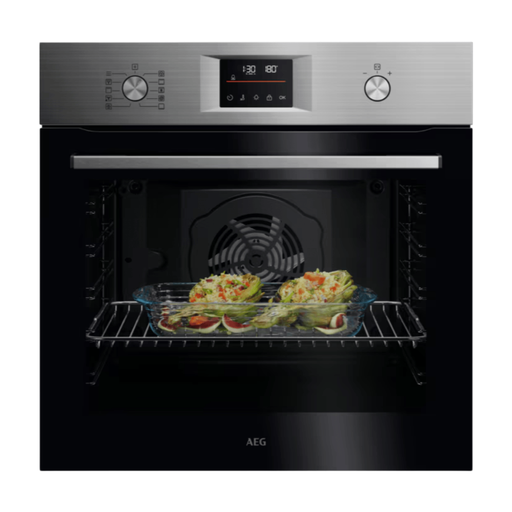 Image unavailable
AEG OU5PB40ZSM Series 5 oven
One to consider if the listed capacity and pyrolytic cleaning suit your needs.
The product information lists a 72-litre capacity and pyrolytic cleaning.
View at Joybuy
Frequently asked questions
Should I adjust the temperature for a fan oven recipe?
If the recipe uses conventional top and bottom heat, the Netherlands Nutrition Centre advises setting the temperature about 10% lower for a fan oven and checking towards the end that the food is cooked through. If the recipe gives a specific fan oven setting, follow that rather than converting it again.
How can I cater for guests with a food allergy?
Ask about allergies in advance and check the labels on every ingredient. Nuts are allergens, and other ingredients in nut bread may contain allergens too. Don’t assume a dish is free from allergens without checking.
Can I make nut bread ahead and reheat it later?
Yes, but follow the storage and reheating instructions for the dish. The Netherlands Nutrition Centre advises letting leftover cooked food cool within two hours.
What warranty applies when buying an oven in the Netherlands?
For a consumer purchase, the seller must offer a solution if the product doesn’t meet what you could reasonably expect. The Dutch Government says there is no fixed statutory warranty period in the Netherlands; any manufacturer’s warranty or additional warranty you buy is on top of this.


