
Host with a large baking dish
You want to bake one fish pie for several guests and need to know in advance whether your dish will actually fit in the oven. The Consumers’ Association advises checking the internal dimensions.


First, measure your largest baking dish and the space available in your kitchen: the stated capacity in litres doesn’t guarantee that your dish will fit. Then choose a fan oven with settings to suit your recipe. A spacious oven may accommodate a large dish, while a compact or freestanding model may be a better fit for the space you have. Check that the fish is cooked through, regardless of how brown the crust looks.
You want to bake one fish pie for several guests and need to know in advance whether your dish will actually fit in the oven. The Consumers’ Association advises checking the internal dimensions.
You want to plan the pie and any side dishes, and are looking for suitable oven settings and shelf positions. Check that the fish is cooked through separately from the colour of the crust; the Netherlands Nutrition Centre advises eating fish thoroughly cooked.
You’re looking for a compact or freestanding oven, or a built-in model that fits the available housing. Check the internal dimensions of the exact model before choosing based on capacity.
Best for: a suitable built-in housing and a large baking dish, possibly with side dishes on other shelf levels.
Keep in mind: the housing must suit the model; having several shelf levels doesn’t guarantee that every dish will cook evenly.
Best for: anyone who doesn’t want to use a built-in housing but needs room for a larger dish.
Keep in mind: the appliance needs worktop space and must be set up in line with the installation and connection instructions.
Best for: a kitchen with limited space, provided the dish fits within the actual internal dimensions.
Keep in mind: there may be limited room for a large pie or several dishes; microwave heating isn’t the same as fan baking.
| What to consider | What should you check? | Who is this important for? |
|---|---|---|
| Space for the dish | Measure the width, depth and height, including handles, and compare them with the usable internal dimensions. | I want to use one dish for all my guests and know in advance whether it will actually fit. Around 36% of consumers put space for the dish first. |
| Cooking the filling and browning the top | Compare the fan, top heat and grill settings with your recipe; check separately that the fish is cooked through. | I want the filling to cook properly and the top to brown, without relying on the crust as proof that the fish is cooked. Around 29% of consumers prioritise cooking the filling and browning the top. |
| Fitting the oven into your kitchen | For built-in models, check the specified housing dimensions; for freestanding models, check the external dimensions and installation instructions. | I need to fit the oven into my kitchen and want to know in advance whether built-in or freestanding is practical. Around 21% of consumers prioritise the space available in their kitchen. |
| Use and maintenance | Where applicable, compare energy consumption per cycle using the same heating setting, and check the cleaning method. | I want to know how regular use and cleaning should affect my choice. Around 14% of consumers prioritise running costs and maintenance. |
The stated capacity doesn’t automatically tell you whether your baking dish will fit. The Consumers’ Association advises measuring your largest dish and checking the internal dimensions.
Measure the dish, including the handles, and allow for the space needed around it.
If the dish doesn’t fit, you may need a different dish or a different oven.
The colour of the crust doesn’t tell you whether the fish in the filling is cooked through. The Netherlands Nutrition Centre advises eating fish thoroughly cooked.
Check the filling separately before serving the pie.
A compact model may have less room for a large pie or several dishes. A microwave setting is also not the same as fan baking.
Check the internal dimensions and baking settings of the exact model before deciding.
Limited internal space may restrict your choice of dish or make it harder to cook side dishes at the same time.
When you buy as a consumer in the Netherlands, you have statutory rights if a product is faulty. The Dutch Government says there is no fixed statutory warranty period.
Check what an additional plan actually offers and compare its terms with your statutory rights.
The freestanding OV607B is an example of a fan oven that doesn’t need a built-in housing, with a stated net capacity of 60 litres.
The HBF133BR0 is an example of a built-in oven with fan, top and bottom heat, and grill settings.
The TO 2056 is a freestanding mini oven with a stated capacity of 30 litres.
The CM450RVS is a built-in oven with a microwave function, designed for a 45 cm housing, and turbo fan baking.
The NBU5P40SK is a built-in oven with fan cooking and a cleaning function.
This selection focuses on built-in fan ovens for cooking a fish pie and any accompanying side dishes.
 No image available
A built-in model with a stated capacity of 71 litres and 3D fan cooking, as indicated in the product name. Check that the housing and your baking dish will fit.
 No image available
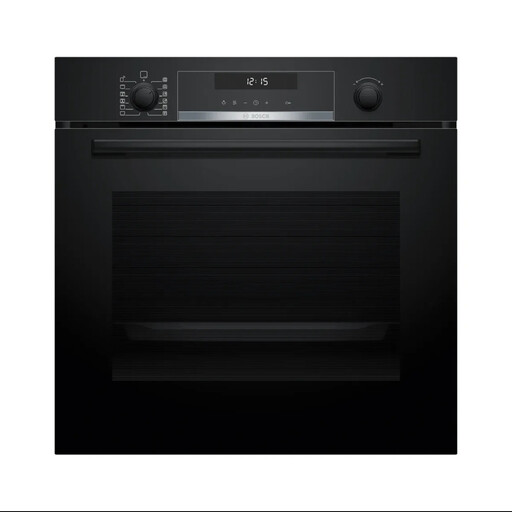
This built-in model has a stated capacity of 66 litres. Bosch Netherlands lists five heating systems for the HBF133BR0, including fan, top and bottom heat, and grill; check the housing dimensions.
 No image available
The product name describes a 71-litre electric built-in oven with Air Fry, a steam function and pyrolytic cleaning. Check the housing dimensions and whether these features suit your needs.
 No image available
The product name describes a 71-litre electric built-in oven with Air Fry, Home Connect and pyrolytic cleaning. Measure the housing before choosing a built-in model.
 No image available
The product name describes a 71-litre, 60 cm built-in oven with Air Fry, EcoClean Direct and an A+ energy rating. Check the specified housing dimensions and whether the features suit your needs.
You can’t tell from the litre capacity alone. Measure the dish, including the handles, and compare it with the usable internal dimensions; the Consumers’ Association points out that this space may be smaller than the oven’s stated capacity.
Check the filling separately: the Netherlands Nutrition Centre advises eating fish thoroughly cooked. The colour of the top alone isn’t a reliable way to check.
The Netherlands Nutrition Centre advises not leaving perishable food out of the fridge for more than two hours. Once cooled, cover leftovers and keep them in a fridge at 4 °C for up to two days, or freeze them.
For ovens covered by the EU energy label, compare the consumption in kWh per cycle using the same heating setting. The European Commission describes exceptions to the scope, including small ovens; a standard cycle also won’t predict the energy used for your particular fish pie.
You don’t need one to have statutory consumer rights: in the Netherlands, you’re legally protected if a product is faulty. The Dutch Government says there is no fixed statutory warranty period, so check whether an additional plan genuinely offers anything extra.