
Cooking for a large group
You want to roast plenty of carrots and possibly cook other dishes at the same time. The Consumers’ Association recommends checking the internal dimensions and measuring whether your chosen oven dish will fit.


Start by checking the baking tray space and where the oven will go. A built-in fan oven can suit larger portions if you have a suitable housing unit, while a freestanding mini oven may be an option if you don’t. Check the internal dimensions and tray size: the Consumers’ Association warns that an oven’s stated capacity doesn’t automatically tell you whether your baking tray will fit. With a smaller oven, you may need to roast the carrots in batches.
You want to roast plenty of carrots and possibly cook other dishes at the same time. The Consumers’ Association recommends checking the internal dimensions and measuring whether your chosen oven dish will fit.
You’re looking for a freestanding fan oven and need to weigh up the baking tray space against the room available on your worktop and the ventilation clearance required by the model.
You want the oven to be easy to clean after cooking and are mindful of energy use for the portions you usually prepare.
First, measure the baking tray you want to use and check whether the oven will fit where you plan to put it. Then look at the oven settings, cleaning options and energy use.
| What to consider | What should you check? | Who is this important for? |
|---|---|---|
| Baking tray space and roasting at the same time | Measure the baking tray and compare it with the internal dimensions; check the usable shelf positions and the trays supplied. | If I want to roast several portions at once for a family gathering, I need to know whether the tray will fit and which shelf positions I can use. Around 40% of consumers prioritise baking tray space and cooking several portions at once. |
| Space in the kitchen | For a built-in oven, compare the housing unit dimensions; for a freestanding model, check the external dimensions and the model-specific ventilation instructions. | I want to know in advance whether an oven will fit in my housing unit or can stand safely on my worktop. Around 30% of consumers give suitable kitchen space and positioning their highest priority. |
| Oven settings and temperature | Check whether the model has a fan setting and adjustable temperature; follow the recipe for the oven setting you choose. | For roasted carrots, I want to be able to match the oven setting and temperature to the recipe. Around 20% of consumers choose an oven mainly for the control it gives them over cooking. |
| Energy use and cleaning | For ovens that suit your portions, compare the stated energy use per cooking cycle; check the cleaning method for the exact model. | If I cook often, I want to know in advance what maintenance the oven needs and how its energy use fits with the portions I usually prepare. Around 10% of consumers give running costs and cleaning their highest priority. |
The usable space may be smaller than the stated capacity suggests, so your chosen baking tray might not fit.
Measure the baking tray or oven dish you want to use and compare it with the internal dimensions and accessories supplied with the exact model.
The capacity of a freestanding oven doesn’t tell you how many carrots will fit on the baking tray. With a smaller tray, you may need to roast in batches.
Check the tray size and choose based on the portion you want to prepare, not just the oven’s compact exterior.
An oven’s label rating and size don’t, on their own, tell you how much energy it uses for a cooking cycle.
For ovens with enough tray space for your usual portions, compare the stated energy use per cooking cycle.
Bosch describes the HBA534BB3 as a built-in oven with a 71-litre capacity, 3D Hot Air and a cleaning coating.
AEG lists the OBU3P40SM as a built-in fan oven with a 72-litre capacity and pyrolytic cleaning.
IKEA describes the FORNEBY 305.568.99 as an oven with fan cooking, added steam and pyrolytic cleaning.
Beko describes the BBIE12100BD as a built-in oven with fan cooking, a 66-litre main capacity and a mechanical timer.
According to Severin, the TO 2058 is a freestanding oven with fan cooking and a 42-litre capacity.
This selection focuses on built-in ovens with a fan setting for larger portions. Check the tray space, built-in dimensions and installation requirements for each model.
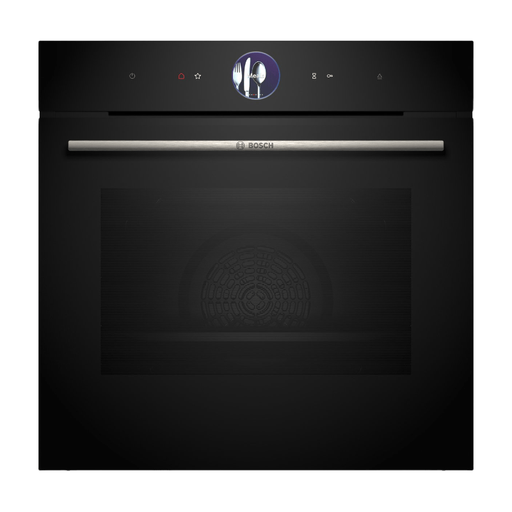 No image available
A built-in option with fan cooking and a steam function; check whether the extra cooking options suit the way you cook.
Capacity: 71 litres. Stated minimum housing unit dimensions: 59,5 × 56,8 × 55 cm. Installation by a qualified electrician.
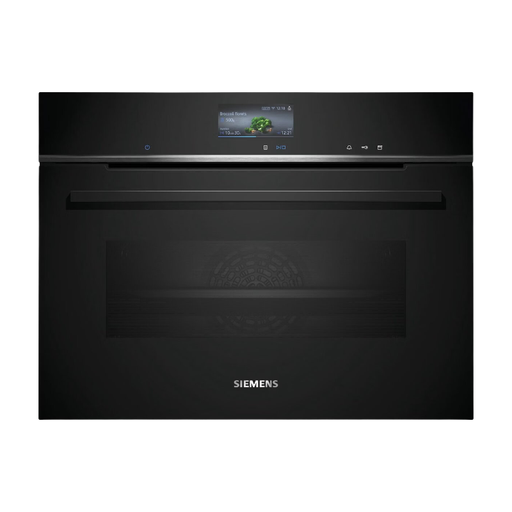 No image available
This built-in oven lists 4D Hot Air; check whether the oven space and baking tray will accommodate the amount you want to roast.
Capacity: 47 litres. Listed features: 4D Hot Air, pyrolytic self-cleaning and Home Connect.
 No image available
The description lists 3D Hot Air and baking on up to three levels, which may be useful if you want to use several trays at once.
Capacity: 71 litres. The description lists cleaning assistance. Installation by a certified professional technician.
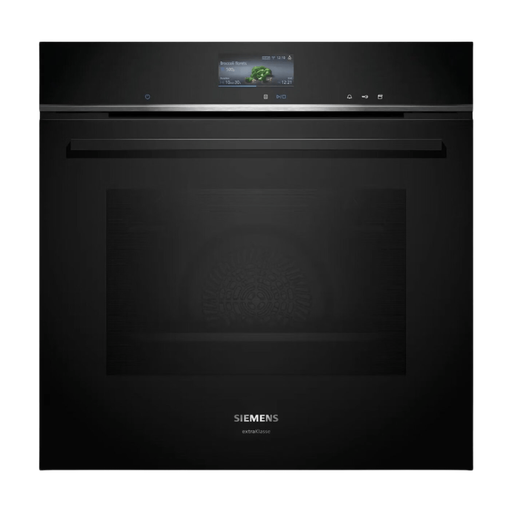 No image available
This built-in oven lists 4D Hot Air; measure your baking tray and compare it with the usable internal space for your portions.
Capacity: 60 litres. Listed features: 4D Hot Air, pyrolytic self-cleaning and Home Connect. Installation by a qualified electrician.
 No image available
A built-in option if you’re looking for an oven with a fan setting; check the settings available on the exact model to suit your recipe.
Capacity: 66 litres. The title lists five cooking programmes, ecoClean self-cleaning and rapid preheating.
Measure the baking tray or oven dish you want to use and compare it with the usable internal dimensions. The Consumers’ Association says the usable oven space may be smaller than the stated capacity suggests, so the number of guests alone won’t give you a reliable minimum capacity.
For a built-in oven, measure the housing unit and follow the installation instructions for the exact model. For a freestanding oven, check the required positioning and ventilation. The Netherlands Fire Service stresses that heat from appliances such as ovens and microwaves needs room to escape.
Use the fan setting if your recipe and model are suitable for it. The Netherlands Nutrition Centre recommends setting the fan oven temperature about 10% lower when adapting a conventional recipe. If the recipe is already written for a fan oven, you don’t need to adjust it again in this way.
First compare models with enough space for your needs, then look at the stated energy use per cooking cycle rather than just the label rating. Milieu Centraal notes that a smaller oven with an A+ rating may use less energy than a larger oven with an A+++ rating.
No, pyrolytic cleaning isn’t necessary for roasting carrots. If easy cleaning matters to you after regular use, compare the cleaning method for the exact model. An extra feature doesn’t remove the need to check the baking tray size and oven space.