
Bakers who use their own baking dish
If you use a shallow dish for clafoutis, you’ll want to know whether it fits on the rack and be able to keep an eye on how it’s cooking. Albert Heijn’s recipe uses a shallow baking dish of around 1 litre.


First, measure your baking dish and check that it fits on the rack. Then choose an oven that will fit on your worktop with the required ventilation clearance. For clafoutis, useful baking settings and a clear view of how it is cooking are worth considering, but product specifications alone cannot tell you how a dish will bake in a particular oven.
If you use a shallow dish for clafoutis, you’ll want to know whether it fits on the rack and be able to keep an eye on how it’s cooking. Albert Heijn’s recipe uses a shallow baking dish of around 1 litre.
You’ll need to weigh up the oven’s external dimensions against the usable space inside and the clearance needed for heat to escape. Brandweer Nederland advises allowing for ventilation around electrical appliances.
A small oven may seem appealing for smaller dishes, but only comparable energy-use figures can tell you what it’s like to run. Milieu Centraal recommends comparing ovens by their electricity consumption per use or per year.
First, check that your dish will fit and that you have a suitable, safe spot for the oven. Then compare the cooking settings and energy use.
| What to consider | What should you check? | Who is this for? |
|---|---|---|
| Control over cooking | Check which cooking settings the model offers and whether you can see how the food is cooking. | When I bake clafoutis, I want to keep an eye on how it’s cooking and choose suitable settings. Around 36% of consumers say control over baking is their top priority. |
| Dish and rack fit | Measure your dish and check the usable interior space and rack position. | When using my own baking dish, I want to know in advance whether it will fit on the rack. Around 29% of consumers put dish fit first. |
| Safe positioning | Check the external dimensions, the space needed when the door is open and the model’s ventilation requirements. | With a small worktop, I want to leave enough space and allow heat to escape. Around 21% of consumers say safe positioning is their top priority. |
| Energy use | Where possible, compare electricity consumption per cooking session on the same basis; don’t judge it by wattage alone. | If I mainly cook smaller dishes, I don’t want to choose an oven based on wattage alone. Around 14% of consumers put energy use first. |
Capacity doesn’t tell you how much usable width, depth and height there is inside. Albert Heijn’s recipe uses a shallow dish on a rack.
Measure your own dish and check the usable internal dimensions and rack position of the exact model.
Joybuy lists the Severin TO 2056 as having a fan oven function, whereas Severin itself says this model does not have one.
Check the full model number and the manufacturer’s information before choosing an oven with a fan function.
External dimensions alone don’t show how much space the model needs to let heat escape.
Follow the manufacturer’s positioning instructions and allow for the space taken up by the open door. Brandweer Nederland advises plugging high-power appliances directly into a suitable socket rather than using a cable reel or extension lead.
Severin describes the TO 2068 as a freestanding oven with a capacity of around 20 litres, a fan function, and top and bottom heat that can be used separately or together.
Tefal describes the Optimo OF444810 as a 19-litre oven with a fan setting and, among other options, a baking setting.
Tristar describes the OV-3625PR as a 28-litre convection oven with six heating settings.
Princess describes the 112371 as a 28-litre convection oven with separately switchable top and bottom heat.
These products are for anyone considering an oven with baking functions and hot-air circulation. Check the interior space with your own dish and follow the positioning instructions for the model you choose. The NVWA states that CE marking is compulsory for electrical consumer products in the Netherlands; a CE mark is not the same as an independent inspection of every individual item.
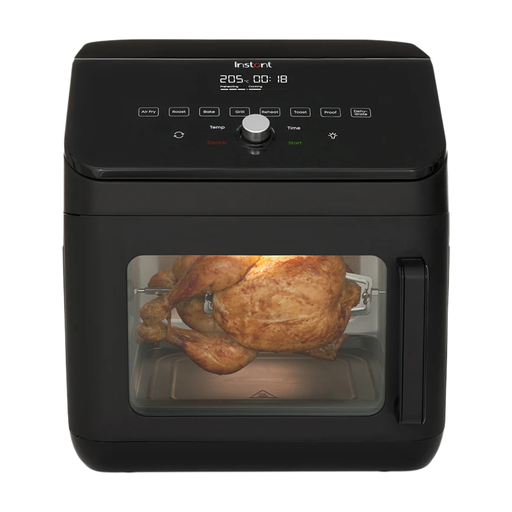 No image available
Worth considering if you’re looking for a baking function and a viewing window; check whether the interior is suitable for your baking dish.
13L; 1700W; Black.
 No image available
An option to consider if you want a choice of heating settings; the product information lists top and bottom heat and convection.
The oven and hotplates get hot during use; use a heat-resistant surface and allow enough ventilation.
 No image available
A larger convection oven to consider if you need more oven space; check that its dimensions suit your worktop.
45L; 2000 W; White.
Keep the ventilation openings clear and use the oven on a stable, heat-resistant surface.
 No image available
An option to compare if you’re looking for a mini oven with a choice of baking settings; check the interior space and rack position using your own dish.
Allow enough ventilation and use the oven on a flat, heat-resistant surface.
 No image available
An option for anyone considering an oven with cooking programmes; check how much space the appliance takes up and whether your baking dish will fit inside.
30L; 21 presets; 1800W; Silver.
Keep the appliance away from flammable materials and clean the interior according to the product warnings.
Albert Heijn’s recipe uses a shallow baking dish of around 1 litre and specifies 180 °C for about 35 minutes. These instructions won’t suit every compact fan oven; follow your recipe and check that the clafoutis is cooked through.
Make sure heat can escape and follow the clearances in the manual for the model you choose. Brandweer Nederland advises plugging high-power appliances directly into a suitable socket rather than using a cable reel or extension lead.
No. Wattage indicates power, not the measured electricity used for one baking session. Milieu Centraal recommends comparing ovens by their electricity consumption per use or per year; only compare figures measured on the same basis.
Yes. The NVWA states that CE marking is compulsory for electrical consumer products. Check the mark on the specific product; on its own, it is not proof that every individual item has been independently inspected.
If a product is faulty, the seller must provide a solution. According to the Rijksoverheid, the Netherlands does not have one fixed statutory guarantee period for all products; what you can expect depends, among other things, on the product and the sales information.