
Weekend cook preparing larger portions
You want to cook chicken legs, perhaps with potatoes or vegetables, on one baking tray. Consumentenbond recommends checking the oven’s interior and the largest oven dish you plan to use.


First, choose a fan oven that will fit your baking tray or roasting tin. Then decide whether you have a suitable built-in space or enough room on your worktop. A larger oven or multiple shelf positions can give you room for chicken and side dishes, but it will take up more space and may use more energy. Milieu Centraal advises choosing an oven that is no bigger than you need. A fan setting does not prove that chicken is cooked through: the Netherlands Nutrition Centre recommends cooking chicken thoroughly and checking that it is done separately.
You want to cook chicken legs, perhaps with potatoes or vegetables, on one baking tray. Consumentenbond recommends checking the oven’s interior and the largest oven dish you plan to use.
You’re looking for a freestanding oven and need to work out how much worktop space you have. Check the model’s external dimensions and installation requirements too.
You want to monitor the oven settings and check the chicken while it cooks, then know which parts need cleaning afterwards. The Netherlands Nutrition Centre recommends using a meat thermometer when roasting.
Best for: a suitable built-in space and regular use of a full baking tray or cooking several dishes.
Bear in mind: the exact dimensions of the space and any installation requirements. Measure your oven dish too.
Best for: a kitchen without a suitable built-in space, but with room on the worktop for a larger oven.
Bear in mind: the external dimensions, available space and connection requirements.
Best for: limited worktop space and a portion that will fit on the supplied tray or in a smaller dish.
Bear in mind: there may be less room for a large weekend portion or side dishes.
| What to consider | What to look for when buying | Who should consider this? |
|---|---|---|
| Space for your portion | Measure your oven dish, including the handles, and compare its size with the oven’s interior, baking tray and permitted shelf positions. | If I want to cook chicken legs and possibly side dishes in one go, having enough room is my first concern. Around 36% of consumers focus mainly on portion size. |
| Where the oven will go | For a built-in oven, check the installation dimensions for the exact model. For a freestanding oven, measure it and follow the placement instructions. | If you first need to know whether an oven will fit in an existing space or on your worktop, placement is a key consideration. It comes first for around 29% of consumers. |
| Controls and checking your food | Check the settings for oven mode, temperature and timer, and make sure you can easily reach the dish to check the chicken. | If I want to keep an eye on the cooking and clean the oven easily afterwards, I look at the controls and how easy it is to access. Around 21% of consumers pay the most attention to this. |
| Energy use | For ovens with an energy label, compare the consumption in kWh per standard cycle for the same oven setting. This is not a measurement of the energy used to cook your dish. | If you want to weigh electricity use against the oven space you need, compare the size and like-for-like energy figures. Energy use is the main consideration for around 14% of consumers. |
The capacity in litres won’t tell you whether your baking tray or roasting tin will fit. That’s why Consumentenbond recommends checking the internal dimensions and measuring your largest oven dish.
Measure your dish and compare it with the interior dimensions and layout of the exact model before you choose.
A built-in oven needs to fit the available space; a freestanding model needs a suitable place to stand. Dimensions and placement requirements vary by model.
First decide where the oven will go, then check the installation details or placement instructions in the manual.
A set cooking time or browned exterior is no substitute for checking that the chicken is cooked through. The Netherlands Nutrition Centre recommends cooking chicken thoroughly.
Follow the recipe and the manual, and check the chicken separately before serving. When roasting, use a meat thermometer and make sure it is not touching a bone.
According to ACM ConsuWijzer, statutory guarantees in the Netherlands do not have a fixed two-year limit. What you can reasonably expect from a product depends, among other things, on the product and the circumstances.
If there’s a fault, contact the seller and consider any additional cover separately from your statutory rights.
A built-in option for anyone with a suitable space who wants to compare shelf positions.
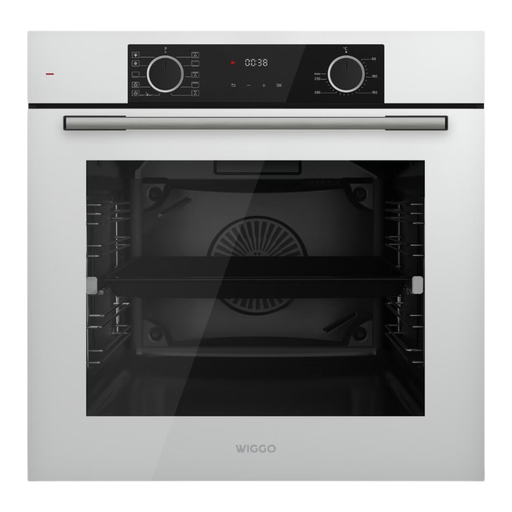
A built-in option with turbo fan-assisted cooking and a grill, as illustrated by the OM165ZT.
A freestanding option for anyone without a built-in space but with room on the worktop.
A more compact freestanding mini oven for baking and toasting, if space is a key consideration.
This selection includes built-in and freestanding fan ovens, from spacious models to a more compact freestanding option for cooking chicken legs.
 No image available
This built-in model is a good fit if you have a suitable space and want to cook chicken legs using fan-assisted heat.
The description lists fan-assisted cooking, top and bottom heat, and a grill function. It also mentions rotary controls, a digital display, and a removable baking tray and wire rack. Check the dimensions of your kitchen’s built-in space.
 No image available
This built-in model is suitable if you have a compatible space and want to use multiple shelf positions.
The product description lists a capacity of 71 litres, 3D hot air and baking on up to three shelf levels. It also mentions a display, time setting and Cleaning Assistance. Check that your dish will fit and follow the cleaning instructions for this model.
 No image available
This built-in oven is an option if you have a suitable space and need room for chicken legs and possibly side dishes.
The product description lists a capacity of 71 litres, 3D hot air and baking on up to three shelf levels. EcoClean Direct and Cleaning Assistance are mentioned for cleaning. Check the dimensions of the built-in space and the cleaning instructions for this specific model.
 No image available
This built-in model is a good fit if you have a suitable space and want to make use of multiple shelf positions.
The product description lists a 71-litre capacity, 3D hot air on up to three levels and pyrolytic cleaning. Check the installation dimensions and follow the cleaning instructions for the exact model.
 No image available
This freestanding model is a good fit if you don’t have a built-in space and want a compact oven for a portion that will fit.
The product name lists 2000 W and 45 litres. The description mentions convection, top and bottom heat, a grill, a timer and removable parts. Check the space available and the placement instructions.
Start by measuring your baking tray or roasting tin, then check that the chicken and side dishes will fit in the arrangement you have in mind. The Netherlands Nutrition Centre has a recipe for cooking chicken and potatoes together on a baking tray; the cooking time in that recipe won’t necessarily apply to different quantities, cuts of chicken or ovens.
Cook chicken thoroughly and don’t rely on the timer or colour alone. When roasting, the Netherlands Nutrition Centre recommends measuring the temperature in the centre of the meat with a meat thermometer, making sure it doesn’t touch a bone.
For a built-in oven, compare all the dimensions of the space with the installation details for the exact model, and check that your dish will fit inside the oven. For a freestanding oven, check the external dimensions, connection requirements and placement instructions in the manual.
The label shows energy use per standard cycle for a specific oven setting, not the measured energy used to cook your chicken legs. For household ovens covered by the relevant EU rules, the European Commission includes energy consumption per cycle for conventional and fan-assisted cooking.
Cool leftovers quickly, store them in a sealed container and don’t leave them out of the fridge for more than two hours. The Netherlands Nutrition Centre recommends keeping cooked chicken legs with the skin on in the fridge for up to two days.