What should you look for when choosing?
Freestanding fan oven
A good fit if: you don’t have a suitable built-in space and have somewhere to put it that meets the model’s instructions.
Keep in mind: the space available on your worktop and the oven’s internal dimensions. A stated capacity in litres doesn’t guarantee that your cake tin will fit.
Built-in fan oven
A good fit if: you have a suitable built-in space, or are designing your kitchen around one, and the usable oven space suits your baking plans.
Keep in mind: the built-in space, usable oven area and electrical connection. Manufacturer information about baking on multiple shelf levels doesn’t guarantee the same results at every level.
Measure your cake tin first, then choose between a freestanding model and an oven for a suitable built-in space. The percentages below show which considerations matter most to different consumers.
| What to consider |
What to look for when buying |
Who may prioritise this more |
| Tin and oven setting |
Measure your tin, including its rim, and check the usable internal dimensions and shelf height. Make sure the oven has the setting specified in your recipe. |
I want to use my usual cake tin and choose the setting in my recipe. Around 36% of consumers give the tin and oven setting top priority. |
| Baking space |
Decide on the size of tin and how many batches you plan to bake. Then compare the usable space, baking tray and shelf heights; don’t rely on the capacity in litres alone. |
If I’m planning to use a larger tin or bake several batches, I want to know how much usable space there is. Around 29% of consumers give baking space top priority. |
| Placement and connection |
Compare the external dimensions with the space available. For a built-in oven, measure the space and check the model’s placement and connection instructions. |
I want to be able to position and connect the oven in my kitchen according to the instructions. Around 21% of consumers give placement top priority. |
| Use and maintenance |
Where available, compare energy information with the oven’s size, and check its cleaning method and accessories. |
If I’ll use the oven regularly after this coffee morning, I’ll look at energy use and cleaning. Around 14% of consumers give future use and maintenance top priority. |
Ovens at Joybuy
This selection includes freestanding and built-in ovens for anyone looking for a fan oven to bake a chocolate cake. For each model, check that your tin will fit and that the oven is suitable for the space available.
 No image available
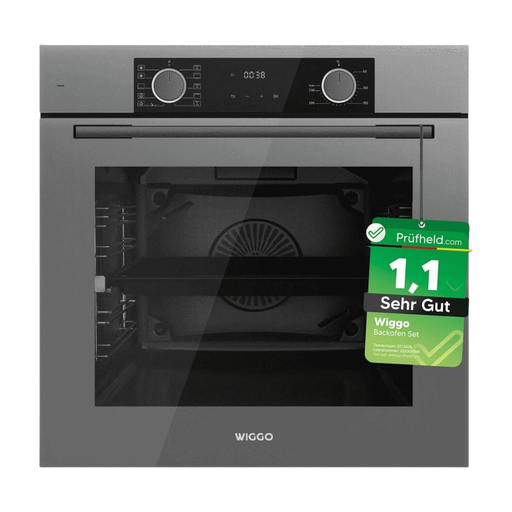
Wiggo AKA1WO-BFA610 built-in oven, grey
A good fit if you’re looking for a built-in oven and want to choose between fan-assisted cooking and top and bottom heat.
The product information lists both functions. Check that the built-in space and electrical connection are suitable for this model.
Joybuy
 No image available
Bosch HBF133BR0 built-in oven, 66 l
A good fit if you’re looking for a built-in oven with fan-assisted cooking and top and bottom heat. First check the built-in space and whether your cake tin will fit inside.
The product information lists 3D Hotair, baking on three levels, a temperature range of 50 °C to 275 °C and ecoClean Direct cleaning.
Joybuy
 No image available
Bosch HBA534BB3 Serie 4 built-in oven, 71 l
A good fit if you’re looking for a built-in oven with fan-assisted cooking and the stated capacity suits your baking plans.
Bosch lists a 71 l capacity, 3D Hotair and top and bottom heat. The capacity doesn’t prove that a specific cake tin will fit; measure the usable space and check the built-in space.
Joybuy
 No image available
Rommelsbacher BGS 1400 mini oven
A good fit if you’re looking for a freestanding model and use a cake tin that’s within the stated maximum size of 25 cm.
The product information lists a 22 l capacity and settings for top and bottom heat and fan-assisted cooking. Place the oven on a flat, heat-resistant surface with plenty of ventilation.
Joybuy
 No image available
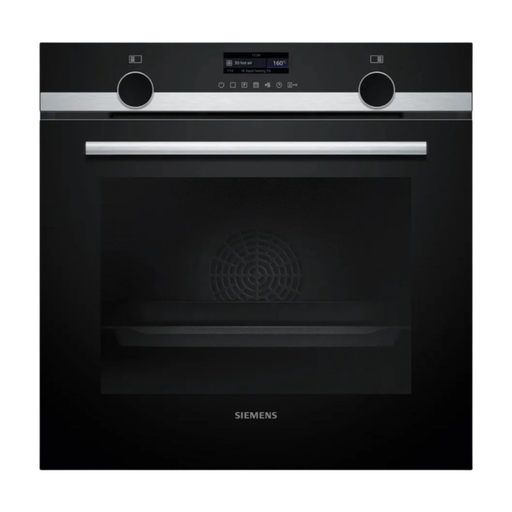
Siemens iQ500 HB579GBR3 built-in oven, 71 l
A good fit if you’re looking for a built-in oven with fan-assisted cooking and top and bottom heat. Check the built-in space and required connection.
The product information lists a 71 l capacity and hydrolytic and pyrolytic cleaning. Measure the usable internal space to find out whether your cake tin will fit.
Joybuy
Frequently asked questions
Do you always need to use fan-assisted cooking for chocolate cake?
No. First follow the oven setting specified in the recipe. The Consumentenbond recommends top and bottom heat for cakes, among other things, and explains that fan-assisted cooking often requires a lower temperature. So don’t use a recipe’s temperature for a different setting without adjusting it.
How can you tell whether your cake tin will fit?
Measure the tin, including its rim, and compare it with the usable internal dimensions and shelf height of the exact model. The Consumentenbond points out that the usable space may be smaller than the capacity figure suggests.
What should you consider when positioning or connecting the oven?
Follow the manual for the model you choose. For a built-in oven, measure the space and check what electrical connection is required. For a freestanding model, make sure the place where you position it meets the instructions for that model.
What rules apply if we sell the cake at the coffee morning?
When selling food at an event, private individuals must also prepare, sell and store it safely and hygienically, according to the NVWA. Whether you need a food safety plan depends in part on whether you prepare and sell food repeatedly; the NVWA defines this as several times a year. The NVWA also explains that businesses selling food must provide information about any allergens it contains. These selling rules don’t necessarily apply to a cake that’s shared free of charge.
How should you store a chocolate cake with whipped cream ganache?
Follow the recipe’s storage advice and take the filling or topping into account. Rutger Bakt recommends keeping the cake from the recipe mentioned above, which has ganache, in the fridge. This isn’t a storage recommendation for all chocolate cakes.


