
Home baker making a cake for guests
What matters most is that your cake tin fits and that the oven has the setting specified in your recipe. Heel Holland Bakt shows that recipes can call for different oven settings.


Start with your cake tin and the setting specified in your recipe: choose an oven that fits the tin and offers the right setting. A freestanding model is a good choice if your kitchen doesn’t have a suitable built-in space, but you’ll need room on the worktop and adequate ventilation. A built-in oven requires a suitable housing unit and connection. A fan setting is useful when your recipe calls for it, but follow the recipe for pear cake: a recipe from Heel Holland Bakt uses conventional top and bottom heat. You don’t necessarily need a large oven for a single cake.
What matters most is that your cake tin fits and that the oven has the setting specified in your recipe. Heel Holland Bakt shows that recipes can call for different oven settings.
You’re looking for a freestanding fan oven. As well as checking that your cake tin fits, you’ll need to consider the available worktop space and the ventilation requirements for the model.
You want an oven whose size and features suit the things you cook most often. If you usually bake just one cake, weigh up the extra space against your other needs.
The Consumentenbond recommends checking the usable internal dimensions rather than looking only at the capacity in litres. You should also follow the setting specified in your recipe: the winter pear cake recipe from Heel Holland Bakt that we consulted calls for conventional top and bottom heat.
| What to consider | What to look for | Who should pay particular attention? |
|---|---|---|
| Oven setting and texture | Check that the oven offers the setting your recipe calls for, such as fan or conventional top and bottom heat. | If you want to bake your cake to a specific recipe, you’ll need to be able to select the recommended setting. Around 36% of consumers prioritise the oven setting and cake texture. |
| Space for your cake tin | Measure your own tin and compare it with the usable internal dimensions; capacity in litres alone won’t tell you whether it will fit. | If you want to keep using a Bundt tin or loaf tin, the actual internal space is what matters. Around 29% of consumers give priority to a suitable fit. |
| Positioning and connection | For a built-in oven, check the housing space and connection; for a freestanding model, follow the ventilation requirements for that exact model. | If your kitchen has limited worktop space or you want to use a built-in space, the oven needs to fit the available location and connection. Around 21% of consumers look at this first. |
| Energy use | Where available, compare the energy use per cycle for the relevant setting, and choose an oven size that suits how you’ll use it. | If you bake regularly, you’ll want to factor in ongoing energy use without choosing more oven space than you need. Around 14% of consumers make energy use their main consideration. |
An oven’s capacity doesn’t necessarily tell you whether your cake tin will fit. The Consumentenbond recommends checking the internal dimensions.
Measure your tin and compare its dimensions with the usable space at the shelf level you want to use. Weigh the extra capacity against how often you cook more than one dish at a time.
The airflow can dry out some bakes more quickly, and recipes may call for conventional top and bottom heat instead. Heel Holland Bakt gives both settings, depending on the recipe.
Check the setting and temperature in your recipe. If you regularly use recipes with different settings, choose an oven that offers both heating methods.
The clearance and ventilation requirements can vary between models.
Before buying, read the manual for that exact model and leave the specified space around the appliance.
A freestanding oven takes up worktop space, so check in advance that you’ll have room for it while it’s in use.
A Joybuy listing for the Severin TO 2073 gives a capacity of 18 litres in the title and 60 litres in the description. The two details contradict each other.
Before ordering, compare the full model number and key specifications with the manufacturer’s information.
Bosch lists features including 3D Hotair and conventional top and bottom heat for the HBA534BS3 built-in oven.
Severin lists a capacity of 42 litres, a fan setting and separately or jointly usable top and bottom heat for the freestanding TO 2058 mini oven.
Tristar lists a capacity of 60 litres, top and bottom heat and an adjustable temperature of 90–230 °C for the freestanding OV-3640KW fan oven.
Tomado lists a capacity of 75 litres for the freestanding TEO7501B fan oven.
This selection includes freestanding and built-in fan ovens. Choose one to suit your cake tin, the settings you need and the space available in your kitchen.
 Image unavailable
The stated oven capacity and four-level rack may be useful if you’re looking for baking space; check that your cake tin will fit.
The product name lists a thermometer, LED display, grey finish and a four-level rack.
 Image unavailable
This built-in oven is designed for a kitchen with a suitable housing space. Check the dimensions and make sure your tin will fit in the usable oven space.
The product name lists a capacity of 71 litres, 3D HotAir, EcoClean Direct, an A+ energy rating and a black finish.
 Image unavailable
A freestanding option if you don’t have a built-in space. Place the appliance on a stable, heat-resistant surface and keep the ventilation openings clear.
The product information lists a capacity of 45 litres, 2000 W and separate top heat, bottom heat and convection functions.
 Image unavailable
The product information says it accommodates baking tins up to 25 cm in diameter. Compare this limit with your own tin before choosing.
The description lists a capacity of 22 litres and five heating settings, including conventional top and bottom heat and a fan setting. Place the oven on a flat, heat-resistant surface with adequate ventilation.
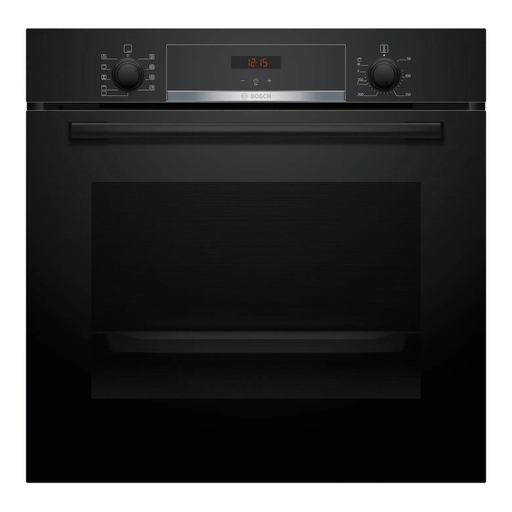 Image unavailable
This built-in oven is suited to a kitchen with a suitable housing space. Check the installation dimensions and make sure there’s enough room for your cake tin.
The product information lists a capacity of 71 litres, convection cooking, seven cooking programmes and a grill function.
No, start by following the setting in your recipe. The winter pear cake recipe from Heel Holland Bakt that we consulted uses conventional top and bottom heat. If you switch to a fan setting, you may need to adjust the oven settings, and the airflow can affect the texture.
Measure your tin and compare it with the usable internal dimensions, rather than looking only at the capacity in litres. The ø 25 cm Bundt tin in the recipe we consulted is an example for that recipe, not a standard size for all cake tins.
Check the manual for the exact model to find out how much ventilation space it needs, and keep the ventilation openings clear. For example, the manual for the Tomado TEO2101B specifies 10 cm of clearance on all sides, but this measurement doesn’t automatically apply to other models.
Choose a freestanding model if you don’t have a suitable built-in space and have enough worktop space, including the required ventilation clearance. A built-in oven is a better fit for a kitchen with a suitable housing space, provided the dimensions, connection and usable internal space are right.