
Cooking for a shared meal
You want to bake a single fish pie in your existing baking dish and mainly need to know that it will fit inside and that the oven has a suitable cooking setting.


Choose an oven that fits your baking dish and has the cooking setting your recipe calls for; the capacity in litres alone doesn’t tell you whether your dish will fit. If you have a suitable housing unit, you could consider a built-in oven. Without one, a freestanding model is an option, while a combination model is best suited to you if you also want a microwave function. Before installation, check the dimensions, ventilation requirements and connection details for the exact model.
You want to bake a single fish pie in your existing baking dish and mainly need to know that it will fit inside and that the oven has a suitable cooking setting.
You’re looking for a freestanding fan oven and need to check not only whether your dish will fit, but also the available space and ventilation on your worktop.
You also want a microwave function, without assuming that every combination model has the same oven settings or usable space.
A good fit if: you have a suitable kitchen housing unit and don’t want the oven on your worktop.
Things to consider: check the housing dimensions, connection and ventilation space before choosing a model.
A good fit if: you don’t have a suitable built-in housing unit, but do have somewhere safe to put the appliance where heat can escape.
Things to consider: allow for the space it will take up on your worktop, and measure your baking dish to check that it will fit inside.
A good fit if: you want to use a microwave function as well as bake.
Things to consider: according to the Consumentenbond, a combination oven focuses more on oven functions, while a microwave oven focuses more on microwave functions. Check the settings and installation requirements for each model.
| What to consider | What should you check? | Who is this important to? |
|---|---|---|
| Suitable cooking setting | Check whether the exact model has a fan setting and whether you also want to use conventional top and bottom heat or the grill. Follow your recipe’s instructions. | If you want the fish filling to cook through and the top to brown, look for a cooking setting that suits your recipe. Around 31% of consumers say the cooking setting is their main concern. |
| Room for your baking dish | Measure the width, depth and height of your dish and compare them with the usable internal dimensions and the position of the shelf. The Consumentenbond points out that the usable space may be smaller than the stated capacity. | If you want to make fish pie in your own large dish, check that it fits rather than looking only at the capacity in litres. Around 31% of consumers are mainly looking for enough room for their dish. |
| Positioning and connection | Compare the housing dimensions or available worktop space with the model’s dimensions and installation instructions. Also check the ventilation requirements and connection. | If your kitchen only has a specific spot available, you’ll want to know in advance whether a built-in or freestanding oven can go there. Around 23% of consumers prioritise where the oven will go. |
| Size and energy consumption | Choose a size that suits your dish and how you plan to use the oven. Where available, compare consumption per cycle in kWh, and don’t use an energy label as a direct comparison between appliances with different functions or capacities. | If you usually bake just one dish, an oven that’s much larger than you need may not be the best choice. Around 15% of consumers mainly consider size and energy consumption. |
The stated capacity doesn’t tell you whether your baking dish’s shape and dimensions will fit. And you don’t automatically need a larger oven for a single dish.
Measure your dish and compare its dimensions with the usable internal space and the position of the shelf.
A microwave oven may have different oven settings or shelf positions from a conventional oven. The Consumentenbond distinguishes between combination ovens and microwave ovens based on which functions they focus on.
For the exact model, check the fan setting, internal space and how a shelf or turntable is positioned.
An oven needs to fit in the chosen spot and have enough room to release heat. The Brandweer points out that heat from appliances such as ovens needs to be able to escape.
Compare the available space with the installation instructions for the exact model, and follow the guidance on ventilation and connection.
Buying an additional warranty doesn’t replace your statutory rights to a product that meets legal standards. According to the Rijksoverheid, there is no fixed statutory warranty period in the Netherlands.
Check what additional cover the package offers and what it excludes, and compare this with your existing rights.
The Inventum OV607B is a freestanding fan oven for anyone who isn’t looking for a built-in model and wants to use their own dish.
The Bosch HBA534BB3 is a built-in oven for a suitable housing unit, with a range of heating settings.
The ETNA OM316MZ is a built-in option for anyone who wants to compare other oven functions as well as fan cooking.
The Siemens HB534AER3 is a built-in oven for anyone with a suitable housing unit who is considering features such as telescopic rails.
These models include built-in, freestanding and combination ovens with an oven function for cooking a baked dish.
 No image available
An option for a kitchen with a suitable housing unit; the product information lists fan cooking and a grill.
Specifications: capacity 70 L; width 60 cm; power 3 kW; grill; AquaClean steam cleaning; energy label A.
 No image available
A freestanding model to consider if you don’t have a built-in housing unit, but do have enough worktop space and ventilation.
Specifications: capacity 65 L; six cooking functions; turbo fan; power 2000 W.
 No image available
A built-in option for a kitchen with a suitable housing unit; check the dimensions of your dish and the required installation dimensions.
Specifications: capacity 66 L; five cooking programmes; 3D fan cooking; top and bottom heat; grill; temperature range 50–275 °C.
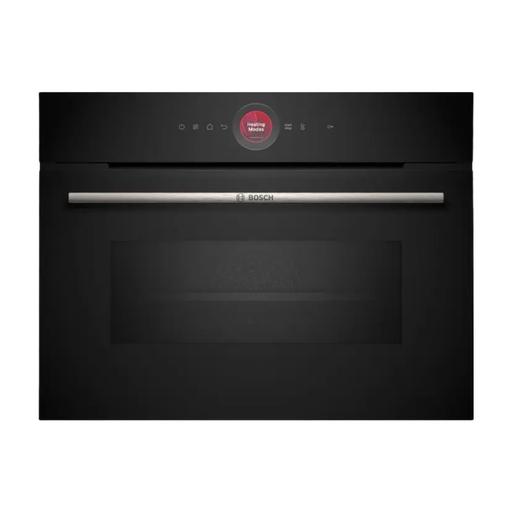 No image available
A combination option for anyone who wants a microwave function as well as an oven function and has a suitable built-in housing unit.
Specifications: capacity 45 L; convection cooking; grill; microwave power 900 W.
 No image available
A built-in model to compare if you have a suitable housing unit; also check whether your baking dish will fit in the usable space.
Specifications: capacity 71 L; 3D HotAir; baking on up to three levels according to the product information; EcoClean Direct; energy label A+.
Measure your dish and compare its dimensions with the oven’s usable internal space, including the shelf position and any protruding parts. The Consumentenbond points out that the usable space may be smaller than the stated capacity in litres.
Follow the cooking setting and method in your specific recipe, and check that the fish filling is cooked through. A fish bake recipe from the Voedingscentrum uses a preheated oven at 180 °C and cooks the dish until it is done and golden brown; this setting won’t necessarily suit every fish pie or oven.
Follow the installation instructions for the exact model and make sure the oven fits in the intended spot and can release heat. The Brandweer recommends connecting high-power appliances directly to a socket rather than using a multi-socket adaptor or cable reel.
According to the European Commission, household electric and gas ovens are generally covered by the energy labelling rules for ovens. Small and portable ovens are outside the scope of those rules, according to the Commission; appliances that use microwave heating are also treated differently. So, if a small freestanding model or microwave oven doesn’t have an oven energy label, don’t automatically draw conclusions about its energy consumption.
Not necessarily. According to the Rijksoverheid, you’re entitled to a product that meets legal standards in the Netherlands, where there is no fixed statutory warranty period. An additional package is most relevant if its terms provide cover that suits your needs; if something goes wrong, the retailer is your first point of contact.