
Baker with limited worktop space
Want to know whether the oven dish will fit without taking up the shared worktop for longer than necessary. Measure both the space for the appliance and the usable space inside the oven.


Start by checking the dimensions of your oven dish and the usable interior space; the oven’s capacity in litres alone won’t tell you whether your dish will fit. Then choose a compact or larger freestanding model based on the space available, the cooking settings you want and how easy it is to clean. Before use, check the instructions for positioning and connecting the oven.
Want to know whether the oven dish will fit without taking up the shared worktop for longer than necessary. Measure both the space for the appliance and the usable space inside the oven.
Want to bake a larger dish in one go and weigh up the interior space against the room a larger appliance takes up.
Want to position and connect the oven safely, keep an eye on the cooking and leave the appliance clean and tidy afterwards.
Best for: a small dish and a space where a larger appliance would be awkward. Tristar lists a 20 l capacity and convection for the OV-3652.
Keep in mind: the capacity doesn’t confirm that your dish will fit; also follow the clearance requirements in the manual.
Best for: anyone looking for more oven space who can compare dish and worktop dimensions for each model. Inventum lists a 30 l capacity for the OV307B, while Tristar lists 38 l for the OV-3660.
Keep in mind: capacity in litres and external dimensions don’t tell you how much room there’ll be around a dish once it’s in the oven.
Best for: a larger dish or several people, provided there’s enough suitable space for the oven. Inventum lists a 60 l capacity, fan-assisted cooking and top and bottom heat for the OV607B.
Keep in mind: a larger appliance needs more space; check the manual and connection requirements. The stated power rating doesn’t tell you how much energy one cooking session uses.
| What to consider | What should you check? | Who should pay particular attention? |
|---|---|---|
| Will the dish fit? | Compare your dish with the interior dimensions, shelf height and rack of the exact model. | If I want to be sure my oven dish will fit before I buy, I put its dimensions first; around 36% of consumers say that fitting their dish is their main concern when buying. |
| Safe positioning | Check the model’s manual, the space available and the socket. The Netherlands Fire Service recommends plugging high-powered appliances directly into a wall socket wherever possible. | If the oven will share a worktop and power connection with others, I want to know that the set-up follows the manual; around 29% of consumers say safe positioning is their top priority. |
| Cooking settings and controls | Check whether the model offers the combination of fan-assisted cooking and top and bottom heat you want, and whether the timer or interior light would be useful to you. | If I want to keep a close eye on my bread pudding and adjust the settings as needed, I focus on the controls and cooking settings; around 21% of consumers put control over cooking at the top of their list. |
| Cleaning and aftercare | Check which parts can be removed and which cleaning methods the manufacturer allows. Keep your proof of purchase and warranty information too. | If I want to leave the shared kitchen tidy after baking, I pay extra attention to maintenance and support if something goes wrong; around 14% of consumers say cleaning and aftercare are their main concerns when buying. |
The capacity in litres won’t tell you whether your oven dish will fit through the door and sit on the rack.
Measure your dish and compare it with the interior dimensions and shelf height of your chosen model before buying.
If the dish doesn’t fit, you may need a different oven dish.
An oven that fits on the worktop doesn’t automatically meet the manufacturer’s positioning and connection instructions.
Before use, check the manual, the space where you’ll position it and the connection. For high-powered appliances, follow the safety advice from the Netherlands Fire Service.
The European Commission excludes small and portable ovens from the scope of the energy labelling rules for ovens.
First check which product category the exact appliance falls into. Don’t use the wattage or absence of a label to estimate how much energy one baking session uses.
According to Inventum, the freestanding OV307B and OV607B models reviewed have capacities of 30 and 60 l respectively.
According to Tristar, the freestanding OV-3652 and OV-3660 models reviewed have capacities of 20 and 38 l respectively.
Princess lists a 45 l capacity and convection for the freestanding 112754.
This selection consists of built-in ovens with hot-air cooking functions. Consider them only if the shared kitchen has a suitable permanent space for a built-in oven and the necessary installation; these are not freestanding worktop ovens.
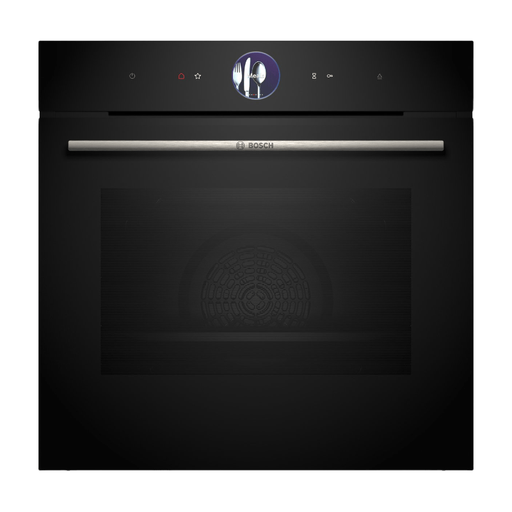 No image available
Worth considering if you have a suitable built-in space and want to use hot air with top and bottom heat.
21 heating functions, touchscreen, hydrolytic cleaning assistance and dimensions of 60 × 60 cm.
 No image available
Suitable for anyone with a permanent built-in space who’s looking for an oven with 3D Hot Air.
Capacity: 71 l. The description mentions cooking on up to three levels and Cleaning Assistance for light soiling.
 No image available
Worth considering if you have a permanent built-in space and want to combine hot-air cooking with a range of settings.
The product information lists 3D Hot Air, pyrolytic self-cleaning, 20 heating settings, a touchscreen and a digital control ring.
 No image available
Suitable for anyone with a permanent built-in space who wants to weigh up hot-air cooking alongside steam functions.
The product information lists 3D Hot Air, Hotair Steam, top and bottom heat, and pyrolytic self-cleaning.
 No image available
Worth considering if you have a permanent built-in space and want to use hot air with top and bottom heat.
The product information lists 3D Hot Air, Eco Clean Direct and a quick cleaning function.
You can’t tell from the capacity in litres alone. Compare the dimensions of your oven dish with the usable interior dimensions and shelf height of the exact model.
Follow the positioning and connection instructions in the model’s manual. The Netherlands Fire Service recommends plugging high-powered appliances directly into a wall socket wherever possible, rather than using a multi-socket adaptor or cable reel; this advice doesn’t confirm that a particular socket is suitable.
Heat the dish thoroughly and check that it’s cooked through. The Netherlands Nutrition Centre advises not leaving leftovers out of the fridge for more than two hours; according to the Centre, refrigerated leftovers keep for two days. Cool them quickly and store them in a sealed container.
Not always. The European Commission excludes small and portable ovens from the scope of the energy labelling rules for ovens. First check which category the exact appliance falls into, and don’t assume that the absence of a label automatically tells you how energy-efficient it is.
Electrical appliances placed on the market under the applicable EU rules must meet the relevant safety requirements. The Dutch government’s Business Portal also outlines the related documentation and CE marking requirements. If a consumer product is faulty, the seller is responsible under the statutory guarantee: ACM ConsuWijzer lists repair, replacement or a refund as possible solutions. Check the documentation and product details for the exact item you’re buying.