
Cooking several dishes at once
If you make shepherd’s pie for several meals, you’ll benefit most from shelf levels and internal dimensions that suit your dishes. Check which shelves are included too.


If you regularly cook several dishes at once, start by checking the internal dimensions, the clearance at each shelf level and the fan oven settings. The capacity in litres alone won’t tell you whether your dishes will fit. A freestanding oven may suit one dish at a time or a kitchen without a suitable built-in space, while a combination microwave is worth considering if you also want to reheat individual portions. Compare energy use per cycle and cleaning requirements too, and treat safe storage and reheating as a separate step.
If you make shepherd’s pie for several meals, you’ll benefit most from shelf levels and internal dimensions that suit your dishes. Check which shelves are included too.
If you usually cook one dish at a time or don’t have a suitable built-in space, a freestanding oven could be a good option. Measure both your dish and the space available on your worktop.
If you bake whole dishes and reheat individual portions later, compare ovens with microwave functions. The functions and internal space vary by model.
Suitable for: a kitchen with a suitable built-in space and regularly cooking several oven dishes in one session.
Consider: check the dimensions of the space and whether your dishes will fit on the shelf levels you want to use; a larger capacity doesn’t guarantee they will.
Suitable for: a kitchen without a suitable built-in space, or if you usually cook one dish at a time.
Consider: as well as the internal space, measure how much room the appliance will take up on your worktop.
Suitable for: anyone who regularly wants to reheat individual portions as well as cook oven dishes.
Consider: compare the oven settings, shelf positions and space for your dishes; functions vary by appliance.
| What to consider | What to check before buying | Who is this important for? |
|---|---|---|
| Several dishes | Compare the internal width, depth and clearance with your dishes. Check whether the model can cook on multiple shelf levels. | If you want to cook several dishes in one session, you’ll want to know whether they really fit on the available shelf levels. Around 33% of consumers prioritise cooking several dishes at once. |
| Positioning and fit | For a built-in oven, check the dimensions of the space; for both types, compare the internal dimensions with your largest dish. | If the oven needs to fit in your kitchen as well as accommodate your dish, both the external dimensions and internal space matter. Around 27% of consumers prioritise where the oven will go and whether their dish will fit. |
| Baking and reheating | Check the oven settings and shelf positions for whole dishes, as well as the microwave function and space for individual portions. | If you want to bake a whole dish and reheat individual portions later, both functions matter. Around 20% of consumers prioritise this combination. |
| Energy use and cleaning | Compare energy use in kWh per cycle on the fan setting, and check the cleaning method and removable parts. | If you use your oven often, you’ll want to weigh up energy use and cleaning against the space you need. Around 20% of consumers prioritise energy use and maintenance. |
Components and the distance between shelf levels affect how much usable space there is. Having several levels doesn’t automatically mean taller dishes will fit.
Measure your dishes and check the internal dimensions, clearance and available shelves before choosing a model.
If your dishes don’t fit at the same time, you may need to plan an extra cooking session.
Some combination microwaves have fewer oven settings or shelf positions, which can matter when you’re cooking large dishes.
Compare the specific oven functions and layout. Choose a microwave function based on whether you need to reheat individual portions, not just on the product name.
Oven capacity and energy rating alone don’t tell you how much electricity a suitably sized oven uses per cycle. Energy use also depends on the oven’s size and how you use it.
Compare the stated energy use in kWh per cycle on the fan setting, and think about how often you’ll use all the available space.
A larger oven may use more electricity than you need if you rarely use the extra space.
According to Bosch Netherlands, the HBA514BB3 is a 71-litre built-in oven with 3D Hot Air.
ETNA lists the OM316MZ as having a 77-litre capacity, five shelf positions and turbo fan cooking.
According to Inventum, the freestanding OV607B is a 60-litre fan oven with top and bottom heat.
According to Siemens Netherlands, the HB457G0B3F is a 71-litre built-in oven with 3D Hot Air, a grill and humidClean Plus.
Beko lists the BBIE17300BMPC as a 72-litre built-in fan oven.
This selection focuses on built-in ovens for anyone who prepares shepherd’s pie in advance and wants to fit several dishes in the oven. Check the internal dimensions and shelf levels of each model against your own dishes.
 No image available
An option to compare if you’re looking for a built-in oven for batch cooking; measure the built-in space and check there’s room for your dishes.
The product name lists a 70 L capacity, 3 kW, fan cooking, a grill, a pizza function and AquaClean steam cleaning. It also lists an LED display with timer and ECO mode.
 No image available
A built-in model to compare if you’re looking for an oven for cooking several dishes; check whether your dishes will fit on the shelf levels you want to use.
The product name lists a 71 L capacity and 3D Hot Air.
 No image available
This model is worth comparing for a built-in kitchen; check the dimensions of the space and measure your dish against the internal space.
The product name lists a 66 L capacity, five cooking programmes, ecoClean cleaning and rapid preheating.
 No image available
A built-in oven to include in your comparison if you want to cook several dishes; check the shelf levels and internal dimensions against your dishes.
The product name lists a 71 L capacity, 3D Hot Air, EcoClean Direct and an A+ energy rating.
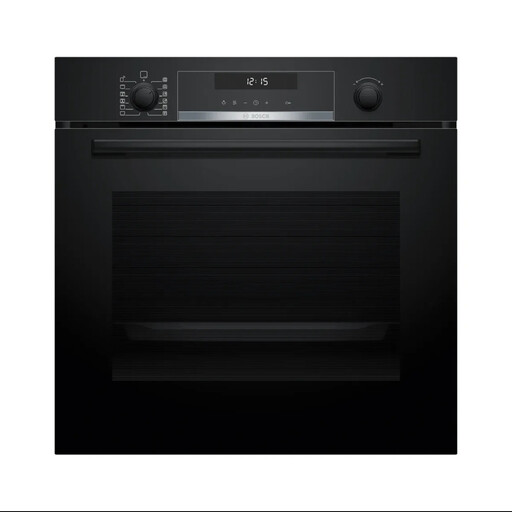 No image available
A built-in model to compare for batch cooking; check whether the oven space and layout suit your dishes.
The product name lists a 71 L capacity, Air Fry, Home Connect and pyrolytic cleaning.
No. Measure your largest oven dish and compare it with the internal dimensions and clearance between the shelf levels. The Consumers’ Association (Consumentenbond) recommends checking the internal dimensions, as usable space determines whether a dish will fit.
The Netherlands Nutrition Centre (Voedingscentrum) advises cooling leftovers within two hours and storing them covered at 4 °C. Eat them within two days if kept in the fridge, or freeze them for up to three months. Reheat a portion until piping hot throughout, and avoid reheating leftovers more than once.
For ovens with an energy label, compare the stated energy use in kWh per cycle on the fan setting, as well as the capacity. The European Commission lists the energy use per cycle for this setting; actual use also depends on how you cook.
When you buy from a business online, you generally have a 14-day cooling-off period, according to the Dutch government. You’re also entitled to a product that works as it should. There’s no fixed statutory warranty period, and if something is faulty, you should contact the seller. Before ordering, check who the seller is and which terms and conditions apply.
Don’t assume that the same energy labelling rules apply to every appliance. The European Commission sets out rules for household ovens covered by the scheme, with some exceptions, such as small ovens and appliances with microwave heating.