
Parents sharing breakfast cereal with a toddler
You’re looking for a variety the whole family can enjoy, but first want to know whether it fits with the alternative to bread that the Voedingscentrum describes for children aged 1 to 3.


When choosing breakfast cereal to share with your toddler, start with the ingredients: the Voedingscentrum recommends wholegrain cereals with no added sugar or salt as an alternative to bread for children aged 1 to 3. A larger pack is most practical when the family regularly eats the same variety. If wheat, gluten or other allergens are a concern, always check the latest label.
You’re looking for a variety the whole family can enjoy, but first want to know whether it fits with the alternative to bread that the Voedingscentrum describes for children aged 1 to 3.
You want to avoid buying a pack that’s bigger than the amount of that cereal your family will actually use.
You check the label for wheat, gluten and other listed allergens, and ask about school or childcare policies before packing a portion to take along.
First check the cereal’s ingredients, then choose a pack size to suit your family’s consumption. If you’re packing a portion to take along, remember to check the allergen information and your school or childcare provider’s policies too.
| What to consider | What to check | Who it matters to |
|---|---|---|
| Ingredients for regular breakfasts | Check that the cereal is wholegrain and read the ingredients list to see whether sugar or salt has been added. | If my toddler eats it regularly, I want to choose a variety that fits with the alternative to bread described by the Voedingscentrum. For an estimated 50% of consumers, suitability for everyday use is the deciding factor. |
| Pack size and family consumption | Compare the net weight of suitable varieties and consider how often your family eats the same cereal. | A larger pack only makes sense for me if several family members will use it up. For around 33% of consumers, sharing the cereal is the main consideration. |
| Allergens and taking cereal with you | Check the latest label for the type of grain and any allergens; if you’re taking cereal with you, ask about the school or childcare provider’s policies. | If I’m packing a portion or need to consider allergens, I want to know what the ingredients are and which policies apply. This is estimated to be the top priority for 17% of consumers. |
A large pack doesn’t tell you anything about the ingredients. For example, wholegrain cereal, cornflakes and muesli aren’t automatically interchangeable when choosing a cereal for a toddler.
Check the ingredients first, then choose a pack size your family will actually use.
The name ‘cornflakes’ doesn’t tell you whether a product is wholegrain or made without added sugar and salt. According to Kellogg’s product information, Corn Flakes contain ingredients including barley malt extract, sugar and salt.
Check the ingredients and compare the nutritional information per 100 g, including fibre, sugars and salt.
Kellogg’s lists sugar as 37% of the ingredients in Frosties. This is a different composition from the wholegrain cereals with no added sugar or salt that the Voedingscentrum recommends as an alternative to bread.
Distinguish between a product your family chooses occasionally and cereal you serve to a toddler regularly.
When it comes to allergens, the packaging of the product you’re using is what counts. For example, Jumbo lists wheat and cereals containing gluten for Brinta Wholegrain cereal breakfast.
Check the label again when you buy it, and ask your school or childcare provider about their policies before packing cereal to take along.
Brinta Wholegrain cereal breakfast 500 g is a wholegrain wheat cereal, not crunchy cornflakes.
The range includes Corn Flakes and the sweetened corn flakes Frosties. Assess each variety separately.
The own-brand range includes various types of breakfast cereal and pack sizes.
This ALDI own-brand range includes cornflakes, special flakes and wholegrain muesli.
This product selection features a 500 g pack of wholegrain wheat cereal for preparing as a hot breakfast. It isn’t a crunchy cornflake variety, and its added salt means it doesn’t fully meet the Voedingscentrum’s recommendation for a choice with no added sugar or salt.
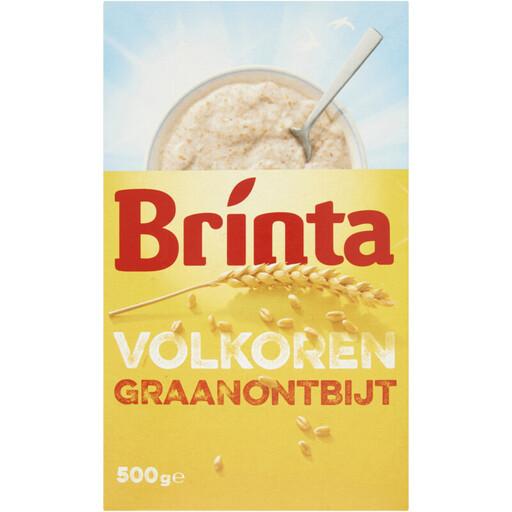 Image unavailable
For families who occasionally share a hot wholegrain wheat breakfast. The ingredients are wholemeal wheat flour and salt; the product information lists 10 g of fibre and 0.52 g of salt per 100 g. The added salt differs from the no-added-salt choice recommended by the Voedingscentrum for toddlers. Contains wheat and cereals containing gluten: check the latest label if allergens are a concern.
Don’t assume that breakfast cereal should replace bread every day. For children aged 1 to 3, the Voedingscentrum recommends porridge oats, muesli or other wholegrain cereals with no added sugar or salt as an alternative. Also consider what your child eats during the rest of the day.
Start with the ingredients, not the size of the pack. Check that the cereal is wholegrain and whether sugar or salt has been added. Then consider whether your family eats that variety often enough to make a larger pack worthwhile.
Read the ingredients list on the packaging you’re actually using. The Netherlands Food and Consumer Product Safety Authority explains that allergens must be listed on labels. Check the type of grain and any other listed allergens for each product.
No. A product’s name doesn’t guarantee that it has the same ingredients or nutritional value as another. According to the product information, Brinta Wholegrain cereal breakfast 500 g is made with wholemeal wheat flour and salt, while Kellogg’s Corn Flakes contain ingredients including maize, barley malt extract, sugar and salt. So compare the ingredients and nutritional information on the specific packs.