Who is this guide for?

Family in a small room

If your tripod can only go in one place, the angle of view and sensor size are important for fitting everyone into the frame. Canon Europe explains how to frame a group, while Sony describes how a lens’s angle of view changes on APS-C.

Family in several rows

You want faces at the front and back to be sharp, but you also need to account for movement during the shot. Canon Europe discusses depth of field in group portraits, and Canon explains how movement can cause blur.

Photographer who wants to be in the picture

Set up the composition in advance and, if your camera supports it, use the self-timer or a remote control to join the group. Sony explains how to use the self-timer to get yourself in the shot.

What should you consider when choosing?

Standard zoom

Choose this when: the group size or composition changes and you want to adjust the framing from the same tripod position. Sigma and Tamron describe zoom lenses that start at 28 mm.

Bear in mind: 28 mm may not be wide enough in a very small room; also check that you choose the right mount version.

Prime lens

Choose this when: you can decide on the distance and framing in advance, and the whole group fits in the frame on your camera. Canon, Nikon and Sony list 35, 40 and 50 mm options for their respective systems.

Bear in mind: you can’t adjust the framing with a zoom ring; a wide maximum aperture doesn’t automatically give you enough depth of field for multiple rows.

A wider angle of view

Choose this when: you can’t fit the whole group in the frame, even at the widest setting on your standard zoom, from the available tripod position. Canon cites the RF 16mm F2.8 STM as an example for photographing a large group in a small space.

Bear in mind: a wider angle of view also shows more of the surroundings; check that the lens is compatible with your camera.

Concern What to check when buying Who is this more important for?
Fitting the whole group in the frame Assess the angle of view from your intended tripod position, taking your sensor size and group size into account. A zoom with a wider setting can help if you need to change the framing. If I can’t move my tripod any further back, I want to know in advance whether everyone will fit in the frame. Around 25% of consumers say getting the framing right is their main concern.
Sharpness across multiple rows Check every face in a test shot and assess the depth of field at your chosen aperture. Canon Europe suggests f/5.6 or f/8 as possible starting points for group portraits, not as a fixed setting for every situation. If family members are standing at different distances from the camera, I want faces at the front and back to be sharp. Around 20% of consumers say sharpness is their top priority.
Movement in low light Consider both the available light and the shutter speed: a tripod stabilises the camera, not the people. A wider maximum aperture gives you more exposure options, but may reduce depth of field. When family members are moving in a dark room, I want to account for motion blur rather than relying on the tripod alone. Around 15% of consumers say this is their main buying concern.
Changing the framing A zoom can give you several different framings without changing lenses; with a prime lens, the composition is more fixed. Sigma and Tamron describe zoom lenses with a range that starts at 28 mm. If the group or composition changes while my tripod stays in place, I want to be able to adjust the framing. Around 15% of consumers give this flexibility top priority.
Mount and sensor size Check the exact mount version and your camera model. Also bear in mind the difference in angle of view between full-frame and APS-C. Before choosing a lens, I want to be sure that the version fits my camera and gives me the framing I want. Around 25% of consumers say compatibility and angle of view are their main concerns.

Common pitfalls

  • Choosing a ‘portrait lens’ without framing the group

    An angle of view that works for one person may be too narrow for the whole family from a fixed tripod position.

    Before choosing a lens, assess the framing based on your sensor size, group size and available distance.

  • Using the widest aperture to get everyone in focus

    A wide aperture generally gives you less depth of field. And a tripod won’t stop people from moving.

    Take a test shot and check the faces in every row. Balance the depth of field you want against the shutter speed and available light.

  • Assuming versions with the same lens name are interchangeable

    A lens name can refer to different mount versions; not every version fits every camera.

    Check the specific mount version against your camera model before ordering.

Relevant brands

Canon

Canon describes RF lenses for compatible EOS R cameras, including prime lens options.

  • Canon lists a maximum aperture of f/1.8 and an RF mount for the RF 35mm F1.8 MACRO IS STM.
  • Canon recommends the RF 16mm F2.8 STM for specific situations involving a large group in a small space; check your camera model and framing.

Nikon

Nikon describes the NIKKOR Z 40mm f/2 as a prime lens for its Z system.

  • Nikon specifies 40 mm and f/2 for this model.
  • On a DX camera, the angle of view is narrower than on a full-frame Z camera; check whether the group will fit from your tripod position.

Sony

Sony describes the FE 50mm F1.8 for compatible E-mount cameras, both full-frame and APS-C.

  • Sony lists f/1.8 for this model.
  • Sony describes its angle of view on APS-C as roughly equivalent to 75 mm; this may be too narrow for a group in a small room.

Sigma

According to Sigma, the Sigma 28-70mm F2.8 DG DN | Contemporary is available in Sony E and L mount versions.

  • Sigma specifies a zoom range of 28–70 mm and a maximum aperture of f/2.8.
  • Check whether the 28 mm wide-angle setting is wide enough for your room, and choose the right mount version.

Tamron

Tamron lists the 28-75mm F/2.8 Di III VXD G2 in versions for Sony E and Nikon Z.

  • Tamron specifies a range of 28–75 mm and f/2.8 for this model.
  • Check which version is compatible with your camera model and whether the 28 mm setting gives you enough room for the group.

Lenses at Joybuy

This selection of Joybuy products includes Sony E lenses with either a fixed angle of view or a zoom range; check the mount and sensor size supported by your camera for each version.
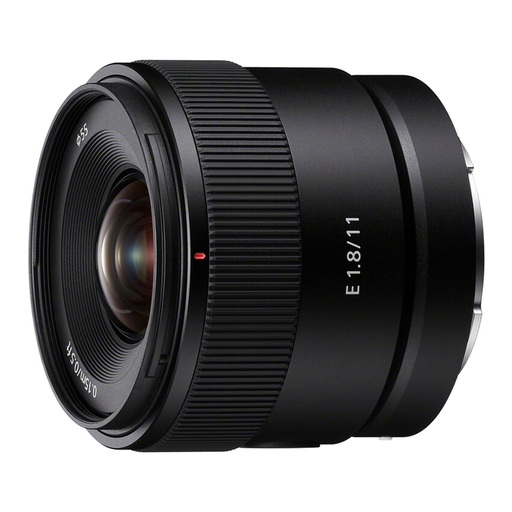
Sony E 11mm F1.8 APS-C wide-angle prime lens (SEL11F18)

Sony E 11mm F1.8 APS-C (SEL11F18)

The wide angle of view may be a good fit if you want to capture more of the group from a fixed tripod position.

11 mm, maximum F1.8, APS-C and a stated angle of view of 104°; it’s a prime lens, so you can’t adjust the framing with a zoom ring.

Joybuy
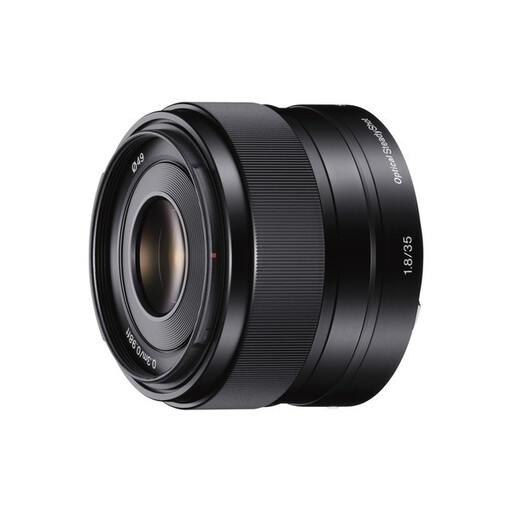
Sony SEL 35mm F1.8 OSS lens

Sony SEL 35mm F1.8 OSS

A prime lens for a composition you’ve decided on in advance from your tripod position.

35 mm, F1.8 and OSS; you can’t adjust the framing with a zoom ring.

Joybuy
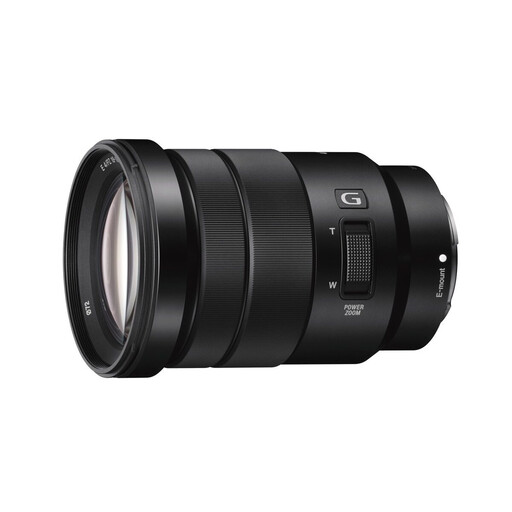
Sony E PZ 18-105mm f/4 G OSS

Sony E PZ 18-105mm f/4 G OSS

The zoom range gives you different framing options without changing lenses if the composition changes.

18–105 mm, maximum f/4, G and OSS.

Joybuy

Sony E 50mm f/1.8 OSS Black

Sony E 50mm f/1.8 OSS Black

This prime lens suits a composition decided on in advance, provided the group fits comfortably in the frame from your tripod position.

50 mm, f/1.8 and OSS; on APS-C, the angle of view may be too narrow for a family in a small room. Check the framing on your own camera.

Joybuy

Frequently asked questions

Can I simply use f/1.8 when photographing people in several rows?

Not without checking that every row is in focus: a wide aperture gives you less depth of field. Take a test shot and check the faces at the front and back. Canon Europe suggests f/5.6 or f/8 as possible starting points for keeping detail from the front row to the back, not as a guaranteed setting for every set-up.

Will a tripod prevent motion blur when photographing children?

A tripod stabilises the camera, not the people. If family members are moving, keep an eye on the shutter speed and adjust the exposure or ISO if needed.

How can I join the group without disturbing the set-up?

Use the self-timer or a compatible remote control if your camera model supports it. Sony suggests using a 10-second self-timer to get yourself in the shot; available settings vary by model.

What if a lens I bought online doesn’t fit or is faulty?

Check the mount and camera model before ordering. According to the Dutch government, online purchases generally come with a 14-day cooling-off period, subject to exceptions. If a product is faulty, it must be of satisfactory quality and the retailer is your point of contact; in the Netherlands, there is no fixed statutory period for the legal guarantee.
