
Families who often serve toast
Do you serve toast several times a week for breakfast, lunch or a get-together? If so, the number of inner packs and the amount in each one matter just as much as the total weight.


A large pack of toast is most useful when the amount suits what your household gets through in a week. If you use it over several days, smaller inner packs can help you open only a little at a time. If you eat toast less often, consider a smaller total pack weight too. Choose the type of toast for how you plan to serve it, and check the ingredients, allergens, salt and storage advice on the pack you buy.
Do you serve toast several times a week for breakfast, lunch or a get-together? If so, the number of inner packs and the amount in each one matter just as much as the total weight.
If you only eat toast occasionally, a pack that suits how much you actually use can help. Also consider how much toast you need to open at once and how you’ll store it afterwards.
Are ingredients or allergens important to your choice? Check the specific variety and pack, even if you’ve bought the same brand before. Salt is listed in the nutritional information per 100 g.
First, think about how often you use toast and what you serve it with. Then compare the pack size and total contents, and read the label for the variety you want to buy.
| What to consider | What to check when buying | Who it matters to |
|---|---|---|
| Keeping it fresh | Check the number of inner packs and the storage advice after opening. | If we eat toast on different days, I don’t want to open the whole pack at once. Around 33% of consumers prioritise this convenience for keeping toast fresh. |
| Getting the right amount | Compare the total weight and number of pieces with how much your household uses in a week. | When doing a regular weekly shop, I want to buy enough toast without choosing a pack that leaves lots over. Around 27% of consumers prioritise getting the right amount. |
| Ingredients and nutritional information | Read the allergen information and compare salt per 100 g; if you have questions about iodine, check the listed ingredients. | When the label is what matters most to our household, I want to see the details for this exact variety. Checking the label is the top priority for around 20% of consumers. |
| Type of toast | First choose between, for example, slices of toast for toppings and smaller Melba toast for a get-together. | I might want something different for breakfast than for a sharing platter. For around 20% of consumers, how they plan to serve it is the deciding factor. |
A large pack may not suit occasional use if you have to open a lot of toast at once. For example, AH Melba toast naturel is divided into 12 packs of 6 pieces, while Bolletje Geroosterd Brood comes in packs of four.
As well as the weight, compare the number of inner packs with when you plan to eat the toast. Store opened toast according to the instructions on the pack.
According to the Netherlands Nutrition Centre, it is not compulsory to bake bread with baker’s salt in the Netherlands. So the product type alone won’t tell you which type of salt has been used in a particular toast.
If the type of salt used matters to you, check the ingredients or ask the manufacturer.
Different varieties of toast can contain different allergens and amounts of salt. Albert Heijn also says that product information, including ingredients and allergen information, can change.
Read the label on the pack you’re buying, especially if it’s a different size or variety, or a supermarket own-brand product.
Bolletje Geroosterd Brood is toast for toppings, in a 240 g pack divided into 6 packs of 4 pieces.
The Melba toast naturel variety reviewed comes in a 120 g pack, divided into 6 packs of 6 pieces.
AH Melba toast naturel combines a total weight of 240 g with 12 packs of 6 pieces.
The range includes different options for a get-together or toppings, including toast and mini crackers.
The toast and cracker range includes Sun Snacks Melba toast naturel, in a 240 g pack.
Lidl is another shop to consider when looking for toast during your weekly shop.
These products are Danish Toast in a 4 × 85 g pack and Melba toast in a 240 g pack. Choose an amount that suits when you plan to eat it, and check how to store the toast after opening.
 No image available
Worth considering if you want toast for breakfast or with toppings throughout the week. The pack shown contains 4 × 85 g; check the ingredients and storage advice on the pack you buy.
 No image available
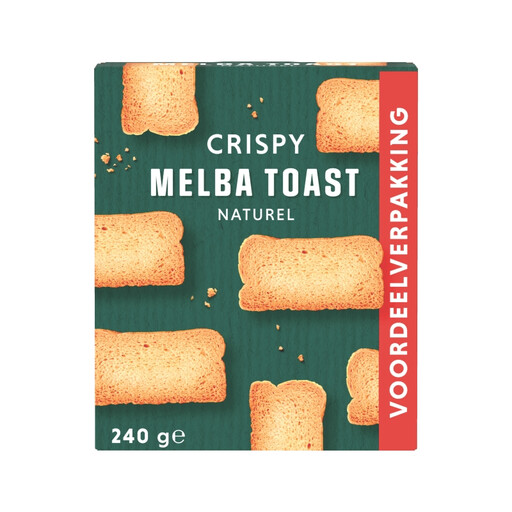
Consider this Melba toast if 240 g suits how much you use in a week. Check the pack to see how much you need to open at a time, and read the ingredients and storage advice.
If you eat it on different days, it’s best to open only the amount you need and store opened toast according to the instructions on the pack. For its Melba toast, AH recommends storing it in a sealed tin after opening; Bolletje says to store its Geroosterd Brood in a dark, dry, airtight place.
No, you can’t tell from the name toast. According to the Netherlands Nutrition Centre, it is not compulsory to bake bread with baker’s salt in the Netherlands. For a particular toast, check the ingredients or ask the manufacturer which type of salt has been used.
It varies by variety. According to the product information, Van der Meulen Melba toast naturel contains wheat, barley and soya, and may contain sesame; Bolletje Geroosterd Brood lists egg, milk, wheat and soya. Always read the label on the pack you buy.
No, check the nutritional information for the specific toast too. The Netherlands Nutrition Centre says that wholegrain products generally contain more fibre than white grain products made from flour, but the ingredients and salt content can vary between varieties of toast.