
Families who eat toast regularly
If the biscuit tin is topped up several times a week, the contents of a larger pack may be useful. Also consider whether you can keep the toast dry and well sealed once the pack is open.


A larger pack of toast is a good choice for a shared mid-morning snack if several people in your household eat it regularly and you can keep it dry and well sealed once opened. If you eat toast less often, a smaller pack may be more practical. Then choose a variety based on the ingredients, nutritional information and allergens listed on the exact pack, rather than pack size alone.
If the biscuit tin is topped up several times a week, the contents of a larger pack may be useful. Also consider whether you can keep the toast dry and well sealed once the pack is open.
Compare plain, wholemeal and multigrain varieties using the ingredients and nutritional information per 100 g. A large pack doesn’t tell you anything about its ingredients by itself.
For every variety you choose, read the ingredients and allergen information on the physical pack. Toast products in the same category can differ too.
First, work out how much toast you get through between snack times. Then compare the grain type and nutritional information. If allergens are a concern, the information on the exact pack should guide your choice.
| What to consider | What should you check? | Who should consider this? |
|---|---|---|
| Pack size and storage | Compare the net weight and check whether you can keep the pack dry and well sealed once opened. | If several people in my household regularly reach for toast, I want enough in the cupboard without the rest going soft. For around 50% of consumers, having a useful supply is the top priority. |
| Grain type and nutritional information | Read the ingredients and compare fibre and salt per 100 g; don’t rely on the word ‘multigrain’ alone. | For a regular snack, I want to know which grains it contains and how the nutritional values differ. Around 33% of consumers give this nutritional profile top priority. |
| Allergens | Check both the ingredients and the ‘contains’ and ‘may contain’ statements on the exact pack. | If someone at home needs to avoid certain ingredients, I want to choose a variety whose label suits their needs. For around 17% of consumers, this check is the first condition for making a purchase. |
A 240 g pack contains more than a 120 g pack, but that’s only practical if you’ll get through the toast after opening it while it’s still crisp.
Choose a pack size that suits how often you serve toast and whether you can seal the pack properly.
The product name doesn’t tell you how much wholegrain or fibre a particular toast contains. For example, Albert Heijn lists Van der Meulen Melba Toast Luxe Volkoren & Spelt as containing 64% wholemeal wheat flour; that percentage applies to this variety.
Compare the ingredients and nutritional information per 100 g on the packs you’re considering.
For a 240 g Melba toast listed on Joybuy, the ingredients and allergen statement contradict each other. This means the online information isn’t suitable as the only basis for choosing a product if you have an allergy or intolerance.
Check the physical pack of the exact variety and, if in doubt, ask the manufacturer or seller for clarification before use.
Baker’s salt is iodised salt, but according to Voedingscentrum, using baker’s salt isn’t compulsory. So the word ‘toast’ doesn’t confirm which type of salt a product contains.
If the type of salt used matters to your choice, check the ingredients on the exact pack.
A brand offering plain, wholemeal and other Melba toast varieties, for anyone wanting to compare grain types and pack sizes within the same product range.
A supermarket own-brand worth considering if a larger pack of plain toast for the biscuit tin appeals to you.
A Melba toast option in a smaller pack for anyone who doesn’t want a large one.
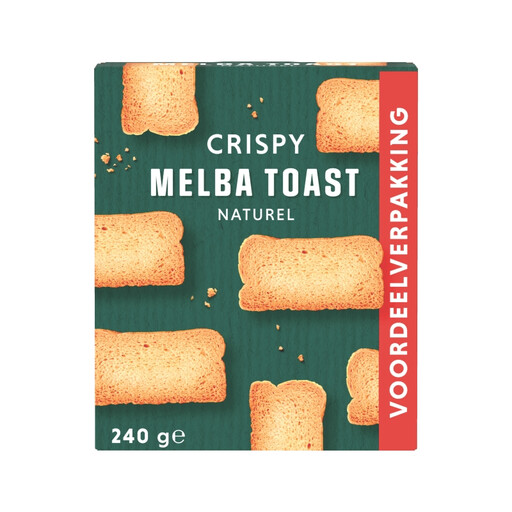
This 240 g pack is an option if several people regularly reach for toast from the biscuit tin. Whether the size is practical also depends on how you store the contents after opening.
 No image available
The 240 g pack could be a good choice if you serve toast at several snack times. Keep it dry after opening and make sure the pack is well sealed. The online ingredients and allergen information contradict each other, so check the physical pack, especially if someone needs to avoid allergens.
Store the toast somewhere dry and keep the pack well sealed after opening. Choose a large pack if you’re likely to get through it before any leftover toast goes soft.
No, those names don’t necessarily describe the same ingredients. Compare the ingredients and nutritional information for the exact products. For example, the 64% wholemeal wheat flour listed by Albert Heijn applies to Van der Meulen Melba Toast Luxe Volkoren & Spelt, not to every multigrain toast.
It varies by variety, so read both the ingredients and allergen warnings on the physical pack. The Joybuy listing for Delverde Classic Melba Toast mentions wheat and barley and warns that it may contain traces of sesame, soya and mustard. Don’t assume the same applies to other products.
No, you can’t tell from the product category. Baker’s salt is iodised salt, but according to Voedingscentrum, its use isn’t compulsory. Check the ingredients of the exact toast if the type of salt used matters to your choice.