
Families serving filled rolls as a meal
If you’re serving rolls with soup, salad or fillings, it’s useful to work out how many you need and when to serve them in advance. For bake-at-home rolls, check the preparation time on the pack too.


Choose white rolls if you want a neutral option to serve with a range of fillings. If the type of grain and fibre content matter more to you, look for rolls explicitly labelled wholemeal. For bake-at-home or frozen rolls, plan the preparation around serving time and check the pack for the number of rolls, allergens and storage instructions. If anyone needs a gluten-free product, don’t assume it’s suitable just because it’s labelled spelt or multigrain.
If you’re serving rolls with soup, salad or fillings, it’s useful to work out how many you need and when to serve them in advance. For bake-at-home rolls, check the preparation time on the pack too.
The name ‘multigrain’ doesn’t tell you on its own whether a roll is wholemeal. Check the product description and ingredients list for wholegrain cereals, and compare the stated fibre per 100 g.
Standard white, multigrain and spelt rolls may contain wheat or other cereals containing gluten. If anyone at the table has a specific allergen requirement, check the latest product information and take care to avoid contact with standard rolls during preparation.
First, check whether anyone at the table has an allergen requirement. Then compare the type of roll and the number in the pack, and plan the preparation so they’re ready on time.
| What to consider | What to check when buying | Who it matters to |
|---|---|---|
| Rolls for the meal | Check the number of rolls in the pack and, for bake-at-home rolls, the preparation method and baking time. | If rolls with fillings or soup are making up the meal, I want to know how many I can serve at once. For around 50% of consumers, this meal planning would be the first consideration. |
| Wholegrain and fibre | Look for ‘wholemeal’ in the product description or ingredients list, and compare fibre per 100 g. | If I’m choosing a wholemeal roll, I won’t rely on the name ‘multigrain’ alone. For around 30% of consumers, this choice of grain and fibre would come first. |
| Gluten and other allergens | Read the latest allergen information, and check separately for an explicit gluten-free label if required. | If someone at the table needs to avoid a particular allergen, I also need to consider preparation alongside standard rolls. For around 20% of consumers, this allergen requirement would be the main priority. |
The name ‘multigrain’ doesn’t tell you how much wholegrain or fibre a roll contains. PLUS states that its wholemeal multigrain rolls are made with wholegrain ingredients and contain 7 g of fibre per 100 g; don’t assume those figures apply to other multigrain products.
Check the product description and ingredients list, and always compare nutritional values per 100 g.
Spelt is a type of wheat. Jumbo’s organic spelt roll lists spelt flour as wheat, so it isn’t a gluten-free alternative.
If you need a gluten-free option, choose a product explicitly labelled gluten-free and avoid contact with crumbs and utensils used for standard rolls.
According to the product information, Jumbo’s frozen white rolls must not be refrozen once thawed and need to be prepared and eaten within 24 hours.
Read the instructions on your pack before thawing the rolls, and only take out as many as you’ll use according to those instructions.
According to the Netherlands Nutrition Centre, bread doesn’t have to be baked with baker’s salt. So, a mention on one product tells you nothing about the ingredients in another.
If you want to know what type of salt a roll contains, check the ingredients list on the pack you’re buying.
Albert Heijn sells white rolls baked in store, as well as packaged white rolls that you can bake at home.
Jumbo offers a range to compare, including white bake-at-home rolls, organic spelt rolls and frozen white rolls.
PLUS offers white and wholemeal multigrain rolls, so you can compare their ingredients and nutritional information.
ALDI lists an individual white roll for anyone who wants to choose the number of rolls they need.
Dirk lists a pack of four own-brand 1 de Beste white bake-at-home rolls.
Lidl Netherlands says that almost all its stores have an in-store bakery where rolls are baked.
This pack of four white rolls is an option if you’re serving rolls at a family dinner. Before buying, check how to prepare them and whether the allergen information is suitable for everyone at the table.
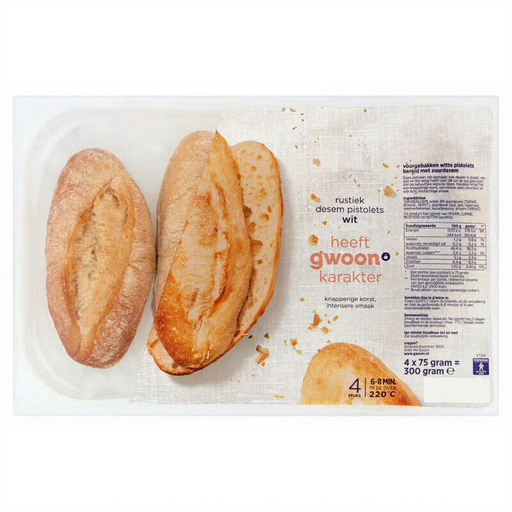 Image unavailable
This pack of four white rolls could work well for a meal where you want to serve four.
Check the preparation instructions so they’re ready in time to serve. This isn’t a gluten-free option; if you have allergies, check the latest allergen information.
Yes, as long as the number of rolls and the preparation fit your meal plans. The bake-at-home products reviewed are sold individually or in packs of four; check the pack you choose to see when they need to go in the oven. A roll is a small loaf, not a thick slice of bread.
No. Check that ‘wholemeal’ actually appears in the product description and ingredients list. PLUS states that its wholemeal multigrain rolls reviewed contain 7 g of fibre per 100 g; for other products, check their own nutritional information.
No. According to the Netherlands Nutrition Centre, bread doesn’t have to be baked with baker’s salt. If you want to know whether your chosen product contains iodised salt or baker’s salt, check its ingredients list.
Choose a product explicitly labelled gluten-free and read the latest allergen information. Don’t use a standard white, spelt or multigrain roll containing wheat or other cereals with gluten as a substitute, and avoid contact with ordinary bread crumbs during preparation.
Follow the instructions on the pack of the product you’ve chosen. For the Jumbo frozen white rolls reviewed, the instructions are: don’t refreeze once thawed, and prepare and eat within 24 hours.