
Shoppers who want to check the certification
You want to see exactly what the Fairtrade claim applies to on the packet you choose. Fairtrade International advises reading the explanation on the back if there’s an arrow by the FAIRTRADE Mark.


For Easter, choose biscuits with a FAIRTRADE Mark on the packaging if you want to check a product claim for yourself. If there’s an arrow by the mark, read the explanation on the back, as Fairtrade International advises. A claim about Fairtrade cocoa in chocolate biscuits doesn’t automatically apply to all the other ingredients or mean that the cocoa is physically separated. If you’re buying for guests with allergies, the label on the product you choose is what matters.
You want to see exactly what the Fairtrade claim applies to on the packet you choose. Fairtrade International advises reading the explanation on the back if there’s an arrow by the FAIRTRADE Mark.
You’re looking for biscuits for an Easter brunch or a treat, and allergies or a gluten-free diet may be a factor. Check the ingredients, allergens and any precautionary cross-contamination warning on the packaging you buy.
You want to bake your own Easter biscuits using cocoa or chocolate you’ve chosen separately, so you can decide on the recipe and portions yourself. Check the Fairtrade and allergen information for each ingredient individually.
First, decide whether you want to serve ready-made biscuits or bake your own. Then check the Fairtrade claim on each packet and make sure the ingredients are suitable for the people you’re buying for.
Choose these if: you want to be able to check the Fairtrade claim on the biscuit packet itself for your Easter table.
Bear in mind: for a composite product, the claim may apply to ingredients available under Fairtrade terms. According to Fairtrade International, an arrow by the mark points to further information on the back.
Choose these if: you’re specifically looking for chocolate biscuits and the packaging clearly states that they contain Fairtrade cocoa.
Bear in mind: a claim about cocoa doesn’t automatically apply to the other ingredients. Fairtrade International also says that mass balance may be used for cocoa, so it isn’t always physically separated.
Choose this if: you want to decide on the recipe, shape or portions of your Easter biscuits yourself.
Bear in mind: baking takes preparation, and you’ll need to check the claims and allergen information on each ingredient separately.
| What to consider | What to check when buying | Who is this most important for? |
|---|---|---|
| What Fairtrade means | Look for the FAIRTRADE Mark or a specific claim about the cocoa. If there’s an arrow, read the explanation on the back. | I want to be able to check what the Fairtrade claim means for my Easter biscuits on the packet. This is the top priority for around 42% of consumers. |
| Ingredients and allergens | Read the current ingredients list, highlighted allergens and any precautionary cross-contamination warning. | If someone at the table has an allergy, I want to base my choice on the label of the exact packet I’m buying. Around 33% of consumers give this check the highest priority. |
| Serve or bake | Choose between ready-to-serve biscuits and separate ingredients. If you’re baking, check each ingredient individually. | I want to decide on the shape or portions of my Easter biscuits myself, even if that means some preparation. This is the main consideration for around 25% of consumers. |
A claim about cocoa doesn’t automatically tell you which other ingredients were sourced under Fairtrade terms. Fairtrade International also says that mass balance may be used for cocoa.
Compare the exact claim on the front with the mark and the information about ingredients and traceability on the back.
Fairtrade information doesn’t tell you whether a biscuit is suitable for someone with an allergy. The Netherlands Food and Consumer Product Safety Authority treats allergen information on labels as a separate requirement.
Each time you buy, check the ingredients list, highlighted allergens and any precautionary cross-contamination warning on the current packet.
A page with ingredient information doesn’t mean that the baking product is available when you’re ready to buy.
Check current availability and, when buying, also look at the actual packaging.
A brand to consider if you’re looking for chocolate biscuits with a specific claim about the cocoa.
An ingredient brand to consider if you want to bake your own Easter biscuits with your chosen chocolate.
A shop where you can compare own-brand products containing cocoa and check their certification individually.
A shop where you can look for Fairtrade products and individual chocolate or baking ingredients.
If you want to bake your own Easter biscuits, you can choose cocoa as a separate ingredient. The product below is cocoa powder, not a ready-to-serve biscuit.
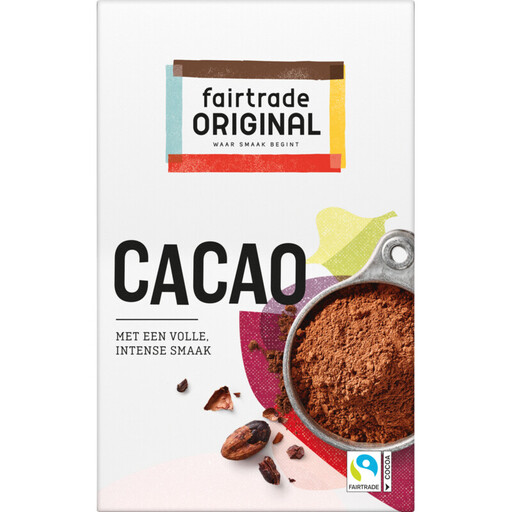 Image unavailable
For anyone who wants to bake their own Easter biscuits and choose the cocoa separately; this isn’t a ready-made biscuit.
Size: 125 g. Check the packaging for the exact Fairtrade explanation and the latest ingredients and allergen information.
No, not necessarily. According to Fairtrade International, for a composite product the mark may apply to ingredients available under Fairtrade terms. An arrow by the mark points to an explanation on the back of the packaging.
No. Fairtrade International allows mass balance for cocoa: volumes can be mixed during processing, while the Fairtrade volumes bought and sold are tracked. Read the packaging for information about the product you’ve chosen.
Read the ingredients list and allergen information on the packet you’re buying, including any precautionary cross-contamination warning. The Netherlands Food and Consumer Product Safety Authority explains the allergen labelling rules and the Dutch rules for such warnings that have applied since 1 January 2026.
You can’t tell from a general claim about the brand. Check each biscuit to see whether the packaging carries a product certification mark or only makes a claim about the cocoa used.