
Home bakers who want to check Fairtrade status
If Fairtrade is a requirement for you, check the information on the cocoa or chocolate you choose. That way, you’re not relying solely on a retailer’s general statement about how it sources cocoa.


Start by choosing the form your cake recipe calls for: cocoa powder for a batter that needs powder, a dark chocolate bar when the recipe specifies chocolate, or biscuits for a base or decoration. If Fairtrade is a requirement for you, check the information on the specific product and read the ingredients and allergen information too; a retailer’s general cocoa policy does not confirm the status of every product.
If Fairtrade is a requirement for you, check the information on the cocoa or chocolate you choose. That way, you’re not relying solely on a retailer’s general statement about how it sources cocoa.
Cake batter, melted chocolate and a biscuit base each call for different ingredients. The role the ingredient plays in the recipe determines which product form you need before you start comparing options.
If you have an allergy, intolerance or other dietary requirement, read the current ingredients list and allergen information for each product. The Netherlands Food and Consumer Product Safety Authority says allergen information should be clearly shown on the label.
Start with the ingredient form your recipe requires, then check the individual product for Fairtrade information, allergens and the quantity you need.
| What to consider | What to check when buying | Who it matters to |
|---|---|---|
| Fairtrade information | Look for the Fairtrade mark or an explicit Fairtrade cocoa statement on the specific product. Read the product information if physical separation of the cocoa is important to you. | I want to check what the Fairtrade claim applies to for my baking ingredient, rather than relying only on a retailer’s general promise. For around 36% of consumers, checking the product comes first. |
| Role in the recipe | Check whether the recipe calls for cocoa powder, a chocolate bar or biscuits. If you’re using a bar, compare its stated cocoa percentage with the flavour you want. | My cake needs an ingredient for the batter, filling or base; I don’t want to discover halfway through baking that I’ve chosen the wrong form. Around 29% of consumers give this baking function top priority. |
| Ingredients and allergens | Read the current ingredients list, allergen information and any precautionary information about traces, even if you’ve bought the product before. | If certain ingredients aren’t suitable for me, I need to check the label before adding anything to my cake. For around 21% of consumers, this is their main concern. |
| Availability and pack size | Check that the option you want is available and that the pack size suits the quantity in your recipe. | I want to be able to buy enough of the right product form for my cake. For around 14% of consumers, practical availability matters most. |
Albert Heijn, Lidl and ALDI each describe their approach to cocoa, but a statement about a product range doesn’t confirm that every individual biscuit or chocolate bar is Fairtrade.
Use retailer information as background, then check the Fairtrade information on the packaging of the product you want to use.
A biscuit base has a different role from cocoa in cake batter or a chocolate bar specified by the recipe. Choosing a different product form may mean you also need to adapt the recipe.
Follow the ingredient form specified in the recipe first, then choose an option whose product information meets your Fairtrade requirements.
A statement that chocolate contains 72% or 85% cocoa doesn’t tell you whether it’s Fairtrade. A different cocoa percentage can also change the flavour of your cake.
Choose a cocoa percentage that suits your recipe and check the Fairtrade information separately.
Those words don’t replace the ingredients list and allergen information. If you have an allergy, the information on the product you choose is what matters.
Read the current label before use, including any information about traces.
Biscuits for making a base, crumb layer or decoration.
A starting point if you’re looking for a dark bar for chocolate cake.
A place to start if your recipe calls for cocoa powder.
Chocolate bars for those who also want to consider how the cocoa is sourced.
A specific example for recipes that call for dark chocolate.
This product selection is a dark chocolate bar for recipes that call for chocolate. If your recipe needs cocoa powder or a biscuit base, you’ll need a different ingredient form.
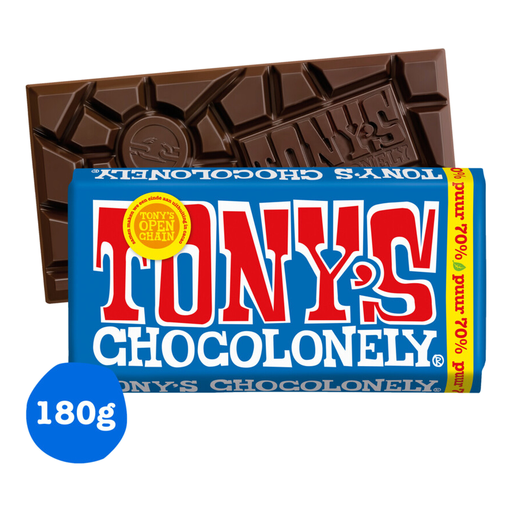 Image unavailable
For a baking recipe that calls for a dark chocolate bar rather than cocoa powder or biscuits.
The product name states 70% cocoa and a pack size of 180 g. Check the current packaging for Fairtrade information, ingredients and allergens before choosing the bar.
Fairtrade International has a cocoa standard covering the production, sourcing and sale of cocoa beans and processed cocoa. When you buy a product, check which Fairtrade information appears on the specific finished product; the presence of cocoa alone isn’t a Fairtrade claim.
Not necessarily. For its AH Biologisch Extra Dark Bar, Albert Heijn explains that certain ingredients may be mixed with non-certified supplies during production, while an equivalent volume of Fairtrade ingredients is purchased. If physical separation is a requirement for you, read the information on the product you choose.
Yes. Read the current packaging before using the product. The Netherlands Food and Consumer Product Safety Authority highlights the importance of clear allergen information on labels, so base your choice on the ingredients and allergen information for the chocolate bar, cocoa or biscuits you’re actually buying.