If a Fairtrade certification is essential for the sprinkles you enjoy on a rusk during a TV night, choose a product that explicitly states Fairtrade on the pack. Fairtrade Original dark is one option, but it may contain milk. A variety with Rainforest Alliance cocoa may suit you if you’re also considering a different certification scheme, but that claim is not proof of Fairtrade certification. For either option, check the allergen information and nutritional values for the amount you use.
Who are these options for?
Snackers specifically looking for Fairtrade
You want to be able to see on the packaging whether your chosen chocolate sprinkles carry a Fairtrade claim. For Fairtrade Original milk chocolate sprinkles, Albert Heijn states that the cocoa and sugar are Fairtrade; Jumbo sells the dark variety as Fairtrade Original Dark Chocolate Sprinkles. Check which ingredients the claim applies to for the variety you choose.
Fans of dark chocolate sprinkles who check allergens
You like dark chocolate sprinkles on a rusk, but the word ‘dark’ doesn’t tell you enough about whether they contain milk or soya. According to the product information, Fairtrade Original dark may contain milk, De Ruijter dark contains soya and milk fat, and Jumbo dark may contain milk. So check the label on the pack you buy.
Snack buyers considering other cocoa certifications too
If Fairtrade isn’t essential, you can compare varieties carrying a Rainforest Alliance claim by pack size, nutritional information and current price per kilo. Jumbo states this cocoa certification for its dark chocolate sprinkles, while ALDI does so for Kiekeboe Dark Chocolate Sprinkles. This is a different certification scheme from Fairtrade.
What should you look for when choosing?
First, decide whether an explicit Fairtrade claim is essential. Then compare only the varieties that meet your certification requirements, looking at taste, allergens and how much you plan to sprinkle on your rusk.
| What to consider |
What to check when buying |
Who is this most important to? |
| Explicit Fairtrade claim |
Read the Fairtrade claim on the pack you’ve chosen and check which ingredients it applies to. |
I specifically want Fairtrade sprinkles for my rusk, not just a general sustainability claim. For around 36% of consumers, an explicit Fairtrade claim matters most. |
| Certified cocoa and choice of shop |
Check the cocoa certification for each variety and compare pack prices on the same basis when checking current prices. |
I’m open to another cocoa certification if it means I can compare more packs. Around 29% of consumers prioritise this combination of certification and choice of shop. |
| Taste and allergens |
Compare dark and milk varieties, and read the ingredients, allergen information and ‘may contain’ statements on the label. |
I want a flavour that goes well with my rusk, but I also need to know whether the sprinkles I choose contain milk or soya. Around 21% of consumers put this consideration first. |
| Portion and nutritional value |
Check the nutritional values per 100 g and decide how much you’ll actually sprinkle on your rusk. |
For a TV night, I want to decide in advance how many rusks I’ll top and how much chocolate sprinkles I’ll use. Portion size and nutritional value are the main consideration for around 14% of consumers. |
Common mistakes
-
Assuming Rainforest Alliance means Fairtrade
A Rainforest Alliance claim on chocolate sprinkles doesn’t prove that the product is also Fairtrade-certified. So, for the dark varieties from De Ruijter, Jumbo and Kiekeboe covered here, the claim is no substitute for an explicit Fairtrade statement.
Decide which certification you require before comparing products, then check the packaging of that exact variety.
-
Assuming ‘dark’ means free from milk or soya
According to their product information, Fairtrade Original dark and Jumbo dark may contain milk; De Ruijter dark contains soya and milk fat. So the flavour name alone isn’t enough when checking allergens.
Read the current ingredients and allergen list, including any ‘may contain’ statements, on the pack you’re planning to buy.
-
Adding more while watching TV
The amount you put on your rusk determines the portion you eat. The Netherlands Nutrition Centre gives 67 kcal for 15 g of dark chocolate sprinkles; a different amount is not the same portion.
Decide in advance how many rusks you’ll top and how much chocolate sprinkles you’ll add. Use the nutritional information on the pack to compare varieties.
-
Assuming a particular type of salt based on the word ‘rusk’
A general assumption about bakers’ salt won’t tell you which type of salt is in the rusk you choose.
If iodine is relevant to your choice, read the ingredients list for the specific rusk or ask the manufacturer which salt it uses.
Brands and product ranges compared
Compare the certification claims and ingredients for each variety of chocolate sprinkles, rather than looking at the brand alone: dark and milk varieties can differ in these respects.
Fairtrade Original
Worth considering if you’re specifically looking for a Fairtrade claim. Jumbo sells a 380 g dark variety under this name; Albert Heijn states that the cocoa and sugar in its milk variety are Fairtrade.
- According to Fairtrade Original, the dark variety contains at least 32% cocoa solids.
- This dark variety may contain milk. Check the label and the claim for the flavour you choose before buying.
De Ruijter
A brand to consider if Rainforest Alliance cocoa is a suitable alternative for you. Albert Heijn states that De Ruijter Dark Chocolate Sprinkles carry this certification.
- According to Albert Heijn, the separate De Ruijter Royaal Extra Dark variety contains at least 43% cocoa solids.
- The standard dark variety reviewed contains soya and milk fat; the cocoa percentage for Royaal doesn’t automatically apply to that variety.
Jumbo
Jumbo Dark Chocolate Sprinkles 380 g is a supermarket own-brand option to compare if Rainforest Alliance cocoa is enough for you.
- Jumbo states that this dark variety contains at least 32% cocoa solids and uses Rainforest Alliance-certified cocoa.
- The variety may contain milk; the Rainforest Alliance claim is not a Fairtrade claim.
Kiekeboe
Kiekeboe Dark Chocolate Sprinkles is an ALDI option to consider if you’re looking for a 600 g pack with a Rainforest Alliance cocoa claim.
- ALDI describes this variety as dark chocolate sprinkles made with Rainforest Alliance cocoa.
- Don’t treat this claim as proof of Fairtrade certification; also check the ingredients on the pack you choose.
Chocolate sprinkles on Joybuy
These dark chocolate sprinkles are an option for rusks during a TV night if you’re also considering varieties without an explicit Fairtrade claim. Check the cocoa certification and allergen information on the pack if these are important to your choice.
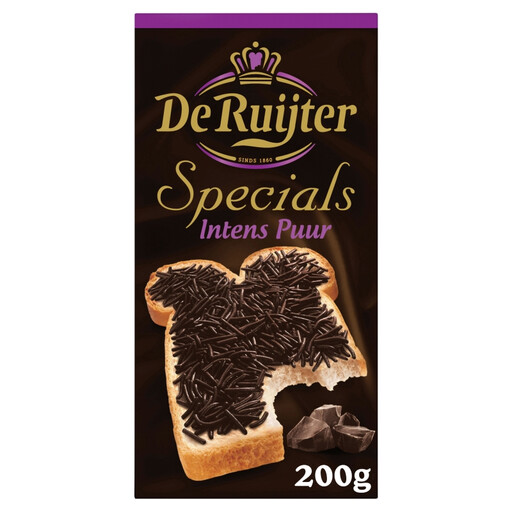 Image unavailable
De Ruijter Intense Dark Chocolate Sprinkles 200 g
Dark chocolate sprinkles to consider as a topping for rusks. The pack contains 200 g. Before buying, check the certification claim and the ingredients and allergen information for this variety, especially if Fairtrade certification or avoiding milk and soya is important to you.
View on Joybuy
Frequently asked questions
Are Rainforest Alliance chocolate sprinkles the same as Fairtrade chocolate sprinkles?
No. They are separate certification schemes. If Fairtrade is essential to you, look for an explicit Fairtrade claim on the chocolate sprinkles you choose; a Rainforest Alliance claim for cocoa isn’t enough.
Can I choose dark chocolate sprinkles if I have a milk allergy?
Not based on the word ‘dark’ alone. According to their product information, Fairtrade Original dark and Jumbo dark may contain milk; the De Ruijter variety reviewed contains milk fat and soya. Check the current allergen information on the specific pack.
How should I store opened chocolate sprinkles?
Close the pack tightly and store the sprinkles in a cool, dry place. For opened chocolate sprinkles, the Netherlands Nutrition Centre gives a storage period of up to one year in a kitchen cupboard. It also notes that a musty smell is one sign that you should check the product.
Can I assume my rusk contains iodised bakers’ salt?
No, don’t assume this based on the product category alone. Read the ingredients list for the rusk you choose and ask the manufacturer which salt it uses if iodine is relevant to your choice.


