Who are these choices relevant to?

Breakfast lovers who want to check the Fairtrade claim

You’re looking for a chocolate biscuit for a sweet breakfast and want to see on the packaging you choose whether the claim relates to cocoa, chocolate or another ingredient. According to Milieu Centraal, a Fairtrade logo on a white background may apply to one certified ingredient, rather than the whole product.

Label readers who check for allergens

You want to check the ingredients, allergens and any cross-contamination warnings before buying. Check this information for the exact variety: a Fairtrade statement tells you nothing about whether allergens are present.

Supermarket shoppers comparing what’s available

You’re looking for a biscuit that’s available when you do your usual food shop. A retailer’s cocoa policy can be a useful starting point, but check the Fairtrade statement on the individual product.

What should you look for when choosing?

Start with the claim on the individual biscuit, then check whether the label and current availability meet your needs.

What to consider What to check Who it matters to
Fairtrade claim Read the wording next to the certification mark and check whether the claim applies to the cocoa, chocolate, another ingredient or the whole biscuit. If Fairtrade cocoa is my main reason for choosing a chocolate biscuit, I want to be able to find that information on the packaging itself. For around 50% of consumers, being able to verify the claim comes first.
Allergens and nutritional information Check the ingredients and allergens; if you wish, compare the sugars and saturated fats per 100 g with the portion you plan to eat. If I have an allergy or prefer certain nutritional values, I read the label before choosing a biscuit. Around 30% of consumers put checking the label first.
Availability Check whether the exact variety is currently available and whether the Fairtrade statement applies to that specific pack. When I’m planning what to buy for breakfast, I want to know whether I can buy this particular biscuit, rather than relying on an older product page. Current availability comes first for around 20% of consumers.

Common mistakes

  • Assuming a cocoa policy means every biscuit has a Fairtrade claim

    Albert Heijn, ALDI and Lidl mention other certification schemes for cocoa alongside Fairtrade. Their policies therefore don’t confirm that a particular biscuit variety is Fairtrade.

    Read the Fairtrade statement on the packaging you choose or on the current product page, and check which ingredient it applies to.

  • Confusing Fairtrade with being allergen-free or a nutritional rating

    A Fairtrade claim doesn’t relate to allergens, sugars or fats. Albert Heijn lists wheat, milk and soya, among other ingredients, for its 150 g pack of Verkade Lange Nekken milk chocolate biscuits.

    As well as checking the certification claim, read the ingredients, allergens and nutritional information on the pack you buy.

  • Relying on an older product page

    Jumbo says that Bio+ Fair Chocolade Koekjes is no longer part of its online range. So the product information doesn’t tell you whether you can buy the biscuits now.

    Check that the exact pack is currently available before planning your food shop.

  • Treating a familiar brand name as proof of Fairtrade

    Lotus Bakeries describes Biscoff as a caramelised biscuit. That product description alone doesn’t make a Fairtrade claim about any particular pack.

    Base your Fairtrade choice on the statement for the specific variety, not the brand name.

Brands and retailers to consider

Verkade

Albert Heijn lists Verkade Lange Nekken milk chocolate biscuits, 150 g, as containing Fairtrade cocoa, and shows the ingredients and allergens.

  • A specific biscuit variety whose claim you can check at product level.
  • Check the exact variety: a claim about cocoa doesn’t automatically apply to every ingredient or other Verkade biscuits.

Albert Heijn

Albert Heijn says that cocoa in its own-brand products is certified by Rainforest Alliance or Fairtrade.

  • Its cocoa policy gives you a starting point when looking for own-brand products.
  • The choice between these certifications doesn’t automatically make an individual AH biscuit Fairtrade.

ALDI

ALDI lists Fairtrade, Rainforest Alliance and the EU organic logo as certification schemes for cocoa in its products.

  • The retailer makes clear that there are different ways to certify cocoa.
  • Check which scheme applies to the specific biscuit variety.

Lidl

Lidl says its own-brand cocoa comes from certified farming through Fairtrade, Rainforest Alliance or organic certification.

  • Its policy helps you look for information about own-brand cocoa.
  • Certified cocoa in an individual biscuit isn’t necessarily Fairtrade cocoa.

Jumbo

Jumbo stated that certain ingredients in Bio+ Fair Chocolade Koekjes met Fairtrade requirements.

  • The product information shows why it’s important to check exactly which ingredients the claim covers.
  • Jumbo says this variety is no longer part of its online range; check current availability separately.

Lotus Biscoff

Lotus Bakeries describes Biscoff as a caramelised biscuit, a different choice from a chocolate biscuit.

  • The product description helps you decide whether this is the type of biscuit you’re looking for.
  • Don’t treat this general description as proof of a Fairtrade claim on a specific pack.

Biscuits at Joybuy

For a sweet breakfast, this selection includes a Verkade biscuit with a Fairtrade ingredient statement. If Fairtrade cocoa or chocolate is essential to you, check the pack to see which ingredient the statement applies to.
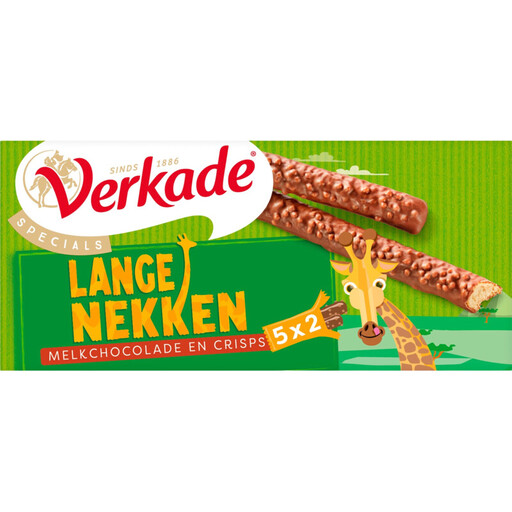
Verkade Long Necks, pack of 10

Verkade Long Necks – 10 biscuits

This biscuit is worth considering for a sweet breakfast if you’re looking for a product with a Fairtrade statement. Joybuy lists Fairtrade ingredients; check the packaging to see which ingredients this refers to, and read the allergen and nutritional information.

View at Joybuy

Frequently asked questions

Are all the ingredients Fairtrade if there’s a Fairtrade logo on the biscuits?

No, the logo doesn’t always mean that. According to Milieu Centraal, a Fairtrade logo on a white background may indicate that one ingredient is certified, rather than the whole product. So read the wording next to the logo on the pack you choose.

Which allergens should I check in a Fairtrade chocolate biscuit?

Check the allergens on the label for the exact variety; Fairtrade certification doesn’t change the ingredients. Albert Heijn lists wheat, milk and soya, among other ingredients, for its 150 g pack of Verkade Lange Nekken milk chocolate biscuits. The Netherlands Food and Consumer Product Safety Authority explains that allergens required by law must be clearly shown in the ingredients list.

How should I store chocolate biscuits after opening?

Follow the storage instructions on the pack you’ve bought and seal it well after opening. Also check the stated best-before date.

Will a Fairtrade biscuit always be available?

No, don’t assume a particular variety will always be available. For example, Jumbo says that Bio+ Fair Chocolade Koekjes is no longer part of its online range. Check what’s currently available when you do your food shop.
