Which airer is right for you?

Limited storage space

If space is tight, compare not only how much room an airer takes up when it’s set up, but also how large it is when folded. Leifheit says the Classic 100 Easy folds away; the design and dimensions still need to suit your storage space.

Washing napkins regularly

For frequent small loads, the number of places to hang items matters: napkins need enough room to hang freely. Compare the bar layout with the size and number of napkins you usually wash.

Keeping electricity use to a minimum

If you can wait for napkins to air-dry, an unheated airer may be a good option. Milieu Centraal points out that an airer itself uses no energy when used indoors; just make sure the room is ventilated.

What should you look for when choosing?

Compact, unheated airer

Best for: a small load that can dry at its own pace, where electricity use is a consideration.

Consider: the airer doesn’t provide heat; ventilation is still needed when you dry laundry indoors.

Small heated rail airer

Best for: regularly drying a small load indoors, provided the dimensions when set up will fit.

Consider: a smaller airer may offer fewer separate hanging spaces; check that your napkins will fit with gaps between them.

Larger heated airer with controls

Best for: drying larger loads more often, if you have enough floor and storage space.

Consider: more hanging space may mean a larger footprint; also check the wattage of the exact model.

What to consider What should you check? Who should pay extra attention?
Space and storage Measure the space available for the airer when it’s open, as well as the cupboard or area where you want to store it. Compare both with the dimensions of the exact model. If space is limited, I want to be sure the airer will fit both while drying and afterwards. Around 36% of consumers in this group give this the greatest priority.
Hanging space Count the napkins in each load and compare their size with the bars; follow the care label and the instructions for use. If I dry napkins regularly, I want to be able to hang them with enough space between them. Around 29% of consumers in this group give load capacity the greatest priority.
Electricity use Check the wattage of the exact model. To calculate usage: kWh = power in kW × hours of use; then multiply by your own price per kWh. If I can wait, I want to know whether an unheated airer will be enough for my napkins. Electricity use is the biggest consideration for around 21% of consumers in this group.
Ventilation and use Plan where the moist air can go and read the instructions for setting up and using the exact model. If my drying area has little air circulation, I want to check first whether I can dry laundry there safely and with good ventilation. Around 14% of consumers in this group focus most on the drying area and how the airer is used.

Avoiding common buying mistakes

  • Only checking whether the airer folds away

    Even when folded, an airer may still be too long or wide for your available storage space.

    Measure both the space where you’ll set up the airer and the place where you’ll store it, then compare these with the dimensions of the model you’ve chosen.

  • Mistaking a wattage range for the wattage of a specific model

    The DreamGoods page for the 12 m airer lists different wattages for different variants. That range doesn’t automatically tell you the wattage of the model you choose.

    Check the wattage of the exact model on its rating plate or in the manual before calculating its electricity use.

  • Assuming heat can replace ventilation

    A heated airer also adds moisture to the air when you use it to dry laundry indoors.

    Milieu Centraal recommends extra ventilation when drying laundry indoors. Choose a spot where moist air can be removed.

Brands to compare

DreamGoods

Offers heated, folding airers in different lengths, including models with a timer or temperature control.

  • For the 21 m model, DreamGoods lists 230 W and 34 heated bars; the retailer also specifies an adjustable timer and temperature.
  • For the 12 m model, the product page lists several wattages for different variants. Check the wattage of the exact model.

Herzberg

A small heated airer is an option to compare if you’re looking for compact dimensions when set up.

  • One listed model is specified as 120 W, with eight heating tubes and dimensions of 95 × 50 × 74 cm.
  • Before buying, check the exact model and whether the instructions allow you to dry your fabric napkins on it; the wattage alone doesn’t guarantee a drying time.

Dirt Devil

The BK-706M-6 is an electric towel warmer with six bars, listed as a freestanding or wall-mounted option.

  • The BK-706M-6 is specified as 100 W, with six bars.
  • According to the product information, this model doesn’t have an automatic shut-off. Also check whether the instructions allow you to use it with your textiles.

Leifheit

An unheated alternative to compare if you can leave small loads to dry without heat.

  • Leifheit lists a drying length of 10 m for the folding Classic 100 Easy.
  • This isn’t a heated airer, so choose it only if you don’t need a heating function.

Joybuy products

These products are designed for heated drying on a folding airer, including a wall-mounted model for anyone looking to save floor space.

Folding electric heated clothes airer with two side wings

Folding electric heated clothes airer with 2 side wings, 230 W, 144 × 53 × 91 cm, silver

An option to consider if you’re looking for heated drying space and the stated dimensions when set up will fit in your room.

The product name lists 230 W and dimensions of 144 × 53 × 91 cm. The product information says to use it indoors on a stable, level surface, with adequate ventilation and at least 31 cm of clearance from walls.

Check the instructions for the exact model; they also specify that it should be plugged into an earthed socket.

View at Joybuy
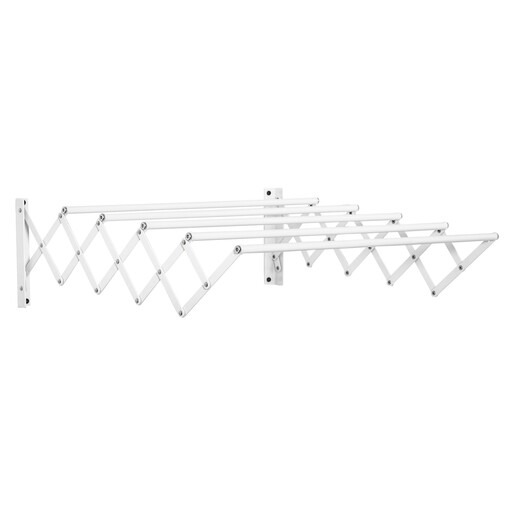
White folding wall-mounted airer with five rails

White folding wall-mounted airer with 5 rails, 63,5 × 60 × 20 cm

A wall-mounted airer may be worth considering if you want to free up floor space and have a suitable place to install it.

The product name lists five rails and dimensions of 63,5 × 60 × 20 cm. Before buying, check that the pre-drilled holes will suit your installation needs.

View at Joybuy

Frequently asked questions

What should I measure before choosing an airer?

Measure both the space where the airer will stand when open and the area where you want to store it. Compare both with the dimensions of the exact model; ‘folding’ doesn’t tell you how much space the airer takes up when folded.

Can I hang fabric napkins close together?

First check the care label and the airer’s instructions. DreamGoods advises against placing textiles too close together so air can circulate; the drying length doesn’t tell you how many napkins of your size will fit with space between them.

Do I need to ventilate when using a heated airer?

Yes. Milieu Centraal recommends extra ventilation when drying laundry indoors; heated bars don’t remove the need to get rid of moist air.

How do I calculate the electricity use of a heated airer?

Multiply the wattage in kilowatts by the number of hours it’s used. At a stated wattage of 230 W, using it for three hours at that wattage would work out at 0,69 kWh; this isn’t a measured drying cycle or a promised drying time.

What information is relevant when buying an electric airer?

Electrical appliances placed on the market in the Netherlands are subject to the applicable European safety requirements. According to Ondernemersplein, these include the required CE marking and an EU declaration of conformity. A CE claim in an advert doesn’t in itself prove that a specific item meets all the requirements.

What can I do if an airer I bought online doesn’t work properly?

According to the Dutch government, the seller must offer a solution if a product is faulty under normal use. When buying at a distance, you’re also entitled to a 14-day cooling-off period in many cases; check the terms that apply to your specific purchase.
