
Vandaag of morgen in huis

Kwaliteit gegarandeerd

Welkomstaanbiedingen ontgrendelen: GRATIS bezorging | Tot 80% korting | Gratis 30 dagen JoyPlus-proefperiode
Download de app
Whether you're a hobbyist looking to refine your skills or an illustrator in search of reliable tools, selecting the right pencils is crucial. Faber-Castell's range is both extensive and specialized, offering everything from opaque colored pencils to watercolor and pastel varieties. It can be challenging to determine which set best suits your technique and projects.
This guide is here to help. We'll break down the specifications of several popular Faber-Castell pencil sets, enabling you to make an informed decision that aligns with your creative goals.
Before purchasing a set, it's helpful to consider a few key characteristics. These will determine how the pencils perform and whether they are suitable for your style.
The primary distinction lies in the composition of the lead core. Each type is designed for a specific technique:
For serious artists and professional drawing pencils, lightfastness is a critical factor. Lightfast pencils contain pigments that resist discoloration and fading when exposed to light. Faber-Castell often indicates the lightfastness of its artist-grade pencils with a star rating system directly on the pencil barrel. A high lightfastness rating ensures your artwork retains its color intensity over time.
The thickness and hardness of the core determine the color laydown and the feel on paper. A soft core (designated with a 'B') lays down a lot of color and is ideal for opaque layers, while a hard core ('H') is better suited for fine details. Many Faber-Castell pencils feature a special SV (Sekuralverfahren) bonding. According to the manufacturer, this process glues the lead to the wooden casing along its entire length, increasing break-resistance, especially during sharpening.
Based on specifications and applications, we've highlighted several popular choices from the Faber-Castell range.
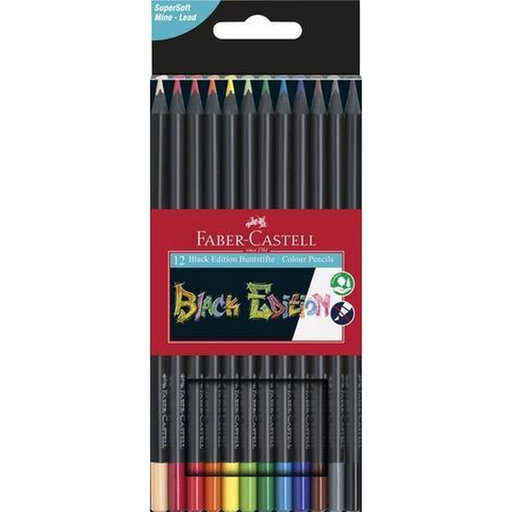
Why It Stands Out The Black Edition pencils are instantly recognizable by their black wood casing. The super-soft lead provides exceptionally vibrant color intensity, making colors pop not only on light paper but also on dark and colored surfaces.
Advantages
Who It's For This set is an excellent choice for hobbyists, students, and illustrators who enjoy working with high contrast and are looking for pencils that deliver a powerful effect on various surfaces.
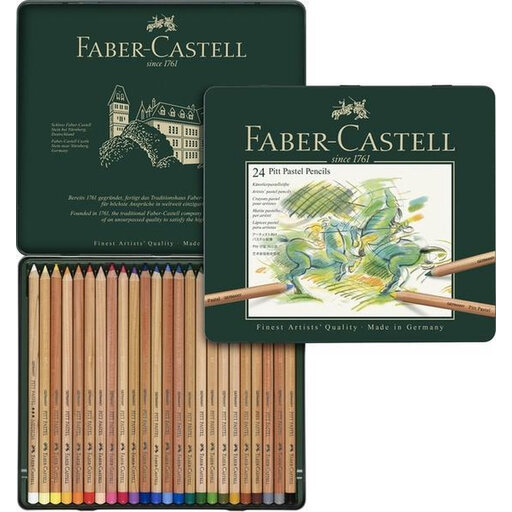
Why It Stands Out The Pitt pastel pencils combine the benefits of pastel sticks with the precision of a pencil. The core contains a high concentration of pigment and is free of wax and oil. This allows the colors to be blended and smudged beautifully for soft transitions.
Advantages
Who It's For This artist pencil set is ideal for drawers who work with pastels and want more control over details. It's also a perfect complement to a set of traditional soft pastels.

Why It Stands Out The Albrecht Dürer pencils offer the best of both worlds: drawing and painting. The 3.8 mm thick lead is fully water-soluble. With a wet brush, you can easily transform a dry drawing into a vibrant watercolor piece with smooth color transitions.
Advantages
Who It's For This set is perfect for artists who enjoy experimenting with mixed media. If you want to combine the precision of a pencil with the expressive freedom of watercolor paint, this is an outstanding choice.
A quality artist pencil set deserves to be well-preserved. To protect your professional drawing pencils and keep them organized, a sturdy case is essential. Explore our range of stationery and pencil cases to find a suitable storage solution for your new set.
1. What is the difference between Faber-Castell Polychromos and Albrecht Dürer pencils? The main difference is the core's binder. Polychromos colored pencils are oil-based, making them water-resistant and excellent for applying multiple opaque layers. Albrecht Dürer pencils are watercolor pencils. Their core is water-based and fully soluble, designed to be activated with water for painterly effects.
2. Are Faber-Castell pencils suitable for professional artists? Yes, particularly the artist-grade lines like Polychromos, Pitt pastel pencils, and Albrecht Dürer are used by professional artists and illustrators worldwide. This is due to the high pigment quality, consistent color laydown, and excellent lightfastness of these ranges.
3. What is the best way to sharpen pastel and watercolor pencils? For the softer and often thicker cores of pastel and watercolor pencils, a sharp craft knife or a specialty sharpener with a wide aperture is recommended. This provides more control and helps prevent the point from breaking. For standard-sized Faber-Castell colored pencils, a high-quality metal sharpener will suffice.
