
Vandaag of morgen in huis

Kwaliteit gegarandeerd

Welkomstaanbiedingen ontgrendelen: GRATIS bezorging | Tot 80% korting | Gratis 30 dagen JoyPlus-proefperiode
Download de app
Faber-Castell coloured pencils are available in compact 12-colour sets, larger 24-colour sets and extensive 36-colour sets. But the number of colours isn’t everything. The shape of the pencil, the hardness of its core and the type of paper you use can all have just as much influence on how well a set works for you.
Parents, students, hobbyists and artists can all fall into a few common buying traps. A small set can quickly feel limiting, while a large one may end up unused in a drawer. Soft coloured pencils can also seem appealing, but may wear down faster or need sharpening more often. Here are the main things to consider, along with some suitable options.
A set with lots of colours may seem versatile, but not everyone uses dozens of shades. For school, simple colouring pages or drawing on the go, a 12-colour set may be enough. If you want to create shadows, skin tones and colour gradients, you’ll get more from a 24- or 36-colour set.
Also consider how the pencils are stored. A metal tin is sturdy and suitable for taking with you regularly. Cardboard packaging is often lighter and takes up less space, but offers different protection against pressure and knocks.
According to Faber-Castell’s product description, Black Edition coloured pencils have a soft B-hardness core. This can give you a smooth flow of colour and rich lines. However, the precise results depend on how much pressure you apply, the paper you use and the pencil point.
A harder core can offer more control for fine technical drawings. A soft core may be more practical for filling in areas, creative sketching and working on dark paper. So don’t just look at the marketing terms: check the stated hardness and recommended surfaces too.
A triangular shape is often described as ergonomic. According to the product information, several Black Edition and Sparkle sets have a triangular grip. This can help you hold the pencil steadily, but whether it’s suitable depends on your hand and age.
Also check the diameter, length and whether a sharpener is included. Not every set comes with an eraser or sharpener. According to its product description, the Sparkle set with 20 pencils does include a mini sharpener; several Black Edition sets do not.
The Black Edition sets in this selection have a 5 mm core and B hardness. The product description mentions special SV bonding, which helps bond the core to the wood. The manufacturer presents this as a way to help prevent breakage. It doesn’t guarantee that a pencil can’t break in all circumstances: pressing too hard or sharpening it incorrectly can still cause damage.
Paper texture and pressure are important for an even layer of colour. Smooth paper works well for neat blocks of colour. More textured paper holds more pigment, but may need several layers.
A larger set doesn’t automatically mean better results. Choose based mainly on how often you draw and whether you want to blend colours or build them up in layers.
The Black Edition and Sparkle pencils mentioned here have a wooden barrel. According to the product information, some models use black wood from certified forests. Check the exact product page if the origin of the materials is important to you.
Use a sharp, suitable pencil sharpener. A blunt blade or a sharpener that isn’t designed for the pencil’s diameter can damage the wooden barrel and core. Store your pencils somewhere dry, and make sure you close other art supplies, such as brush pens and acrylic markers, properly after use.
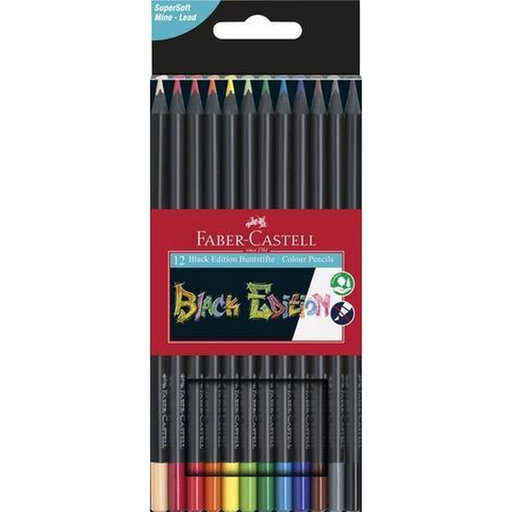
Why this suits this type of user: A compact set of 12 coloured pencils for home, school or getting started with colouring.
The manageable size means you don’t pay for colours you’re unlikely to use. The specifications state that the pencils have a triangular shape and a 5 mm core.
12 colours, a triangular grip, a soft B core, and suitable for children and adults according to the product information.
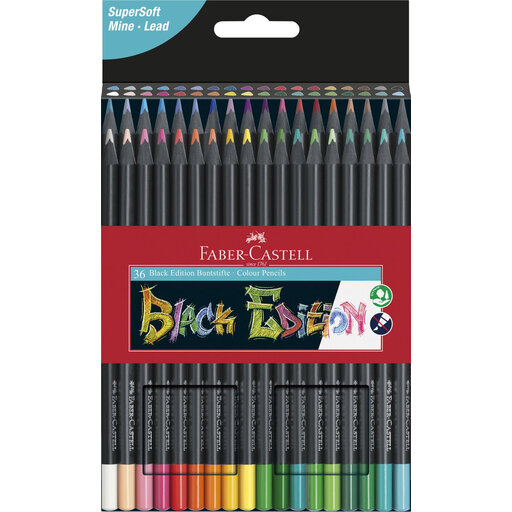
Why this suits this type of user: A generous set for adults, artists and hobbyists who regularly work with a range of shades.
There’s more choice of colours than in a starter set, and the product information clearly lists the core, shape and packaging.
36 colours, a 5 mm core, a triangular grip and a metal tin according to the product specifications.
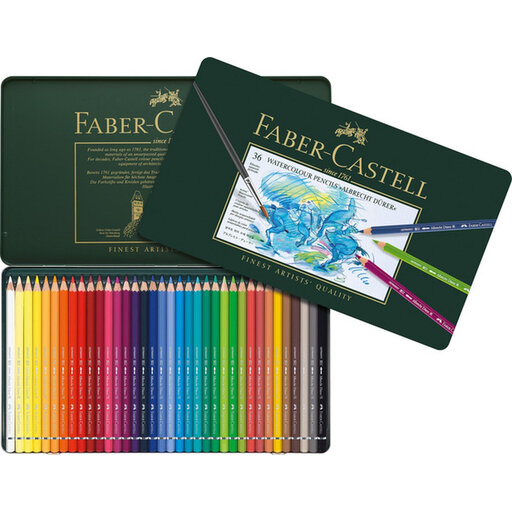
Why this suits this type of user: For anyone who wants to work with water, blending and watercolour effects as well as dry colouring.
The product description specifically states that the pigments are water-soluble. This makes the set’s purpose clearer than that of ordinary coloured pencils.
36 watercolour pencils, a 3.8 mm core, a metal tin and a hexagonal shape according to the product specifications.
We’ve put together a complete, up-to-date list of products that meet these strict selection criteria and the applicable European safety regulations.
Brush pens complement pencils for hand lettering. Faber-Castell Black Edition brush pens are available in sets of 20 or 50. According to the product description, they’re designed for small drawings and lettering, and use washable ink made with food colourings. The same information states that they’re suitable for light-coloured paper, but not black paper.
Acrylic markers are a better choice for surfaces such as wood, glass, ceramic or canvas. According to the product information, Faber-Castell Black Edition acrylic markers use water-based acrylic ink, have two nib sizes of 1 and 3 mm, and feature a shake-and-pump system. Let the ink dry completely, and always check that the surface is suitable for your project.
It depends on the specific set and the child’s age. Several Black Edition and Sparkle products list children and adults as their intended users. The Sparkle set states a recommended minimum age of 6. Always check the age guidance, pencil sharpener and any safety information on the product page.
Their lifespan depends on how often you use them, how you sharpen them and how much pressure you apply when colouring. A pencil will last longer if you use a suitable, sharp sharpener and store it somewhere dry. A soft core can feel pleasant to use, but generally uses up more material when colouring heavily.
Ordinary coloured pencils are designed for dry use. According to the product description, you can use water with watercolour pencils, allowing the colour to spread more like paint. Use watercolour paper or another type of paper that’s suitable for wet media, and test how much water the sheet can take first.
