
Vandaag of morgen in huis

Kwaliteit gegarandeerd

Welkomstaanbiedingen ontgrendelen: GRATIS bezorging | Tot 80% korting | Gratis 30 dagen JoyPlus-proefperiode
Download de app
Choosing a new extractor hood seems straightforward until you have to decide between an under-cabinet, wall-mounted or angled model. Terms such as 60 cm, 90 cm, 580 m³/h and A+++ only become meaningful when you consider how they relate to your kitchen.
Look out for these common pitfalls:
A 60 cm extractor hood is often a good fit for a standard hob that’s around 60 cm wide. For a wider hob or an open-plan kitchen, a 90 cm extractor hood can provide more coverage. Always measure your hob and the available space before ordering.
Common styles include:
Check the installation height too. For the COMFEE’ KWH-SLIF17B-60, for example, a distance of 650 to 750 mm is specified. Always follow the manual for your chosen model and the requirements for your hob.
Airflow is usually given in m³/h. A compact kitchen may need less capacity than an open-plan kitchen, but the layout, how often you cook and the ventilation method you choose all matter.
Also compare the noise level in dB. A model that delivers 650 m³/h may be noisier on its highest setting than on its lowest. Where available, check the noise levels for each speed. For example, the Ciarra Slimline 60 cm is listed at 138 m³/h and 51 dB on setting 1, and 184 m³/h and 61 dB on setting 3.
Bear in mind that measurements aren’t always taken under exactly the same conditions. Use m³/h and dB as points of comparison, rather than a guarantee of how the hood will perform in your kitchen.
A metal grease filter traps grease particles and needs regular cleaning. An extractor hood with a carbon filter is particularly relevant if you’re using recirculation. Check whether the filter is included or needs to be bought separately.
An energy-efficient extractor hood can be identified in part by its stated energy rating and annual consumption in kWh. LED lighting can also be useful above the hob, but check the lamp wattage and how the lighting is controlled.
Mechanical push buttons are simple and straightforward. Touch controls and Wi-Fi offer extra features, but also mean more electronics. Choose based on how you’ll use the hood every day, not just the list of features.
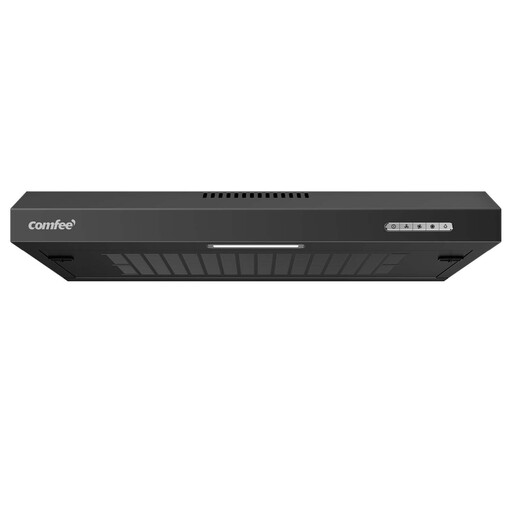
Why it suits this profile: This 60 cm under-cabinet extractor hood has three speeds, LED lighting and a stated airflow of 200 m³/h. It can be used with either external extraction or recirculation; according to the product information, the cotton filter needed for recirculation is sold separately.
Having two ventilation options makes it possible to check your kitchen layout in advance. According to the product information, the removable aluminium filter is washable.
60 cm wide; three settings; LED lighting; energy rating B according to the product listing.

Why it suits this profile: This 60 cm wall-mounted model is designed for people who want Wi-Fi and app controls alongside a high stated airflow of 650 m³/h. It supports both recirculation and external extraction.
The product information lists both installation methods and states that two CBCF003 carbon filters for recirculation are included.
Stated maximum noise level of 59 dB; energy rating A+++ and annual consumption of 12 kWh according to the product specifications.
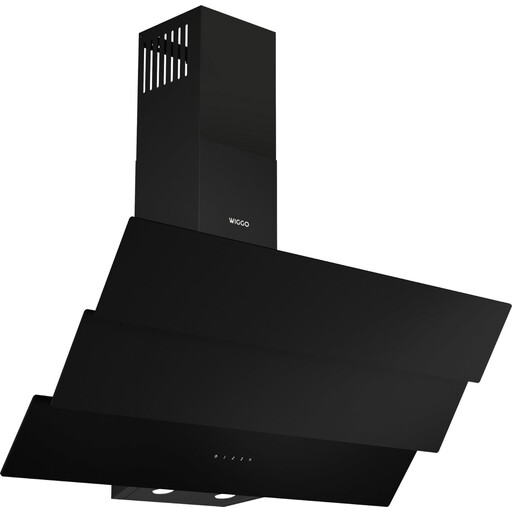
Why it suits this profile: This 90 cm wall-mounted extractor hood is designed for wider hobs and kitchens where extra coverage is useful. The product details list a capacity of 615 m³/h, four settings and support for recirculation.
The stated 120 mm connection, 90 cm width and choice of extraction or recirculation make it easier to check the installation requirements in advance.
90 cm wide; LED lighting; dishwasher-safe filter according to the product information; maximum noise level of 66 dB.
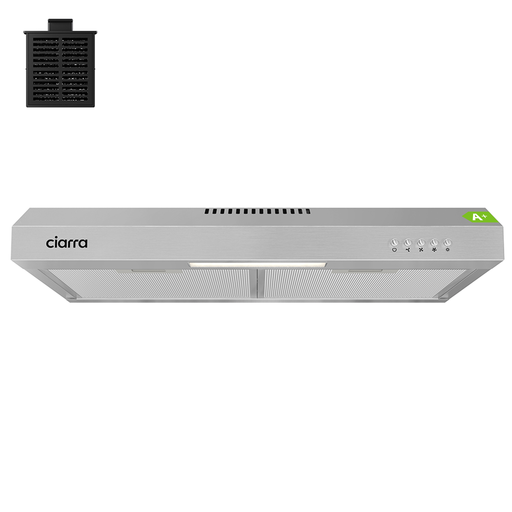
Why it suits this profile: This compact under-cabinet extractor hood is suitable for limited spaces and supports both recirculation and connection to an extraction duct. It has push-button controls.
The dimensions are 596 × 440 × 85 mm, so you can check the available cupboard and wall space accurately before buying.
Airflow up to 184 m³/h; energy rating A+; two washable aluminium filters; stated maximum noise level of 61 dB.
We’ve put together a complete, up-to-date list of products that meet these strict selection criteria and the applicable European safety requirements.
Before buying, check whether external extraction is possible and what duct diameter the model requires. For recirculation, find out which type of carbon filter is compatible and whether it’s included. External extraction generally removes moisture more directly, while recirculation is often easier to set up in a rented home.
Clean the metal grease filter regularly. Product information for several models recommends cleaning it roughly every 2 to 4 weeks, depending on how often you use the hood. Switch off the power before removing filters or carrying out maintenance. Have electrical connections and permanent fittings installed in accordance with the manual and local safety regulations.
For a hob that’s around 60 cm wide, a 60 cm model is usually a good choice. A 90 cm extractor hood can capture more cooking fumes from a wider hob. Also check that the wall, cupboard and extraction opening are suitable.
Recirculation can be a practical solution when external extraction isn’t possible. The air passes through a grease filter and usually a carbon filter. Moisture isn’t removed through a duct, so make sure you ventilate the room in another way too.
A quiet extractor hood often has a lower stated noise level on its lowest settings, but the maximum level can be noticeably higher. Compare the dB readings for each speed and bear in mind that ducting, installation and the acoustics of an open-plan kitchen can all affect the noise.
