
Vandaag of morgen in huis

Kwaliteit gegarandeerd

Welkomstaanbiedingen ontgrendelen: GRATIS bezorging | Tot 80% korting | Gratis 30 dagen JoyPlus-proefperiode
Download de app
An extractor hood may seem like a simple kitchen appliance at first glance. But choosing the wrong one can mean more noise, insufficient extraction or ongoing costs for filters. Size and installation options are especially important in a small kitchen, rented home or open-plan living space.
Product information from brands and sellers often highlights a high airflow rate, a quiet motor or a favourable energy rating. Always check which measurement the claim refers to and whether the model suits your hob, kitchen units and ventilation options. Below, you’ll find the key points to consider, along with some popular options based on verifiable product specifications.
An airflow rate of, say, 580 or 650 m³/h sounds impressive, but the maximum figure doesn’t tell you everything. With ducted extraction, the length, bends and diameter of the duct can affect the actual extraction rate. With recirculation, air passes through filters before being returned to the kitchen.
So, also check:
A recirculating extractor hood doesn’t vent cooking air outside. Air passes through a grease filter and usually a carbon filter before being returned to the room. This is practical in flats and rented homes without an existing ventilation duct, but carbon filters should be checked and replaced in line with the product instructions.
When connected to an external duct, moist, odorous air is vented outside. Check in advance whether a duct is available and whether installation is permitted under the instructions and local regulations. An extractor hood must not simply be connected to any ventilation system.
A 60 cm extractor hood will often suit a standard hob of the same width. For a wider hob, a 90 cm extractor hood can provide more coverage. Measure not only the hob, but also the available wall space, cupboard size and height.
An angled extractor hood or chimney-style wall hood keeps the space above your head clear. This can be useful in a small kitchen, but check that the angled front extends far enough over the rear cooking zones.
Choose the installation type to suit your kitchen:
Check the exact width, depth and adjustable height. The distance from the hob must comply with the instructions. Different minimum distances may apply to gas and electric hobs.
Airflow is usually shown in m³/h. A higher maximum can be useful if you often stir-fry or fry food, but it’s best to compare models at their normal settings too. An extractor hood rated at 59 dB on its highest setting may feel different in an open-plan kitchen from a model rated at 64 dB.
So, a “quiet extractor hood” won’t necessarily be quiet in every situation. Check the full range of noise levels if available, and consider the duct layout, as air resistance can also cause noise.
A removable aluminium grease filter is practical for regular cleaning. Some filters are dishwasher-safe; check this for each model. For recirculation, you’ll also need an extractor hood with a carbon filter, unless the product description specifies another filter solution.
An energy-efficient extractor hood has a stated energy rating and annual consumption in kWh. Compare both figures, as the letter rating alone doesn’t give you a complete picture of expected electricity use. Controls such as push buttons, touch controls or an app are mainly a matter of convenience. An extractor hood with LED lighting can illuminate the cooking area, but check the power rating and whether the light source can be replaced.
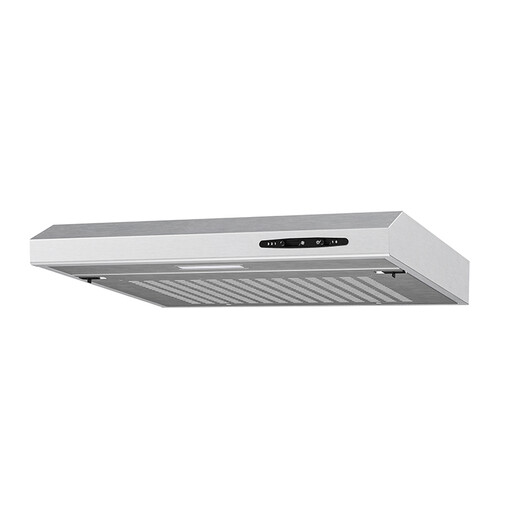
Why it suits this profile: This 60 cm under-cabinet extractor hood is designed for straightforward kitchen layouts and has three settings with push-button controls.
The product information lists a width of 60 cm, an airflow rate of 212 m³/h, and both a carbon filter and a component for ducted extraction.
Stainless steel housing, LED lighting, three settings and a carbon filter included.

Why it suits this profile: This wall-mounted model is ideal for a modern kitchen where you want touch controls and app operation.
The specifications list both recirculation and ducted extraction, so you can choose the installation option that suits your home.
According to the product description: up to 650 m³/h, up to 59 dB, four settings, Wi-Fi control and a stated A+++ energy rating.
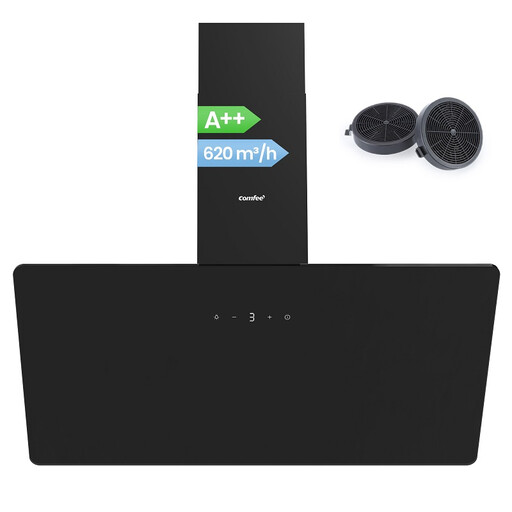
Why it suits this profile: This 90 cm angled extractor hood is designed for wider cooking areas and households where cooking is often intensive.
The product details list four speeds and two ventilation modes. This makes it easier to match the setting and installation to your cooking and home.
According to the product description: 620 m³/h, 59 dB, touch controls, a five-layer aluminium filter and a stated A++ energy rating.
We’ve put together a complete, up-to-date list of products that meet these strict selection criteria and the applicable European safety regulations.
Have a fixed kitchen extractor hood securely installed in line with the instructions. First, check the wall, fixing points, available power connection and route for the exhaust duct. If you’re unsure about the electrical connection or ductwork, it’s best to use a qualified installer.
Clean the grease filter regularly. Product instructions for several models recommend cleaning it roughly every two to four weeks, depending on use. With recirculation, you’ll also need to check the carbon filter. Switch off the power before cleaning, and don’t use abrasive products on glass or stainless steel.
Yes, if extracting air to the outside isn’t possible. Bear in mind the ongoing cost of carbon filters, and make sure the room is well ventilated. Recirculation doesn’t vent cooking moisture outside through a duct.
It varies by setting and model. Compare the stated decibel levels at the same speed. A model rated at a maximum of 59 dB can’t be directly compared with one that only gives a rating for a lower setting.
Its lifespan depends on installation, use and maintenance. Clean grease filters promptly, don’t let grease build up, and follow the manufacturer’s safety instructions. Also check whether parts such as filters and lights will remain available.
