
Housemate with a full fridge
You want to find your herbs among everyone else’s shopping. First, see if you can set aside a regular spot for them in the fridge you already have.


If there’s room in the shared fridge and it can be kept at 4 °C, start by setting aside a regular spot for your herbs before buying another appliance. If you need extra fridge space, compare the external dimensions and layout first, then factor in annual energy consumption and the stated noise level. A thermometer can help you check whether the fridge actually reaches the temperature you want.
You want to find your herbs among everyone else’s shopping. First, see if you can set aside a regular spot for them in the fridge you already have.
You’re looking for extra fridge space, but the available space, doorway and usable layout will determine which table-top model fits.
Before choosing an extra appliance, you compare its stated capacity with its annual energy consumption on the energy label.
Suitable when: there’s room for a clearly marked spot for herbs and you can check the temperature.
Trade-off: you won’t need another appliance, but the space and arrangements will still be shared.
Suitable when: the existing fridge doesn’t offer enough space and there’s room for a second appliance.
Trade-off: check the layout, external dimensions, annual energy consumption and stated noise level.
| What to consider | What should you check? | Who is this most important for? |
|---|---|---|
| Cooling and a spot for herbs | Check the temperature with a fridge thermometer and see if there’s room at the bottom for a regular spot. | If I don’t want my herbs to get lost among my housemates’ shopping, reliable cooling and a clearly marked spot are my main priorities. Around 33% of consumers in this situation put these first. |
| Space and layout | Measure the available space and check the external dimensions, doorway and shelf layout. | If I have limited kitchen space, I want to know whether the appliance will fit and still leave enough usable room for my housemates. Around 27% of consumers prioritise where the appliance will go and how the space is shared. |
| Energy consumption | Compare the stated annual consumption in kWh for models that meet your space requirements. | If I share the energy costs, I want to factor in the annual consumption of an extra appliance. Around 20% of consumers put energy consumption at the top of their list. |
| Noise | Compare the stated noise levels and consider where the appliance will go. | If the kitchen is next to a living area, I want to know in advance what noise level the manufacturer states. Around 20% of consumers make noise their top priority. |
An extra appliance won’t automatically provide the storage temperature you need.
First, check the temperature and see if an agreed spot for herbs in the current fridge will be enough.
Liebherr describes the humidity control in its EasyFresh drawer as being for unpackaged fruit and vegetables; this doesn’t prove that every herb will keep for longer.
Choose a drawer for its layout if it suits the way you use it, and also follow the storage advice for the specific herb.
Capacity doesn’t tell you how much usable space each housemate will get. The energy class alone also doesn’t tell you how many kWh a model uses per year.
Compare the external dimensions and layout, and check the stated annual consumption as well as the energy class.
The features mentioned apply to the specific models, not the brand’s entire range.
The TLT4702B is a slim, freestanding table-top model without a freezer compartment, designed for spaces where width is a consideration.
The KK550 is a larger table-top model without a freezer compartment, for anyone looking for extra fridge space with adjustable shelves.
The Rci 1620 Plus has an EasyFresh drawer, described separately as being for unpackaged fruit and vegetables.
The KTR15NWEB is a table-top model without a freezer compartment and with a door-open alarm.
The options below range from compact mini fridges to freestanding table-top models and a built-in model. Compare their layout and positioning with the space you need in your shared kitchen.
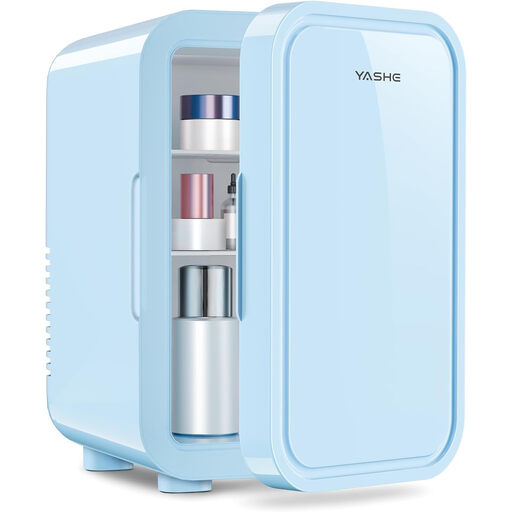 Image unavailable
Could be a good fit if you’re looking for a separate, compact place to keep things cool; check that the cooling setting suits the storage temperature you need.
The title lists a capacity of 6 litres, space for 8 cans and 220–240 V AC/DC. The description mentions a removable shelf and cooling and heating modes.
 Image unavailable
A table-top model without a freezer compartment to consider if you’re looking for extra fridge space and need a layout that can accommodate a regular spot for herbs.
The product specifications list a capacity of 88 litres, energy class E and 90 kWh per year. The description mentions a salad drawer and three adjustable glass shelves.
 Image unavailable
An option if you want a freezer compartment as well as fridge space; check that the available space and layout suit how your housemates will use it.
The product name lists a capacity of 109 litres. The product specifications state energy class C, 89 kWh per year and 37 dB; the description lists 95 litres of fridge space, a salad drawer and two glass shelves.
 Image unavailable
Could be a good fit if you’re looking for a freestanding table-top model with a salad drawer; measure the space before comparing the stated dimensions.
The product specifications list a capacity of 129 litres, 92 kWh per year and 39 dB. According to the product details, the model is 54 cm wide and 88 cm high, with energy class E, a salad drawer and two glass shelves.
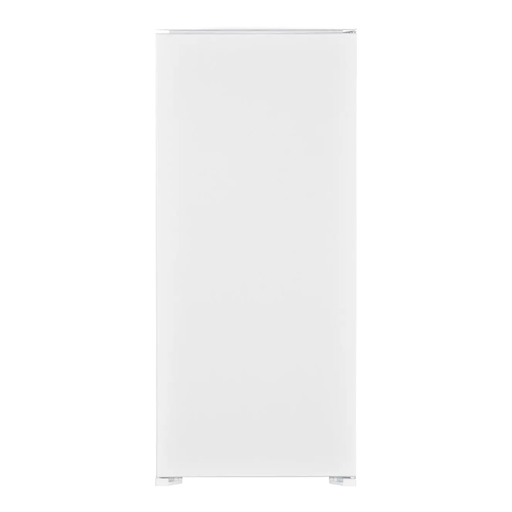 Image unavailable
Consider this model only if you have a suitable built-in space; a built-in fridge is less flexible as a separate extra fridge.
The product specifications list a capacity of 181 litres and 93 kWh per year. The description mentions a salad drawer and three glass shelves.
The Netherlands Nutrition Centre recommends a temperature of 4 °C. Place a fridge thermometer in the middle of the bottom shelf and leave it there for half a day or overnight; adjust the fridge if the reading is higher. The setting on the dial alone doesn’t confirm the temperature the fridge actually reaches.
For leftover parsley, the Netherlands Nutrition Centre recommends wrapping it in damp kitchen paper and storing it at the bottom of the fridge. Follow the appropriate storage advice for each herb and its packaging; for opened fresh basil, the Storage Guide recommends five days in the fridge, after which its quality may start to decline.
Measure the available space and check the full external dimensions of the specific model, as well as the doorway. Also check whether the shelves and drawers provide enough separate space for your housemates’ items.
Compare the stated annual consumption in kWh on the energy label for models with a suitable capacity. A larger fridge may have a good efficiency rating and still use more electricity overall. Only multiply a verified difference in kWh per year by your own electricity tariff if you want to work out the cost.
Compare the stated noise levels of models that suit your space and layout. A specification in dB helps with the comparison, but it can’t tell you exactly how noticeable the noise will be in your kitchen.