Who is this choice relevant to?

Podcasters with a growing archive

If you keep raw recordings, project files and exports, you can work out how much capacity you need more accurately by looking at your own files and expected growth than by counting episodes. Crucial explains that some of a drive’s stated capacity is not available for file storage.

Creators who want to be able to recover recordings

If you want to protect against losing original recordings, you’ll need a separate copy as well as your archive drive. Microsoft Support describes backups as copies that help protect against data loss or corruption, while the Dutch Data Protection Authority explains that appropriate security measures depend on the situation.

Podcasters who share files between devices

If you work on different computers, it’s worth checking the ports, cables and file system in advance. Samsung Netherlands lists the cables supplied with the T7, Kingston Technology sets out the XS1000’s connection options, and Apple Support describes a formatting option for use with Mac and Windows.

What should you look for when buying?

What matters when buying What should you check? Who is this important to?
Capacity and room to grow Check the size of your archive and compare it with the usable capacity of the exact model. I want room for raw recordings, projects and exports, as well as future growth. Around 33% of consumers are mainly looking for room for their archive to grow.
Protection against data loss Plan a separate storage location and check that you can restore your files from it. I want to be able to recover important recordings if something happens to my archive drive. Around 33% of consumers put loss prevention first.
Connections and sharing files Check the USB port, required cable and file system for each device. I share files between computers and want to be able to open them on each device. Around 20% of consumers mainly share files between devices.
Portability and physical protection Compare the size, connections and stated protection of the exact model. I take my archive drive with me and want features suited to travelling and using it on the go. Around 14% of consumers put portability or physical protection first.

Common pitfalls

  • Assuming a rugged SSD is a complete backup

    An IP rating or drop-resistance claim does not tell you whether you can recover files if, for example, you accidentally delete them.

    Choose physical protection if you take the drive with you, but also plan a separate backup that you can restore from.

  • Taking a maximum MB/s figure as a guaranteed working speed

    Crucial says that its stated maximum sequential speed was measured under specific test conditions; actual performance may vary.

    Check your computer’s USB capabilities and cable. Don’t choose based on the stated speed alone.

  • Reformatting an archive drive without securing your files first

    Apple Support warns that formatting erases all the files on the drive.

    First, make a separate copy and check that you can open it before choosing a different file system.

  • Assuming a specification for one model applies to the whole product range

    Capacity, included connections and protection claims can vary between models.

    Check the full model name and the features of the specific model you’re considering.

Brands to consider

Samsung

The T7 range is worth considering if you want to compare connection options; the T7 and T7 Shield are separate models with their own specifications.

  • For the T7 2 TB, Samsung lists USB-C to USB-C and USB-C to USB-A cables as included. For the T7, Samsung also lists optional password protection with AES-256 encryption.
  • Samsung specifies IP65 and drop resistance up to 3 metres for the T7 Shield 2 TB. These manufacturer specifications apply to that model and not automatically to other Samsung SSDs.

Crucial

The X9 range has different capacity options to compare for a growing archive; the CT2000X9SSD9 reviewed here is the 2 TB model.

  • Crucial lists USB-C and support for backup software for the X9.
  • The stated maximum sequential speed was measured under specific test conditions. Performance and compatibility can vary depending on the computer and connection.

Kingston

The XS1000 range is worth considering if you’re weighing up compact storage for use with USB-A and USB-C devices.

  • Kingston lists 1 TB and 2 TB models and specifies a USB-C drive connection, a USB-A cable and a USB-A to USB-C adapter for the XS1000.
  • Check the included accessories and connection for the exact model you choose.

Transcend

The ESD310 is worth considering if you want to compare built-in USB-A and USB-C connectors with using a separate cable or adapter.

  • Transcend lists ESD310 models up to 2 TB and a built-in dual connector.
  • Transcend lists conditions for some mobile devices and file systems, so check compatibility with your own devices.

Joybuy products for podcast archiving

This Joybuy selection features portable external SSDs in 1 TB and 2 TB capacities for taking your podcast archive with you or expanding it. Choose a capacity based on the size of your files and the growth you expect.

SanDisk Portable SSD 1 TB

SanDisk Portable SSD 1 TB

A portable 1 TB SSD for taking archive files with you.

The product description lists read speeds of up to 800 MB/s, drop protection up to 2 metres and a fastening hook.

An SSD is not a separate backup; keep important recordings in another location too.

View at Joybuy

SanDisk Extreme Pro Portable SSD 1 TB

SanDisk Extreme Pro Portable SSD 1 TB

A portable 1 TB SSD to consider if you want to take files between work locations.

The product description lists USB-C, a USB-A adapter, IP65 protection and drop protection. The stated read speed of up to 2000 MB/s requires a compatible USB 3.2 Gen 2x2 device; actual speeds may vary.

Keep important recordings in a separate location too, as one SSD is not a backup.

View at Joybuy

Portable SSD 1 TB, 1000 MB/s

Portable SSD 1 TB, 1000 MB/s

A portable 1 TB SSD to consider for storage and transferring files between devices.

The title lists 1000 MB/s; the product description mentions USB-C and drop protection up to 2 metres.

An SSD on its own is no substitute for a separate copy of important recordings.

View at Joybuy

Samsung Portable SSD T7 1 TB, blue

Samsung Portable SSD T7 1 TB, blue

A 1 TB model to consider if you want to share files between devices with different USB ports.

The product description lists USB 3.2 Gen 2, read speeds of up to 1050 MB/s, AES-256 encryption and two types of USB cable included.

An SSD is not a separate backup; keep important recordings somewhere else too.

View at Joybuy
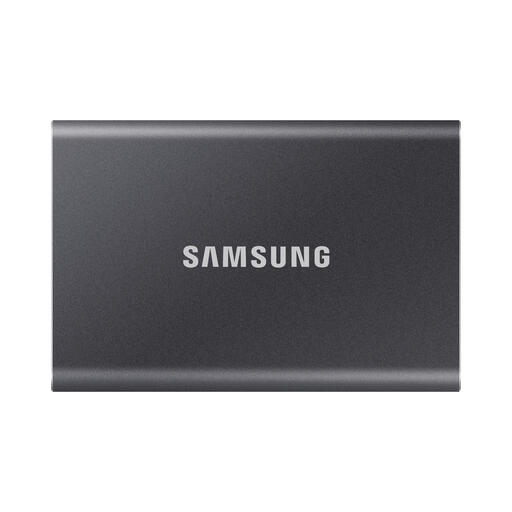
Samsung Portable SSD T7 2 TB, grey

Samsung Portable SSD T7 2 TB, grey

A 2 TB model to consider if your archive is growing and you want to share files between devices.

The product description lists USB 3.2 Gen 2, read speeds of up to 1050 MB/s, write speeds of up to 1000 MB/s, and USB-C to USB-C and USB-C to USB-A cables.

Keep important recordings in a separate location too; this SSD is not a backup on its own.

View at Joybuy

Frequently asked questions

How do you work out how much capacity your podcast archive needs?

Add up the size of your raw recordings, projects and exports, and decide which versions you want to keep. Compare models against your own growth rate; without taking stock of your files, 2 TB doesn’t tell you how many episodes will fit. Some of the stated capacity is also unavailable for files.

How do you use an SSD with both Mac and Windows?

First, check the ports and cables on your devices. Apple Support describes exFAT as a formatting option for a drive larger than 32 GB used with Mac and Windows. Make a copy before reformatting, as formatting erases existing files.

Can one external SSD back up all your episodes?

The SSD is a separate copy only if the original files also remain elsewhere. For important recordings, plan a second storage location and check that you can restore the files. Microsoft Support describes backups as copies that can be used to recover lost or damaged files.

What does the manufacturer’s warranty cover if a product develops a fault in the Netherlands?

A manufacturer’s warranty is in addition to your statutory rights when making a consumer purchase. According to the Dutch Government, there is no fixed time limit for the statutory guarantee in the Netherlands; if a product doesn’t meet reasonable expectations, the retailer is your point of contact. Keep your recordings in another location before sending a faulty drive away for servicing.

Can you keep podcast recordings containing personal data indefinitely?

Not if the GDPR applies to that processing. The Dutch Data Protection Authority says organisations must not keep personal data for longer than necessary and must decide on appropriate security based on the situation. Establish the purpose and whether the rules apply in each case; there is no general retention period for every podcast recording.
