For frequent transfers of large project files, a portable SSD is generally a better fit. An HDD may suit you if space for a growing archive matters more than fast transfers. Check that your computer’s port supports the drive’s interface and make sure you have enough storage. An external drive alone is not a complete back-up: keep a separate copy and test that you can restore your files.
Who is this for?
Creative professional who transfers files frequently
You regularly move large project files between devices and want to match the connection to your transfer needs. Examples from StorageReview and Samsung Netherlands show why both the interface and the host device matter.
Creative professional with a growing archive
You keep portfolio versions and completed projects, so you need enough space for copies and recoverable back-ups. The National Cyber Security Centre highlights the importance of keeping multiple versions of important business data; WD and Seagate offer examples of portable HDDs with generous storage capacities.
Creative professional using multiple computers
You might use both a Mac and a Windows PC, for example, and want to check in advance that the cable, file system and back-up software suit the way you work. Apple Support and Microsoft Support explain what to consider when choosing file formats and back-ups on these systems.
What should you consider when choosing?
Start by thinking about how you use the drive: how often you transfer large files, how many project versions you want to keep and which devices you’ll connect it to. These choices will help you weigh up SSDs and HDDs, storage capacity and connectivity.
| What to consider |
What to look for |
Who does this matter most to? |
| Transfer time |
Check that the port and cable match the interface; compare speeds only under comparable test conditions. |
If I often move large design, photo or video files, I want to know whether my computer can make use of the connection I choose. Around 36% of consumers put transfer time first. |
| Recoverable back-up |
Keep the original and back-up separate; check that your back-up software can restore files. |
If I want to recover a project after losing it, I need more than one saved version and want to test that I can restore it. Around 29% of consumers prioritise recoverability. |
| Archive space |
Count your current files and the versions you want to keep; compare SSD and HDD capacities with your expected growth. |
If my portfolio and old project versions take up a lot of space together, storage capacity matters more than the fastest transfer. Around 21% of consumers choose archive space as their main consideration. |
| Using the drive with different devices |
Check which USB cables you need and which file system to use; make a copy elsewhere before formatting. |
If I move files between different computers, I want the connection and file format to work with both. Around 14% of consumers put compatibility first. |
Common pitfalls
-
Assuming the quoted top speed applies to every transfer
Manufacturer speeds apply to specific models and conditions. Your host port and test conditions also affect transfer speeds; StorageReview reports measurements taken under its own test conditions.
Check your computer’s port and cable, and compare speed measurements only when the test conditions are relevant to how you’ll use the drive.
You could pay extra for an interface that your computer can’t make full use of.
-
Keeping a moved project as your only back-up
Transferring a file doesn’t automatically create a separate, recoverable back-up. The National Cyber Security Centre recommends keeping multiple versions of important business data and testing a recovery.
Keep the original or a second copy somewhere else, and try restoring your files.
-
Assuming an HDD or rugged SSD can’t be damaged
The Consumers’ Association describes HDDs as more susceptible to impact than SSDs. A ruggedness rating for an SSD is no substitute for a separate back-up.
Choose protection that suits where you use the drive, but also keep a separate copy of important files.
-
Formatting without checking the files already on the drive
Apple Support warns that formatting erases the files on the volume in question.
First copy any files you want to keep to another location, then check which file system you need.
Brands to consider
Samsung
The Portable SSD T9 is an SSD option for frequent transfers. For the 2 TB version, Samsung specifies USB 3.2 Gen 2x2 and sequential speeds of up to 2.000 MB/s.
- Samsung lists USB-C-to-C and USB-C-to-A cables, as well as AES 256-bit password protection, for the T9.
- The stated maximum depends on the model and connection, and doesn’t automatically reflect the speed you’ll get with every computer or file transfer.
Kingston
The XS1000 is a compact SSD option for copying and transferring files over USB 3.2 Gen 2.
- Kingston specifies 1 TB and 2 TB versions of the XS1000, with manufacturer-rated maximum speeds of up to 1.050 MB/s read and 1.000 MB/s write.
- These maximum speeds don’t show what you’ll get during long copy operations or with other Kingston models.
LaCie
The Rugged SSD4 is designed for portable project storage. LaCie specifies USB 40Gbps, IP54 and versions of up to 4 TB.
- This connection may be useful if the computer you’re using supports it.
- A ruggedness rating is no substitute for a second copy; the potential speed also depends on the host device.
WD
WD Elements Portable is an HDD option for archiving when storage space matters more than frequent, fast transfers.
- Western Digital lists a 4 TB version of the WD Elements Portable, among other options.
- In 2022, the Consumers’ Association described HDDs as generally more susceptible to impact than SSDs; this was not a model-specific test of this version.
Seagate
Expansion Portable is an HDD option for archiving and storing larger quantities of files.
- Seagate lists a 5 TB version of Expansion Portable with USB 3.0.
- Seagate says that using the drive with Time Machine requires reformatting. Check for existing files and save them before formatting the drive.
Joybuy products
This selection features portable external SSDs for frequent file transfers and storing portfolio and project files.
 No image available
SanDisk Extreme PRO Portable SSD 1TB
Ideal for frequent transfers of large project files; the stated maximum read speed requires a compatible host.
1 TB storage; USB 3.2 Gen 2x2 and USB-C. The product description specifies read speeds of up to 2.000 MB/s and notes that write speeds are lower. A USB-C cable and USB-A adapter are included.
The description specifies AES 256-bit security.
View at Joybuy
 No image available
Samsung Portable SSD T7 2TB Blue
Ideal for carrying portfolio and project files when you need 2 TB of storage.
USB 3.2 Gen 2; the description specifies sequential speeds of up to 1.050 MB/s read and 1.000 MB/s write. USB-C-to-C and USB-C-to-A cables are included.
The product description specifies AES 256-bit password protection and compatibility with Windows and macOS. To achieve the stated optimal performance, the connected device must support USB 3.2 Gen 2.
View at Joybuy
 No image available
Samsung Portable SSD T7 1TB Blue
Ideal for carrying a working copy when 1 TB of storage is enough for your files.
USB 3.2 Gen 2; the description specifies sequential speeds of up to 1.050 MB/s read and 1.000 MB/s write. USB-C-to-C and USB-C-to-A cables are included.
The product description specifies AES 256-bit encryption and compatibility with Windows and macOS.
View at Joybuy
 No image available
Samsung Portable SSD T9 4TB Black (MU-PG4T0B)
Ideal for a growing portfolio when you need 4 TB of portable storage and regularly transfer large files.
USB 3.2 Gen 2x2; the description specifies sequential read and write speeds of up to 2.000 MB/s. Potential speeds depend on the host and connection.
The product description specifies AES 256-bit password protection and USB-C-to-C and USB-C-to-A cables.
View at Joybuy
 No image available
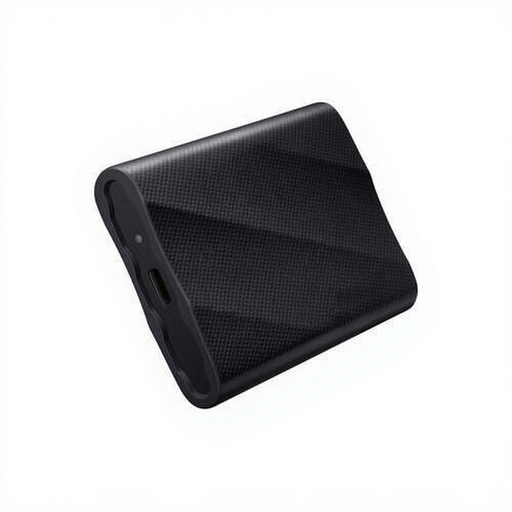
Samsung Portable SSD T9 1TB Black (MU-PG1T0B)
Ideal for frequent transfers of large files when 1 TB is enough for your working copy.
USB 3.2 Gen 2x2; the description specifies read and write speeds of up to 2.000 MB/s. Potential speeds depend on the host and connection.
The product description specifies AES 256-bit hardware encryption and included USB-C-to-C and USB-C-to-A cables.
View at Joybuy
Frequently asked questions
Is one external drive enough for a back-up?
Not as the only copy of important data. For important business data, the National Cyber Security Centre recommends keeping at least three versions: the original files and two back-ups. Also test that you can restore and open your files. This advice is not a uniform legal requirement for every creative professional.
How do you use an external drive for regular back-ups in Windows?
Microsoft describes File History as a way to back up regularly to an external drive or network location. Check that your portfolio folders are included in the back-up, then try restoring a file.
Can you use the same drive for files on Mac and Windows?
You can, provided you use a file system that is compatible with both. Apple Support describes exFAT as compatible with Windows. Check your software and device requirements too. Formatting erases files already on the drive, so copy them somewhere else first.
What warranty applies to a faulty drive in the Netherlands?
For consumer purchases, statutory rights apply alongside any manufacturer’s warranty. According to ACM ConsuWijzer, the seller must resolve the issue free of charge if a product breaks sooner than you could reasonably expect under normal use. There is no fixed warranty period that applies to every product; rights for business purchases must be assessed separately.
Should you encrypt a portfolio containing client data?
If an organisation processes personal data, the GDPR requires appropriate security measures based on the risks, according to the Dutch Data Protection Authority. The Authority does not specify a particular SSD or standard encryption setting on the page cited. Consider, among other things, the consequences of losing a drive you take with you.


