What should you consider when choosing?
Portable external HDD
A good fit if: you mainly store source recordings, finished episodes and successive project folders, and don’t edit directly from the drive all the time.
Bear in mind: check the capacity, cable and format of the exact model; a USB connection alone doesn’t tell you how fast it will be in your setup.
Portable external SSD
A good fit if: you often move project folders or regularly copy large files between workstations.
Bear in mind: stated maximum speeds don’t guarantee the speed you’ll get from your computer, cable and files; make sure the capacity suits the size of your archive.
The National Cyber Security Centre recommends keeping multiple copies of important data. So don’t just choose a drive: decide where to keep an independent copy, too, and how you’ll check that you can restore it.
| What to consider |
What should you check? |
Who should pay particular attention? |
| Restoring versions |
Check whether the backup method keeps successive project versions, and test a restore. |
If I might need an older edit after overwriting it, I want to know in advance whether I can restore it. Around 31% of consumers prioritise restoring project versions. |
| Space for your archive |
Compare the capacity in TB with complete project folders and the version history you want to keep. |
If I want to keep source recordings and several project folders, I look at the size of the entire archive, not just published episodes. Around 25% of consumers prioritise archive space. |
| Transfer speed |
Compare the stated maximum read and write speeds and the USB version supported by the drive and computer. |
If I regularly move large project folders, I want to know the stated speeds for the exact model. Around 19% of consumers put work speed first. |
| Connection and format |
Check that the cable and port are compatible, and find out which drive format your backup software requires. |
If I want to use the same drive with my computers and backup settings, I check the connection and format first. Around 13% of consumers prioritise compatibility. |
| Access to recordings |
Check whether the exact model has the security feature you need, and decide who will have access. |
If recordings feature identifiable people, I want to manage access and retention deliberately. Around 12% of consumers prioritise confidentiality. |
Joybuy products for podcast archives
These portable HDD and SSD options are designed for storing and moving podcast projects. Work out the capacity and connection you need based on your own project folders and computers.
 No image available
WD Elements Portable 5TB USB-C Graphite Black
A portable HDD option if you want to archive project folders and need a USB-C connection.
Capacity: 5 TB. The product details list USB-C and USB 3.2 Gen 1.
The model described is portable and designed for use with Windows and Mac.
View at Joybuy
 No image available
WD My Passport 2TB Blue
A portable HDD option for storing project files if 2 TB is enough for your archive.
Capacity: 2 TB. The product description lists AES 256-bit hardware encryption and scheduled backups; this doesn’t prove that earlier project versions can be restored.
View at Joybuy
 No image available
Toshiba Canvio Ready 4TB
A portable HDD option for source recordings and project versions if the capacity suits your archive.
Capacity: 4 TB. Form factor: 2.5 inches; connection: Micro-USB B.
The product description lists USB 2.0 and USB 3.2 Gen 1 compatibility, as well as USB bus power.
View at Joybuy
 No image available
Samsung Portable SSD T7 2TB Blue
A portable SSD option if you regularly move project folders and 2 TB is enough for your archive.
Capacity: 2 TB. The product description lists USB 3.2 Gen 2 and maximum speeds of 1.050 MB/s read and 1.000 MB/s write; these are stated maximums, not guaranteed transfer speeds for your setup.
The description lists USB-C to USB-C and USB-C to USB-A cables, as well as AES 256-bit encryption.
View at Joybuy
 No image available
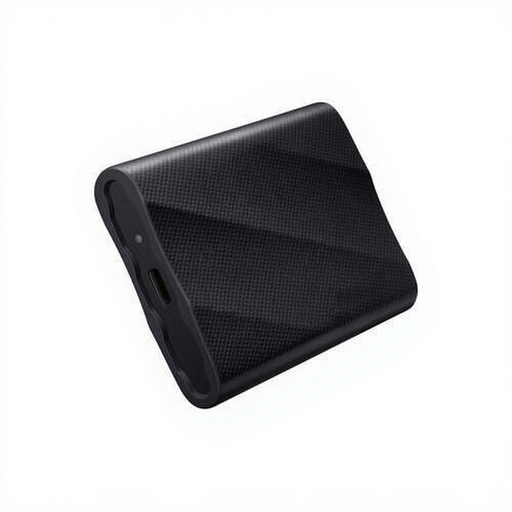
Samsung Portable SSD T9 1TB Black MU-PG1T0B
A portable SSD option to compare if you often move files between locations and 1 TB is enough for your archive.
Capacity: 1 TB. The product description lists USB 3.2 Gen 2x2 and NVMe, with read and write speeds of up to 2.000 MB/s; these are stated maximums.
The description lists USB-C to USB-C and USB-C to USB-A cables, and compatibility with Windows, macOS and Android.
View at Joybuy
Frequently asked questions
Can I recover a project if I accidentally overwrite an edit?
Only if your setup has kept an earlier version. Windows File History can restore earlier file versions; check that your podcast folder is included and test a restore before relying on your archive.
Can the same drive store my Mac archive and Time Machine backups?
Yes, with a suitable drive format and setup. Apple recommends APFS or APFS Encrypted for a Time Machine drive, and describes using an additional APFS volume for regular files on the same physical drive. A new format can erase existing data, so decide how to set it up before use and make a separate copy first.
How can I check that my podcast archive will still be usable later?
Decide which source recordings, project files and final versions to keep, set a suitable retention period, and periodically test that you can restore them. For final audio files, the Library of Congress names WAVE with embedded metadata as a preferred format in its preservation context; this isn’t a requirement for every podcast.
What can I do if a drive I’ve bought breaks down too soon?
If a product is faulty, the seller is responsible for the statutory guarantee under Dutch law, according to the Netherlands Authority for Consumers and Markets; the outcome depends on what you could reasonably expect from the product under normal use. A manufacturer’s warranty doesn’t replace this right. Keep a separate copy of your recordings too, as a warranty won’t restore your archive.
Can I keep identifiable local residents in old podcast projects indefinitely?
Don’t assume you can keep recordings indefinitely if they contain personal data and the GDPR applies to the processing. The Dutch Data Protection Authority says personal data must not be kept for longer than necessary, and that the GDPR doesn’t set a general, specific retention period. Whether this applies to a particular recording depends on its content and circumstances.


