First, choose a stereo pair that you can position symmetrically and connect to your existing audio outputs. Then consider how much bass you can actually assess in your room. A compact set can save space, while two separate nearfields may give you more flexibility with placement and model-specific adjustments. Neither option will automatically make a lively room or high evening listening levels suitable for mixing decisions.
Who is this buying guide for?
Evening mixer in a shared living space
You want to be able to adjust the volume during an evening session to suit others in or around your home. If noise is a concern for your neighbours, the Dutch government recommends agreeing arrangements first, for example about music.
Dance track mixer checking the bass
You want to assess the balance between the kick and bassline. Genelec explains how speaker placement and room resonances can affect bass reproduction.
Mixer with limited space for equipment
You need to fit two speakers and your listening position into the same workspace. Genelec recommends a symmetrical setup; also check that your chosen set is sold as a pair and will physically fit.
What should you look for when choosing?
Compact desktop system sold as a pair
A good choice if: you have limited desk space and want to set up two speakers straight away. PreSonus lists the Eris 3.5 2nd Gen as being supplied as a pair.
Consider: check the inputs and what’s in the box for the exact version. A compact model won’t necessarily tell you how the deepest bass will sound in your room.
Two separate nearfield monitors
A good choice if: you have room for two speakers in matching positions and the outputs on your interface or mixer are compatible with the monitors’ inputs.
Consider: check whether you need to buy two units; a single monitor is not a stereo pair. An EQ setting won’t automatically solve room resonances.
Monitors and headphones for quiet sessions
A good choice if: playing audio through speakers in the evening could disturb others and you want to alternate quiet editing with checks on your monitors.
Consider: headphones can’t replace every check of the stereo image and bass in the room. Keep listening volume and duration in mind, too.
Choose based on four factors: a manageable evening volume, the ability to assess the bass, a symmetrical setup and a complete set that connects to your equipment.
| What to consider |
What should you check? |
Who is this important for? |
| Manageable evening volume |
Check that the level is easy to adjust and that a headphone output suits the way you work. Bear in mind any agreements about playing music in your home. |
When I mix in the evening, I want to be able to adjust the volume to suit my surroundings. Around 31% of consumers say manageable evening sound is their main buying priority. |
| Kick and bassline balance |
Only compare stated frequency ranges if they use the same measurement basis. Assess the bass at your listening position and also check it on another playback system. Genelec highlights the effect of placement and room resonances. |
I want to assess the balance between the kick and bassline without ignoring the effect of my room. Around 25% of consumers prioritise bass balance. |
| Placement and stereo image |
Measure the available width and depth, and check that both speakers can be positioned at equal distances from your listening position. Genelec recommends a symmetrical setup. |
If my workspace is short on room, I still want to position two speakers symmetrically. Around 25% of consumers prioritise placement and stereo reproduction. |
| Connections and complete set |
Check how many speakers are in the box, what inputs they have, whether you need any extra cables and which outputs are available on your source equipment. |
I want to know whether I can connect my equipment and whether I have a complete pair. Around 19% of consumers prioritise connectivity and the cost of a complete stereo set. |
Common buying mistakes
-
Assuming a single monitor is a complete stereo pair
You need two correctly positioned speakers to make left-to-right mixing decisions. The KRK ROKIT 5 Generation Five is listed as a single monitor, while the PreSonus Eris 3.5 2nd Gen is sold as a pair.
Check what’s in the box and how many speakers are included before putting together a set.
-
Treating frequency limits as if they were measured on the same basis
Yamaha gives the HS5’s lower frequency limit at −10 dB, while ADAM Audio gives the T5V’s at −6 dB. Without the same measurement basis, these figures don’t provide a direct performance comparison.
Check the measurement basis for each model, then assess the bass at your listening position and on another playback system as well.
-
Expecting a larger monitor or subwoofer to solve a room problem
Room resonances and the placement of speakers or a subwoofer affect the bass you hear.
Start with a symmetrical setup and assess the result from your listening position before adding more bass.
Brands to consider
PreSonus
The Eris 3.5 2nd Gen is a compact set sold as a pair, suited to a desk where it’s difficult to fit two larger speakers.
- PreSonus lists several input types, adjustment controls and a headphone output for this model.
- Check that the version on offer is actually the 2nd Gen. The model specifications don’t prove how the bass will sound in every room.
Yamaha
The active HS5 is a single nearfield monitor for a setup with two speakers and compatible analogue outputs.
- Yamaha specifies balanced XLR and TRS connections and ROOM CONTROL for the HS5.
- The stated lower frequency limit of 54 Hz is measured at −10 dB; don’t compare it directly with a model figure measured at −6 dB.
KRK
The ROKIT 5 Generation Five is a single active monitor for anyone looking to try different voicings and EQ settings.
- KRK lists Mix, Focus and Create modes, as well as 25 EQ combinations, for this model.
- These settings don’t confirm that any mode will fully correct room problems; you’ll need two units for stereo.
JBL Professional
The 305P MkII is a single active 5-inch monitor with analogue connections and room adjustment options.
- JBL specifies balanced XLR and TRS inputs, Boundary EQ and HF Trim.
- JBL describes the listening area as wide; assess the stereo setup in your own room.
ADAM Audio
The T5V is a compact, single nearfield monitor. Factor in the cabinet depth and port position when planning your setup.
- ADAM Audio specifies a rear-facing bass reflex port and a frequency range starting at 45 Hz at −6 dB.
- ADAM Audio’s description of a wide listening area is a manufacturer claim; your room and speaker placement still have an effect.
Joybuy products
Joybuy picks for a compact stereo workspace with two speakers.
 No image available
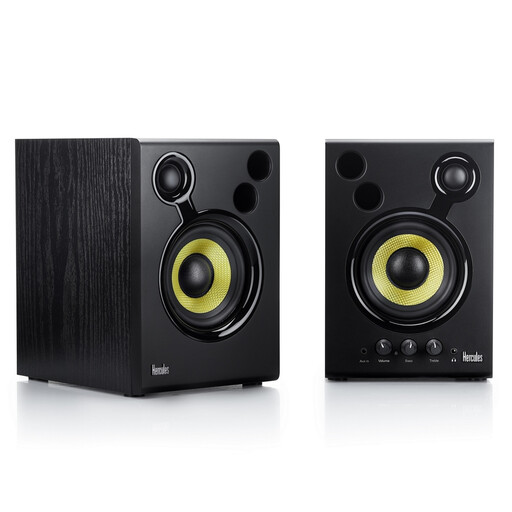
Hercules DJMonitor 42 Active Monitor, Black
Suited to a compact stereo workspace if you want to set up two speakers.
Leave at least 10 cm of clearance behind the bass ports.
View at Joybuy
Frequently asked questions
How should you position two monitors to assess panning?
Start with a symmetrical setup: point both monitors towards your listening position and keep the distances and height equal on the left and right. Genelec suggests an equilateral triangle as a starting point; then assess how the setup sounds in your room.
Should you buy a subwoofer straight away for a dance track?
No. First assess the placement and bass of your existing or planned stereo pair. A subwoofer also needs to be positioned and tuned; Genelec explains that its position in the room can affect how it sounds.
What buying and warranty rights apply to an online purchase in the Netherlands?
In many cases, online purchases from a business come with a 14-day cooling-off period, although exceptions may apply. If a product is faulty, you can also contact the seller. The Dutch government states that the Netherlands does not have a fixed statutory warranty period of two years.
How can you avoid listening too loudly through headphones during a quiet evening session?
Pay attention to both the listening volume and how long you listen, and take breaks. The WHO gives an average of 80 dB and a maximum of 40 hours per week as an example in its safe listening guidelines; this is health advice, not a legal volume limit for monitors.


