
Vandaag of morgen in huis

Kwaliteit gegarandeerd

Welkomstaanbiedingen ontgrendelen: GRATIS bezorging | Tot 80% korting | Gratis 30 dagen JoyPlus-proefperiode
Download de app
An EV charger for home may seem straightforward at first glance: plug it in and start charging. In practice, your electrical connection, your car’s onboard charger and the installation location all determine whether you make a suitable choice. A charging station that can technically handle more power will not automatically charge faster in your situation.
For Dutch owners of electric cars and plug-in hybrids, three common pitfalls are particularly important:
A 7 kW charging station generally operates on a single phase and delivers approximately 32 amps at 230 volts. An 11 kW EV charger usually uses three phases at around 16 amps per phase. A 22 kW EV charger often requires a more powerful three-phase connection.
Therefore, check:
A PHEV charger does not always need to be powerful. Many plug-in hybrids have a lower charging capacity and mainly benefit from a straightforward, reliable PHEV charger. A higher charging capacity on the wallbox will not make charging any faster.
A Type 2 EV charger uses the European IEC 62196-2 connection. There are two practical versions:
A fixed cable is convenient for everyday use. A detachable cable can be more practical if you use several vehicles or want to store the cable separately. Also consider the length. A 5-metre cable is often suitable for a garage or driveway, while 7 or 10 metres offers greater flexibility, although it may also be heavier and more difficult to store.
With a portable EV charger, the mains plug is at least as important as the vehicle connector. A Schuko plug works via a standard socket, but the available power and continuous load capacity are more limited. A CEE connection may be suitable for higher power levels, provided the installation has been designed for this.
Look out for features such as:
An IP65 or IP66 rating in the product description means that, according to the stated product specification, the housing offers protection against dust and water. This does not replace correct installation. Have a fixed wallbox charging station and its associated consumer unit checked and installed by a qualified installer. Also check the manual, CE information, warranty and responsible seller.
The recommendations below are based on verifiable specifications in the product information. Before buying, always check the current version, included accessories and compatibility with your car.
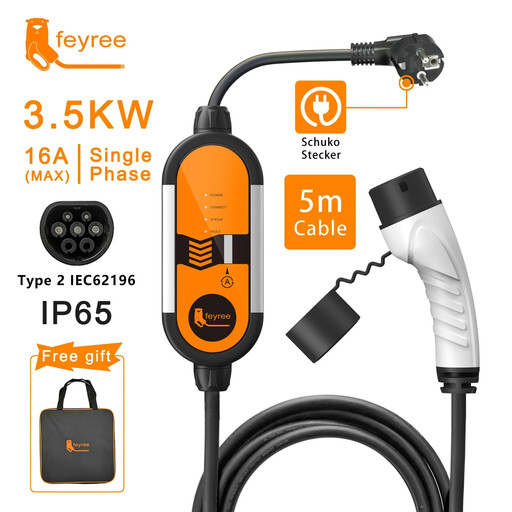
Why it suits this profile: This portable car charger works via a Schuko plug and is suitable for drivers who want to charge at home or at a family member’s property using a standard 230V socket.
The charging current can be set to 8A, 10A, 13A or 16A. This allows you to match the charging power to the available connection.
5-metre cable, OLED status display, IP65 rating according to the product information and a memory function for the selected charging current.
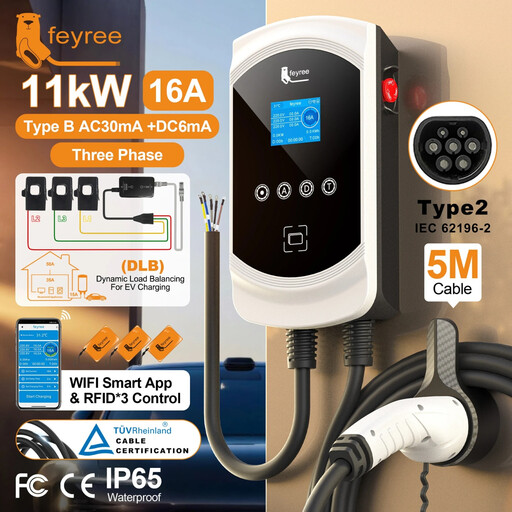
Why it suits this profile: For everyday home charging, this 11 kW wallbox is an interesting option if your home has a three-phase connection and you want to monitor charging status remotely.
The product description mentions dynamic load balancing, which adjusts the charging current according to the consumption of other appliances in the home.
Tuya app for monitoring and scheduling, adjustable charging current, LCD screen and a stated IP65 rating.
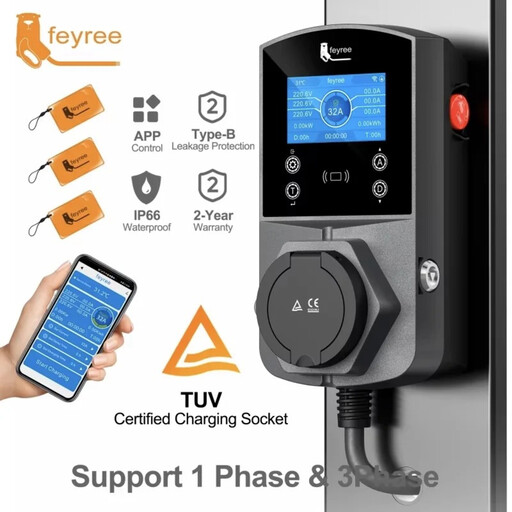
Why it suits this profile: This solution is intended for households with a suitable three-phase installation and a car that supports 22 kW AC charging.
The product information states support for 1.4 to 22 kW and adjustment to the electrical installation. However, check the connection and the car’s onboard charger in advance.
Wi-Fi and Bluetooth control, app-based scheduling, adjustable charging current and a stated IP66 rating.
We have put together a complete, up-to-date list of products that fully meet these strict selection criteria and the applicable European safety regulations.
No. A portable EV charger with a Schuko plug may be suitable for limited or occasional charging. For daily charging, a fixed wallbox is often more practical, especially if you want to use higher power, a fixed cable, scheduling or load balancing. Have the socket and circuit load checked before charging for extended periods at a high current.
For many vehicles, 11 kW is a practical middle ground, but the car must support three-phase AC charging. A model with a single-phase onboard charger can take in less power. Consult the vehicle manual and check the connection in the consumer unit.
The cost mainly depends on your electricity tariff, the number of kilowatt-hours charged and any charging losses. With an app and charging schedule, you can monitor your consumption more closely. A lower charging current may sometimes be appropriate when several appliances are using electricity at the same time, while dynamic load balancing helps distribute the available capacity within the configured limits.
