
Vandaag of morgen in huis

Kwaliteit gegarandeerd

Welkomstaanbiedingen ontgrendelen: GRATIS bezorging | Tot 80% korting | Gratis 30 dagen JoyPlus-proefperiode
Download de app
An EV charging station may seem simple at first glance: plug in and charge. In practice, the connection rating, charging power, cable type and installation determine whether an electric car charger is truly suitable for your situation. The wrong choice can result in slower charging, an overloaded circuit or a wallbox that never charges your car at the promised power.
A 22 kW EV charger will not automatically charge every car at 22 kW. The car must have a three-phase onboard charger, and your home must have a suitable three-phase connection. Many electric cars and plug-in hybrids also charge at a maximum of 3.7, 7 or 11 kW.
Always check:
A Type 2 EV charger compliant with IEC 62196-2 is suitable for many European electric cars and plug-in hybrids. However, this does not mean that every car supports the same power or charging function. Also check whether you need a cable. A wallbox with a Type 2 socket is not always supplied with a separate Type 2-to-Type 2 cable.
Also pay attention to the difference between:
Wi-Fi, an app and a timer can be useful for scheduling charging sessions. They do not reduce your costs automatically. The result depends on your energy contract, charging times, network connection and the car’s settings.
According to the product descriptions of various brands, apps can show details such as charging current, start time and charging status. Treat this as a control function, not as a guaranteed saving. Also check whether the app is compatible with your phone and Wi-Fi network.
A 7 kW charging station usually operates on a single phase and is a practical solution for many households. An 11 kW charging station generally uses three phases and may be suitable if your car supports this. A 22 kW model places greater demands on both the electrical installation and the car.
As a guide:
The actual charging time depends on the battery capacity, charge level, temperature and the car’s onboard charger.
Look for specifications such as overcurrent, overheating, overvoltage, undervoltage and residual current protection. An IP65 or IP66 rating refers to protection against dust and water according to the stated product classification, but it does not make an incorrect installation safe.
A fixed wallbox should preferably be installed by a qualified electrician. With a model featuring dynamic load balancing, the product description states that the available power is adjusted to account for the consumption of other appliances in the home. Check in advance that the function is actually supported, how it is connected and whether additional measuring equipment is required.
A 5-metre cable offers greater flexibility on a driveway or in a garage, but it also takes up more space. Check whether the cable can be used outdoors, whether the plug will remain dry and clean, and whether the parking space provides sufficient room.
A portable model is convenient when you are on the road. A CEE connection can provide more charging power than a standard Schuko socket, but you will need access to the correct socket and a suitable circuit.
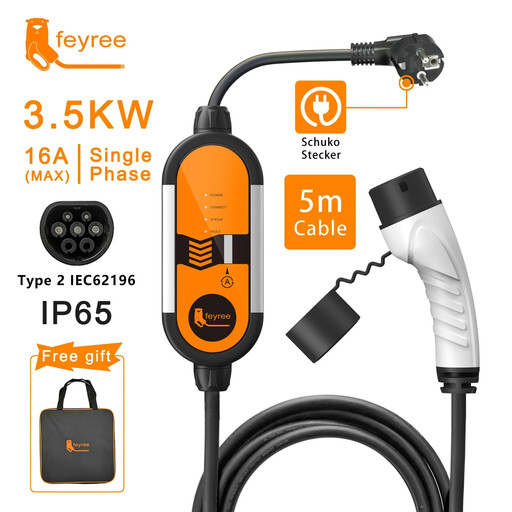
Why it suits this profile: This portable EV charger uses a Schuko plug, has a 5-metre cable and lets you set the charging current to 8A, 10A, 13A or 16A. That makes it suitable for slow charging at home or as a back-up solution on the road.
The maximum power is clearly specified as 3.5 kW. This reduces the risk of buying a higher charging capacity than your socket or car can use.
Type 2, adjustable current, OLED indication and IP65 rating stated in the product description.
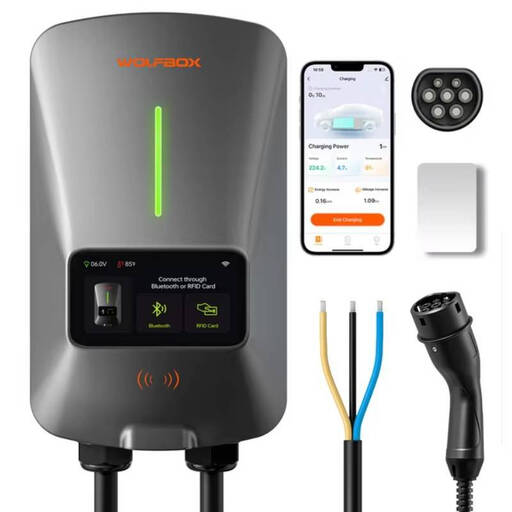
Why it suits this profile: This EV wallbox is designed for a fixed location and combines 7 kW, an LCD screen, Wi-Fi app control and RFID cards. This is practical for households that want to manage charging status and access.
The specification lists single phase, 32A and 7 kW separately. However, check that your car accepts 7 kW AC before ordering.
Type 2, LCD screen, app control and RFID access according to the product listing.
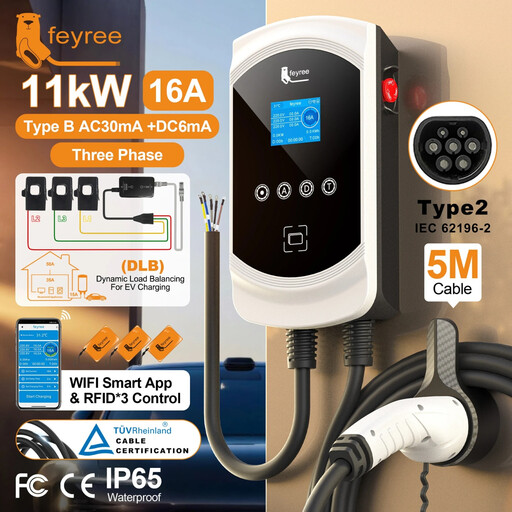
Why it suits this profile: This 11 kW charging station is designed for three-phase charging and lists dynamic load balancing, Wi-Fi app control, scheduling and an adjustable current from 8A to 16A.
The listing distinguishes between 11 kW, three-phase operation and adjustable current. Before buying, have a professional check that your home installation and onboard charger support this.
App functions, charging schedule, 2.8-inch colour display and stated Type B residual current protection.
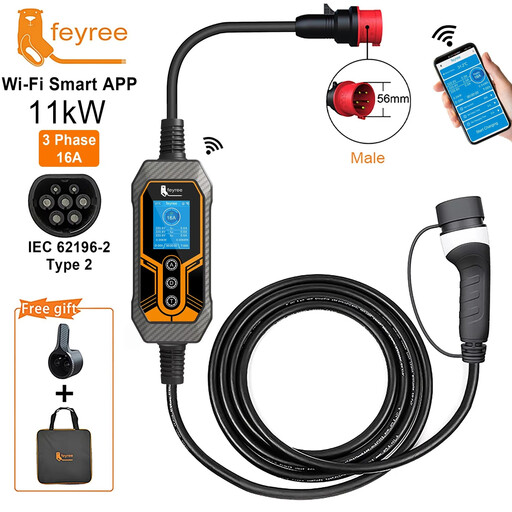
Why it suits this profile: This portable charger combines a CEE plug with a 5-metre cable, LCD screen, app control and adjustable charging current. It is ideal for users who charge at home and in different locations.
It is clearly a CEE model rather than a standard household-socket charger. Check in advance which type of connection is available at your charging locations.
Type 2, 11 kW, charging schedule, LCD screen and multiple protection functions according to the product description.
We have put together a complete, up-to-date list of products that fully meet these strict selection criteria and the applicable European safety regulations.
An EV driver needs more than a charging cable. A portable tyre inflator with a digital display can be useful when you want to check and adjust your tyre pressure on the road. According to the product description, the CARSUN New Wireless Tire Inflator operates wirelessly and has a built-in battery.
USB or 12V fans with adjustable airflow are useful on hot days. Pay attention to the mounting method, number of speed settings and available connection. A car jump starter can also serve as an emergency accessory; check the battery capacity, connections and IP rating, among other details. These accessories are not a substitute for maintenance and should not be left loose on the dashboard while driving.
With a fixed wallbox, a dedicated circuit is often part of a safe installation, particularly when charging continuously at 7, 11 or 22 kW. The exact requirements depend on the power, wiring, residual current protection and existing consumer unit. Have this assessed in advance by a qualified electrician.
Its lifespan depends on frequency of use, storage, temperature, cable loads and correct installation. Protect plugs from moisture and dirt, coil cables without sharp bends and follow the manufacturer’s maintenance instructions. A stated protection rating does not tell you everything about the product’s lifespan.
The cost is mainly determined by your electricity tariff and the number of kilowatt-hours your car uses. An app or charging schedule can help you charge at a preferred time, but the tariff ultimately determines the price. Compare your energy contract and check whether your car can charge automatically during set hours.
