
Espresso tonic maker
You want to make an espresso as the base, then add your own ice and tonic. A separate cold programme isn’t essential for this.


For espresso tonic, a fully automatic coffee machine with a standard espresso function is generally all you need: make the espresso separately, then add ice and tonic. Cold coffee programmes are mainly useful if you also want to make other iced coffees. Compare maintenance, size and the features you’ll actually use, too. Before buying, check the CE marking and product information for the exact model.
You want to make an espresso as the base, then add your own ice and tonic. A separate cold programme isn’t essential for this.
You want a quick afternoon break, so you’re thinking about more than just ease of use: cleaning and descaling matter, too.
You make other iced coffees as well as espresso tonic. In that case, extra cold recipes and personal settings may be worth considering; Philips lists these recipes for the 5500 Series.
A good fit if: you make the espresso separately and combine it with ice and tonic. Albert Heijn Allerhande describes a method where the espresso is cooled first.
Bear in mind: the machine doesn’t cool the drink itself; you add the ice and tonic separately.
A good fit if: you want to make other iced coffees as well as espresso tonic; Philips lists iced coffee recipes for the 5500 Series.
Bear in mind: an iced coffee programme won’t automatically make espresso tonic; tonic and ice are still separate ingredients.
A good fit if: you also want to make cold brew drinks with tonic. De’Longhi Coffee Lounge describes a separate method for this.
Bear in mind: cold brew is made differently from espresso tonic and isn’t needed when using standard espresso as the base.
| What to consider | What should you check? | Who might this matter to? |
|---|---|---|
| Espresso as the base | Check that the model makes espresso and whether you can adjust the volume. | If I want to decide the ratio of tonic myself, I look for an espresso function and an adjustable volume. Around 36% of consumers rank espresso as their top buying priority. |
| Cleaning and descaling | Check the manual to see which parts need cleaning and how to run the descaling programme. | I don’t want my short coffee break to involve a complicated maintenance routine. Around 29% of consumers prioritise ease of maintenance. |
| Size and controls | Check the dimensions, how easy it is to access the water tank and bean hopper, and how the espresso controls work. | If I have limited worktop space or want to make coffee quickly, size and ease of use are important. Around 21% of consumers give these their top priority. |
| Other cold coffees | Read the drinks list for the exact model and check how it distinguishes iced coffee, cold espresso and cold brew. | I want to make other cold coffees as well as espresso tonic, so the specific recipes matter more than the programme name alone. Around 14% of consumers prioritise having more cold options. |
An espresso tonic recipe combines espresso made separately with ice and tonic. Cold recipes on a machine don’t automatically make the same drink.
Check the drinks list for the exact model and first decide which other cold drinks you really want to make.
Extra programmes you don’t use won’t add a necessary step to this recipe.
Ease of use also depends on what you need to clean after making a drink and how to descale the machine according to the manufacturer’s instructions.
Before buying, read the manual for the exact model and check which parts need attention.
Cleaning and descaling take time and may require maintenance products; this varies by model and usage.
The Dutch government distinguishes between a manufacturer’s guarantee and your right to a product that meets the standard you’re entitled to expect.
Keep your proof of purchase and contact the retailer if the product is faulty.
The features mentioned apply to the specific models and versions below; they aren’t a judgement on every product from each brand.
The 2300 version EP2333/40 and 5500 version EP5544/50 show how features vary between series and models.
The Magnifica Start ECAM220.20.W is an example of a fully automatic coffee machine with an espresso function.
According to Melitta, the Solo & Milk is a fully automatic coffee machine with a manual milk-frothing option.
According to KRUPS, the Essential EA815070 is a fully automatic coffee machine with espresso, adjustable grind settings and a steam wand.
According to Siemens, the EQ6 plus s500 TE655203RW makes espresso and milk-based drinks.
These picks range from a fully automatic coffee machine for espresso to a version with iced coffee recipes. For espresso tonic, add the ice and tonic separately. Before buying, check the CE marking and product information for the exact model.
 Image unavailable
A good fit if you make espresso as the base and add the ice and tonic yourself.
The product name mentions a Pannarello steam wand, One-Touch Brewing and the Matt Black finish.
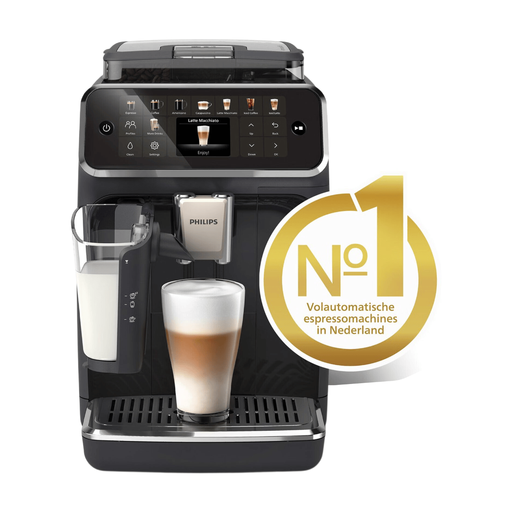 Image unavailable
A good fit if you want to make other iced coffees as well as espresso tonic; add the ice and tonic separately.
The product name mentions 20 drinks, a ceramic grinder, 12 grind settings, AquaClean and a 1,8-litre tank.
No, not if you make the espresso separately and combine it with ice and tonic. A cold programme can be useful if you also want to make other cold coffee drinks, but tonic remains a separate ingredient.
No. Add the tonic to the glass when making espresso tonic. Only put the liquid specified in your model’s manual in the water tank.
Follow the cleaning and descaling instructions in the manual for the exact model. Melitta explains that limescale can affect the water flow and coffee flavour; the steps required may vary from machine to machine.
No. According to the Dutch government, the Netherlands has no fixed statutory guarantee period: you’re entitled to a product that works properly for as long as you can reasonably expect it to. If a product is faulty, contact the retailer; the manufacturer’s guarantee is separate from this.
According to the Netherlands Food and Consumer Product Safety Authority, CE marking is compulsory for electrical products covered by the relevant EU rules. Check the marking and product information for the exact version. The European Union explains that manufacturers use the CE marking to indicate that a product meets the applicable EU requirements; it isn’t a judgement on taste or quality.