
Host serving several latte orders
You want to serve guests without having to prepare espresso and milk by hand for every drink. Focus on milk programmes, ease of use and cleaning between drinks and afterwards.


If you’re making several lattes in a row, a fully automatic machine with a suitable milk function is a sensible choice if you want to keep the steps for each drink to a minimum. A portafilter machine is a better fit if you want to control the espresso and milk texture yourself. For occasional use, a capsule machine with a milk function may be appealing if ease of use and limited space matter more than the ongoing cost of capsules. Check the CE marking on every electrical model: according to the Netherlands Food and Consumer Product Safety Authority, it is compulsory for electrical products.
You want to serve guests without having to prepare espresso and milk by hand for every drink. Focus on milk programmes, ease of use and cleaning between drinks and afterwards.
You want to control the espresso and milk texture yourself, and have time during the meal for the extra steps and practice.
You want to make a latte easily, even if you don’t use the machine often, and weigh up the space it needs against the ongoing cost of coffee or capsules.
First decide how much you want to do yourself while serving: automatic milk frothing, manual preparation and capsules each involve different trade-offs.
A good fit if: you want to make several lattes during the meal with minimal manual steps.
Bear in mind: milk components need cleaning after use. Also check whether the exact model has a latte programme.
A good fit if: you want to grind the beans, make the espresso and froth the milk yourself.
Bear in mind: frothing milk by hand takes practice, and cleaning the components after use takes extra time.
A good fit if: you make lattes occasionally and value ease of use or limited worktop space.
Bear in mind: according to the Consumers’ Association, capsules cost more than loose coffee, and capsule systems are not interchangeable.
| Consideration | What should you check? | Who is this most relevant to? |
|---|---|---|
| Serving several milk-based drinks | Check whether the exact model has a latte programme and whether any two-cup function also applies to milk-based drinks. | If I’m serving several guests, I don’t want to spend ages making espresso and milk by hand for every latte. For around 33% of consumers, serving several guests quickly is the main reason to buy. |
| Milk system and cleaning | Check which components can be removed, what steps the manual recommends after use, and whether any parts are dishwasher-safe. | If I’m making milk-based drinks repeatedly during the meal, I want to know how much cleaning the system will need afterwards. For around 27% of consumers, cleaning the milk system is the top priority. |
| Preparing espresso and milk yourself | Decide whether you want to grind the beans, tamp the coffee and steam the milk yourself, or would rather choose a drink from a menu. | If I want to control the preparation myself, I’d rather accept extra steps than have the machine automate everything. For around 20% of consumers, this hands-on control is the main consideration. |
| Costs over time | Compare the machine and the compatible coffee or capsules with how often you expect to use it. Remember to factor in cleaning and descaling, too. | If I’ll keep using the machine after the celebratory meal, I want to know what ongoing costs to expect. For around 20% of consumers, the purchase price and running costs matter most. |
A two-cup function may only work for black coffee or espresso. As a result, serving several guests could take longer than you expect.
Check the manual or model specifications to see explicitly whether the function also makes two milk-based drinks.
When you have several orders, waiting for the next drink to be made can add time at the table.
A programme won’t necessarily take care of all the cleaning required for the milk components and other parts of the machine.
Check the cleaning steps for the exact model beforehand, and follow the manual after use.
Compatible capsules are an ongoing cost. What’s more, capsule systems aren’t necessarily interchangeable.
Compare the capsules for your chosen system with loose coffee, and consider how often you’ll use the machine after the meal.
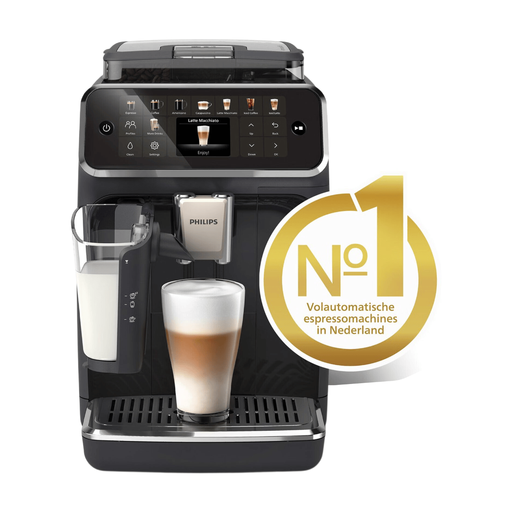
The fully automatic 5500 LatteGo range is worth considering if you want to make milk-based drinks by selecting a recipe.
The Magnifica Evo ECAM290.61.SB is a fully automatic option for anyone who wants to make milk-based drinks with minimal manual steps.
The Barista Express Impress is a portafilter option for anyone who wants to grind beans and steam milk themselves.
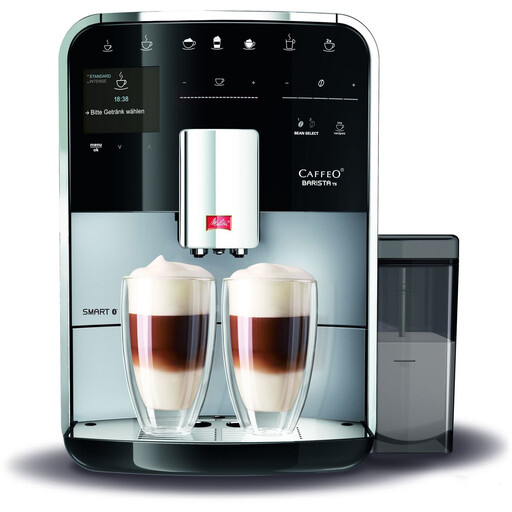
The Barista TS Smart is worth considering if you want to compare different beans and personalised drink settings.
The Lattissima One offers a capsule machine with an integrated milk function, for anyone who doesn’t make milk-based drinks often.
These fully automatic machines have an automatic milk function, making them suitable if you want to prepare lattes or other milk-based drinks during a meal with minimal manual steps. Before buying, check the CE marking on the exact version: the Netherlands Food and Consumer Product Safety Authority states that it is compulsory for electrical products.
 No image available
One to compare if you want to choose lattes from a menu and keep hands-on milk preparation to a minimum.
Philips lists a LatteGo system and 20 recipes, including lattes, for the EP5541/50. The product name also mentions a ceramic grinder, 12 settings, AquaClean and a 1,8 l tank.
 No image available
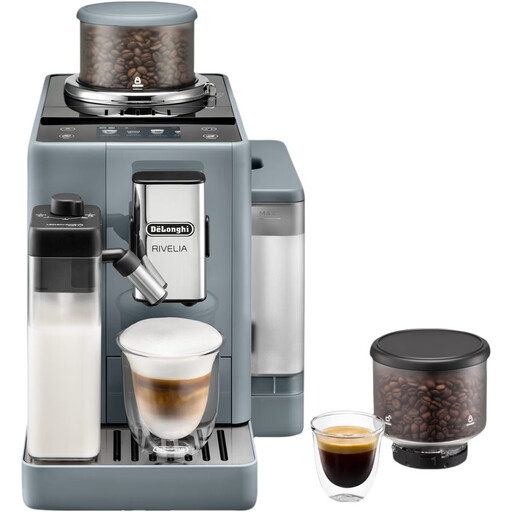
A fully automatic model to compare if you want to make milk-based drinks with minimal manual steps.
The product name mentions a LatteCrema Hot milk frother and a Bean Switch System.
 No image available
One to compare if you want to make a milk-based drink using an automatic function.
De'Longhi lists five one-touch drinks for the ECAM290.61.SB, including MyLatte and cappuccino. The product name also mentions a milk frother and touchscreen.
 No image available
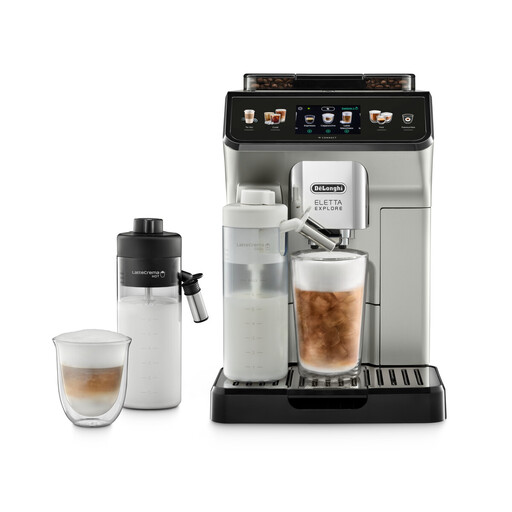
A fully automatic option to compare if you want to explore different drink recipes for guests.
The product name mentions a LatteCrema system and 13 drinks.
 No image available
One to compare if you want to explore different coffee recipes for guests.
Melitta lists two bean hoppers and adjustable recipes for the Barista TS Smart. Check the model name and the milk function you want on the exact version.
No. Don’t assume that from the ‘two cups’ label alone. Check whether the specifications for the exact version say the function also works for milk-based drinks. Melitta states that the Barista TS Smart has a Double Cup function for many coffee specialities, with or without milk.
Put any unused milk back in the fridge and clean the milk components as instructed in the manual. The Netherlands Nutrition Centre advises that perishable products such as milk should not be left out of the fridge for more than two hours. An automatic cleaning programme doesn’t rule out the need for additional cleaning.
A paid extended warranty is not the same as your statutory rights if a product is faulty. The Dutch government states that there is no fixed two-year statutory warranty period in the Netherlands, and that the seller must provide a solution if there’s a problem with a product. Check separately what extra cover a paid plan offers.
According to the Netherlands Food and Consumer Product Safety Authority, CE marking is compulsory for electrical products. Check the marking on the exact version you’re considering; the general product rule doesn’t confirm that a specific model or offer complies.