What should you look for when choosing?
Start by considering how you’ll switch between regular coffee and decaf. Then decide how much control you want over the milk texture and which steps are practical for your workshop.
| What to consider |
What should you check? |
Who should give this more weight? |
| Decaf for each order |
Check whether ground coffee, the right capsules or a model-specific bean changeover process suits the way you plan to switch. |
If participants order regular coffee and decaf in any combination, you’ll want to choose the coffee for each cup. Around 36% of consumers prioritise being able to switch reliably between the two. |
| Milk texture |
Check whether the machine has a steam wand, an automatic milk function or no built-in milk preparation at all. |
If you want to demonstrate how to make a thin layer of microfoam yourself, the level of manual control matters. Around 29% of consumers put milk texture at the top of their list. |
| Making several drinks in a row |
Go through the steps for coffee, milk, refilling and cleaning for the number of participants you expect. |
If you’re serving several participants one after another, you’ll want the whole process to be manageable, not just the preparation of a single espresso. Around 21% of consumers prioritise speed and cleaning between drinks. |
| What you need to use the machine |
Check what milk preparation, coffee input and maintenance steps are needed for your chosen set-up. |
If you want to know in advance everything your set-up requires for coffee, milk and maintenance, look beyond the machine itself. Around 14% of consumers prioritise the overall requirements for using the machine. |
Joybuy products for the workshop
These fully automatic models offer different options for ground coffee, beans and milk preparation. Check how each model works to see whether it suits your decaf orders.
 No image available
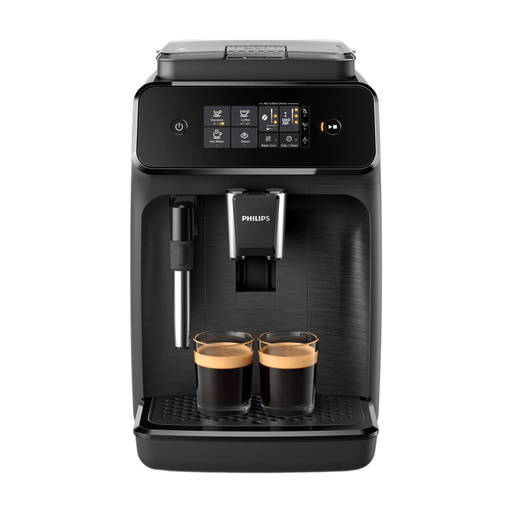
Philips 1200 Series EP1220/00
A good fit if you want the machine to grind coffee beans for each cup and froth the milk yourself during the workshop.
The product name mentions a Pannarello steam wand. The product description lists adjustable coffee strength and volume.
View at Joybuy
 No image available
De’Longhi Rivelia EXAM440.55.G, Pebble Grey
A good fit if you want to combine automatic milk preparation with options for switching between types of coffee.
The product name mentions LatteCrema Hot and the Bean Switch System; the product description lists two interchangeable bean hoppers and a ground coffee input.
Switching beans doesn’t guarantee that the next cup will be completely decaf. Follow the changeover instructions for this model.
View at Joybuy
 No image available
De’Longhi Magnifica Evo ECAM290.61.SB
A good fit if you want to add ground coffee for each drink and have the machine prepare the milk automatically.
The product description lists a LatteCrema Hot milk system, a removable milk container and the ability to make two espressos at once.
Automatic milk preparation doesn’t give you the same direct control over foam texture as a manual steam wand.
View at Joybuy
Frequently asked questions
Can you simply choose a cappuccino programme for a flat white?
Not necessarily. Nespresso describes a flat white as espresso with steamed milk and a thin layer of microfoam, whereas a cappuccino has thicker foam. Check whether you can adjust the amount of coffee and milk, or the foam texture, to suit the drink you want to make.
Is decaf completely caffeine-free?
No. Nespresso describes decaffeinated coffee as containing very little caffeine, not as having a guaranteed zero caffeine content. So don’t promise participants that it contains no caffeine at all.
How should you store milk during the workshop?
Follow the label instructions for milk that needs to be kept chilled, and put it back in the fridge as soon as possible after use. The Voedingscentrum recommends 4 °C as the ideal fridge temperature. Clean the milk system according to the machine’s instructions.
What Dutch regulations apply if you sell or supply flat whites to workshop customers?
According to the NVWA, if you sell food or drink to customers, you must comply with food safety regulations and work with a food safety plan or hygiene code. If you sell or supply unpackaged drinks, you must tell customers about relevant allergens, including milk. These requirements don’t automatically apply to a workshop attended solely by private individuals.
Does a two-year manufacturer’s warranty cover your full statutory warranty rights in the Netherlands?
No. According to the Dutch government, the Netherlands has no fixed statutory warranty period: you’re entitled to a product that works as it should, and the retailer is your point of contact if there’s a problem. A manufacturer’s warranty or an additional warranty is on top of those rights.


