Measure not only the space for the machine, but also the room you need to refill the water, froth soya drink and clean the machine. A slim espresso machine with a steam wand requires some manual work; a bean-to-cup machine takes care of more preparation steps, while a capsule machine offers a different way to prepare your coffee and milk. Barista-style soya drink can be a good starting point, but the froth you get depends on the drink, machine and method you use.
Who is this choice relevant to?
Cook with limited worktop space
You want to make your own soya cappuccino, but need to fit both the machine and the steps involved into a small space. The Consumers’ Association describes different ways to froth milk, while De’Longhi publishes its machine dimensions.
Soya cappuccino drinker
Your main priority is having a practical way to froth soya drink, and you want to know how much control you’ll have. The Consumers’ Association discusses plant-based barista drinks, while manufacturers describe the milk functions of their own models.
Convenience-focused coffee drinker
You want to keep the steps involved in making each cappuccino to a minimum, while weighing this against cleaning, space and coffee costs. The Consumers’ Association describes different espresso systems and what to consider when it comes to maintenance and running costs.
What should you look for when choosing?
Slim espresso machine with a steam wand
A good fit if: width is your main constraint and you want to prepare the espresso and soya drink yourself.
The trade-off: frothing takes practice, and you’ll need to clean the machine after use.
Bean-to-cup machine with a milk system
A good fit if: you regularly want to make a cappuccino with minimal effort and have room for the machine and milk components.
The trade-off: the milk system and brew group still need maintenance; a manufacturer’s claim doesn’t prove how your soya drink will froth.
Capsule machine with a milk function
A good fit if: easy espresso preparation with capsules matters more to you than using beans or ground coffee.
The trade-off: capsules mean ongoing coffee costs, while a separate frother needs extra storage space.
| What to consider |
What should you check? |
Who is this important for? |
| Total space required |
Measure the width, depth and height. Also check that you can access the reservoir and other components, and have room to prepare the milk. |
I want to make a soya cappuccino without the machine or milk jug taking over my limited worktop. Around 29% of consumers give space their highest priority. |
| Frothing soya drink |
Check the milk function on the exact model and, if possible, try the soya drink you normally use. A barista-style version is a practical starting point. |
If getting the right froth with my own soya drink matters most, I want to be able to assess the combination I’ve chosen first. Around 29% of consumers put frothing at the top of their list. |
| Preparation and cleaning |
Check which milk components can be removed, how to clean them and what maintenance steps the manual recommends. |
I want to keep the steps to a minimum on an ordinary day, but also know how much cleaning the milk function involves afterwards. Around 24% of consumers prioritise ease of preparation. |
| Running costs |
Compare the cost of coffee, capsules and model-specific maintenance products based on how often you use the machine. |
If I use the machine regularly, I want to take ongoing coffee costs into account as well as the purchase price. Around 18% of consumers consider running costs their top priority. |
How to avoid common buying mistakes
-
Comparing only the width of the machine
A slim casing doesn’t tell you whether you can reach the reservoir or have room to froth milk beside the machine.
Measure the whole space and think through how you’ll make a single cappuccino before choosing a model.
A milk jug or separate frother may need extra worktop or storage space.
-
Assuming a cappuccino recipe proves it will froth soya drink
A milk function and a good result with your soya drink are two different things.
Check the milk function on the exact model and, if possible, try the soya drink you use. The Consumers’ Association suggests a barista-style version as an option, not a guarantee for every machine.
-
Looking only at the purchase price
Coffee and maintenance costs count too, and how much they add depends on how you use the machine.
Compare the options based on how many cups you make and what your chosen model needs. The Consumers’ Association points out that coffee costs form part of the total cost.
Capsules, coffee, filters and descaling products can all mean ongoing expenses.
Relevant brands to consider
De’Longhi
Dedica espresso machines are worth considering if a slim machine with a steam wand suits you better than a larger automatic milk system.
- De’Longhi lists the dimensions of the EC685.M EX:4 as 149 × 330 × 305 mm and describes it as having an adjustable Cappuccino System.
- You froth the milk manually, and the listed dimensions don’t tell you what results you’ll get with your soya drink.
Philips
The EP2333/40 with LatteGo is an option if you want bean-to-cup cappuccinos with fewer preparation steps.
- Philips says LatteGo can froth plant-based milk alternatives. The manufacturer says the system has two parts and no tubes.
- This is a manufacturer’s claim, not an independent test using your soya drink. Check that the machine and milk container will fit in your available space.
Nespresso
The Original capsule range includes the Creatista Plus with an automatic steam wand; a model without a milk function will need a separate frother.
- Nespresso lists the Creatista Plus dimensions as 17 × 30,8 × 39,3 cm. According to Nespresso, the Aeroccino 4 has a diameter of 10,4 cm.
- If you choose a separate frother, allow for storage space too, and check the froth using your own soya drink.
Krups
The Mini Maestro Hot&Cold XP350DE0 is a manual option for anyone mainly looking for a slim casing.
- Krups lists this model as 12 cm wide and says it has a steam wand.
- Also check the required depth, height and working space. The listed width alone doesn’t tell you how much room the full setup needs.
Joybuy product picks
These picks include manual frothing with a steam wand and automatic frothing with a milk system. Check that the controls and dimensions of each model suit your space; a listed milk function doesn’t guarantee a particular result with every soya drink.
 No image available
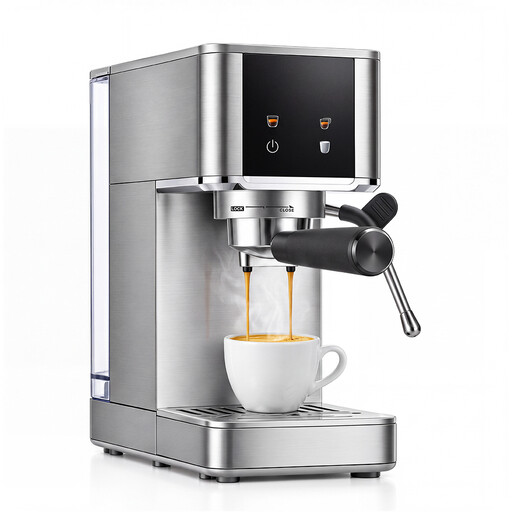
ochama Semi-Automatic 2-in-1 Espresso & Capsule Coffee Machine
The combination of espresso brewing and an integrated steam wand is a good fit if you want to froth milk yourself.
The product name lists 15 Bar Pressure, a removable 1,4 L water reservoir, touch controls and a visible display. Manual frothing means you’ll need to do it yourself.
Joybuy
 No image available
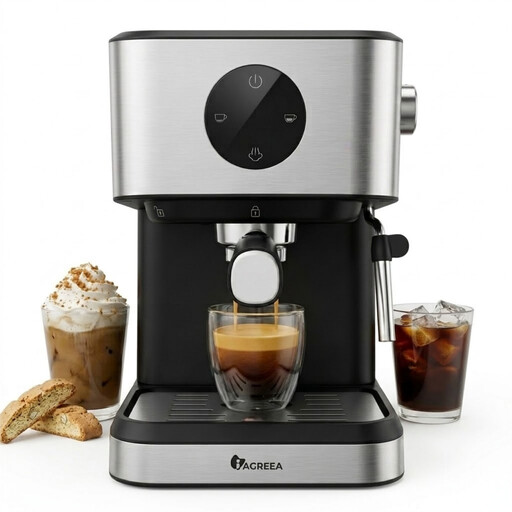
IAGREEA Espresso Machine
A manual steam wand is designed for anyone who wants to prepare the milk themselves. Check that the listed dimensions fit your available space.
The product name lists 20 Bar, a 50 Oz water reservoir, stainless steel and a cup warmer. The product details give the dimensions as 11,9 × 11,2 × 5,1 inch. The steam wand needs cleaning after use.
Joybuy
 No image available
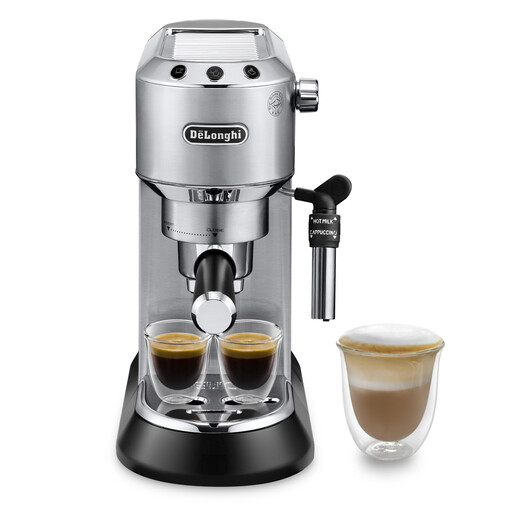
De’Longhi Dedica EC685, metal
The manual milk frother is a good fit if you want to use a steam wand yourself; remember to measure the space you’ll need to operate and clean the machine too.
The product details list a width of 14,90 cm and say it can be used with ground coffee and E.S.E. pods. Milk is frothed manually.
Joybuy
 No image available
Philips 5500 Series EP5547/90 LatteGo
Automatic frothing could suit you if you want fewer steps when making a cappuccino. Check that you have room for the machine and milk system.
The product description says LatteGo can froth plant-based milks. This is a product claim, not a guarantee of how it will perform with your soya drink.
Joybuy
 No image available
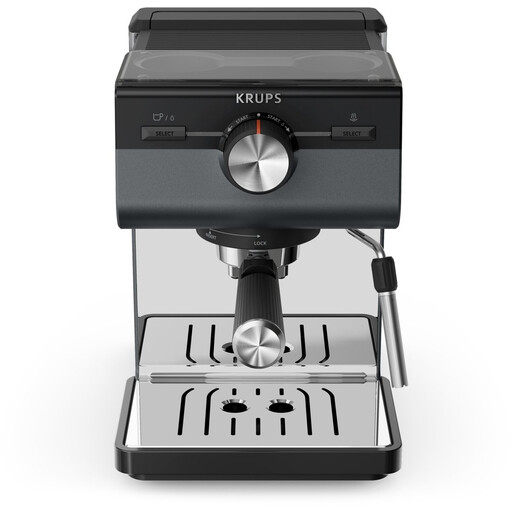
Krups Authentic+ C40 XP384G
This espresso machine is a good fit if you want to control the preparation yourself and use the steam wand to froth milk.
The product details list compatibility with fresh or pre-ground coffee and a removable water reservoir. The steam wand requires you to froth the milk manually and clean it after use.
Joybuy
Frequently asked questions
Can any espresso machine automatically make a soya cappuccino?
No. Check whether the machine has a milk function or whether you’ll need a separate frother. The Consumers’ Association suggests barista-style soya drink as an option for frothing. Philips says the LatteGo system on the EP2333/40 can froth plant-based milk alternatives; neither statement guarantees the same result with every soya drink.
What should I consider when placing a machine under a kitchen cupboard?
Measure the whole machine and check how you’ll access the reservoir, coffee and milk components on the model you’ve chosen. The width alone won’t tell you whether you can use and maintain the machine easily in that spot.
How do I maintain the milk function after making a soya cappuccino?
Remove any milk residue after use and follow the cleaning instructions for your specific model. Clean the other components too, and descale the machine according to its instructions. The process varies from one machine to another.
Is a manufacturer’s warranty the same as my statutory warranty in the Netherlands?
No. According to the Government of the Netherlands, you’re entitled to a product that works as it should, and should contact the seller if there’s a problem. There is no fixed statutory warranty period in the Netherlands; a manufacturer’s warranty is additional.
Do I have a cooling-off period when shopping online in the Netherlands?
According to the Government of the Netherlands, online purchases from a business usually come with a 14-day cooling-off period. Check the terms of your specific purchase, as the same rules don’t apply to every transaction.


