
Home barista who enjoys small milk drinks
You want to control the espresso and milk texture yourself, and don’t mind the extra steps involved in using a steam wand. De’Longhi and Sage describe options for manual milk preparation on specific models.


A portafilter machine is a good choice if you want to control the espresso and milk texture yourself. A fully automatic or capsule machine may be more appealing if ease of use is your priority. Also consider how you’ll prepare the milk separately, whether you have room for the whole set-up and how much cleaning is involved after use. Check the product requirements for the specific model and whether it carries the required CE marking: this marking is not an independent quality seal.
You want to control the espresso and milk texture yourself, and don’t mind the extra steps involved in using a steam wand. De’Longhi and Sage describe options for manual milk preparation on specific models.
You’re looking for a simple machine for one or two people and comparing capsule and portafilter machines. With a capsule machine that has no milk system, preparing the milk is a separate step; De’Longhi describes the EN85.R as a version without a built-in milk system.
You want to make other types of coffee from beans as well as small milk drinks, and are factoring the maintenance of a fully automatic machine into your choice. Philips describes the EP2220/10 as a bean-to-cup machine with a classic steam milk frother.
Best for: anyone who wants to control the espresso and milk texture themselves and is happy to take the extra preparation steps.
Bear in mind: you’ll need to froth the milk manually and clean the steam wand. Also check whether you’ll need ground coffee or a grinder.
Best for: anyone who wants to make espresso with a portafilter but prefers a less hands-on approach to preparing the milk. Sage lists three temperature and three texture settings for the Bambino Plus.
Bear in mind: making espresso still involves using the portafilter, and automatic frothing doesn’t eliminate the need to clean the machine.
Best for: a household that also drinks other types of bean-to-cup coffee and wants to make espresso with fewer separate steps.
Bear in mind: with the Philips EP2220/10, you still need to froth the milk separately. Check that the coffee volume suits your small glass.
Best for: anyone looking for a compact machine for simple espresso and happy to prepare the milk separately.
Bear in mind: a capsule machine without a milk system needs a separate way to prepare the milk. According to Consumentenbond, capsules cost more per cup than beans; a separate frother won’t automatically create the same milk texture as a steam wand.
| What to consider | What to look for when buying | Who this matters to |
|---|---|---|
| Milk texture and small servings | Check the settings for espresso volume and milk texture, the usable milk portion and the cleaning instructions. | I want to choose how much espresso and milk goes into my small glass. Around 33% of consumers prioritise milk texture. |
| Ease of use | Look at the steps involved in preparing both the espresso and the milk; a coffee button may not make the complete milk drink. | When making one or two cups, I want as few separate steps as possible. Around 27% of consumers prioritise convenience when making coffee. |
| Worktop space | Measure the width and depth, and leave room to refill the water, prepare the milk and, if needed, use a separate grinder. | I want to know whether the whole set-up will fit, not just the coffee machine. Around 20% of consumers prioritise worktop space. |
| Running costs and maintenance | Compare the cost of coffee, any extra equipment and maintenance for the same number of cups, without assuming you’ll save money. | If I use the machine regularly, I also want to factor in the ongoing cost of coffee and maintenance. Around 20% of consumers prioritise these costs and maintenance. |
Capsules can cost more per cup than beans, and a machine without a milk system needs a separate way to prepare the milk.
Compare costs based on the number of cups you make and include the milk preparation you’ll need.
A separate milk frother also takes up extra space on your worktop.
The Philips EP2220/10 has a classic steam milk frother, so preparing the milk is a separate step.
Check how you make the espresso and froth the milk separately, rather than relying on the product category alone.
Allow time for frothing the milk manually and cleaning the milk system.
Even a compact machine may need space for a grinder, milk frother or the steps involved in using a portafilter.
Plan the space for the whole set-up before choosing a machine, including room for preparing the milk.
These examples from De’Longhi include both a slim portafilter machine and a compact capsule machine.
The Bambino models sold in the Netherlands are portafilter machines for anyone who wants to make espresso with a portafilter and choose how to prepare the milk.
In this example, the EP2220/10 combines a bean grinder with a classic milk frother.
The Original system includes capsule machines such as the Essenza Mini, as well as separate Aeroccino milk frothers.
The EQ6 plus TE658209RW is an example of a more advanced fully automatic model with milk drinks.
This selection includes portafilter machines, capsule machines and fully automatic machines. Compare how each model prepares espresso and milk, the space available and the maintenance involved.
 No image available
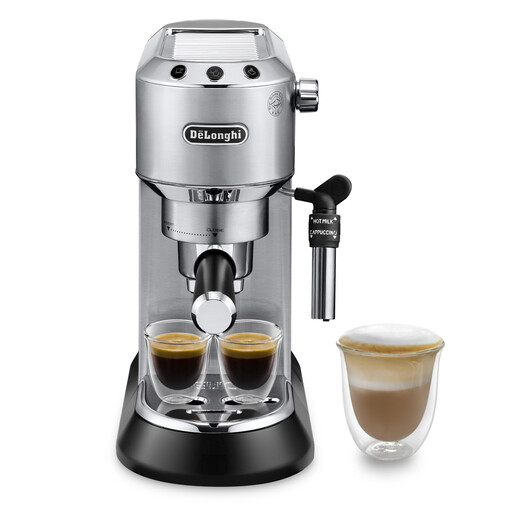
A portafilter machine to consider if you want to prepare the espresso and milk manually; the product name mentions a manual milk frother and a slim design.
The product name lists 15 bar pressure. Measure the space available and bear in mind that you’ll need to prepare the milk separately.
 No image available
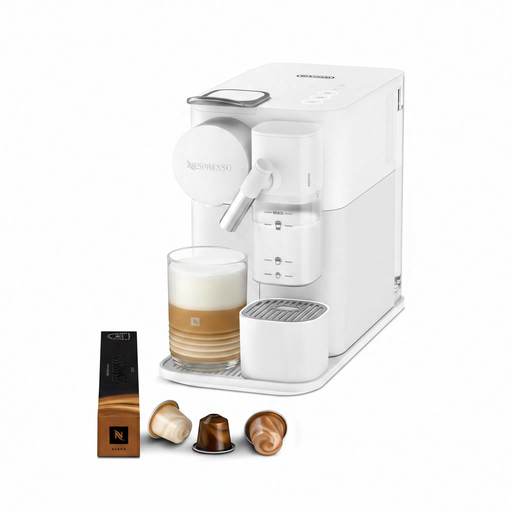
A capsule machine to consider if you want to make espresso and milk drinks with few separate steps; the product name mentions latte and cappuccino preparation.
Check what milk preparation steps are involved for the small serving you want, and how to fill and clean the milk jug according to the instructions.
 No image available
A fully automatic option to consider if you want to combine bean-to-cup coffee with milk drinks.
Check whether you can adjust the coffee and milk volumes to suit your small glass, and what cleaning the milk system requires.
 No image available
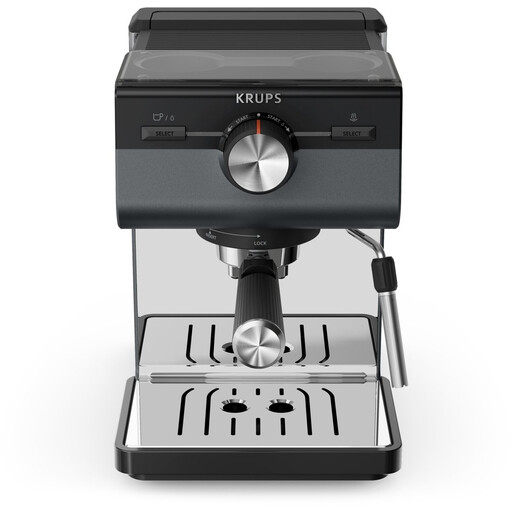
A portafilter machine to consider if you want to make espresso and froth the milk separately; the product name describes a portafilter espresso machine with a milk frother.
Check the steps involved in making a single small serving and remember to clean the milk system after use.
 No image available
A fully automatic machine to consider if you want to combine bean-to-cup coffee with milk drinks.
The product name mentions a milk frother and touchscreen. Check whether you can adjust it to make the small serving you want, and how to clean the milk system and brew group.
No, not necessarily. Choose a way to prepare espresso and milk in the small serving you want. Check separately whether you can adjust the coffee and milk volumes; a milk drink programme won’t necessarily suit every glass.
Follow the instructions for your specific model. Philips says the brew group of the EP2220/10 needs regular cleaning; Siemens requires the EQ6 plus milk system to be cleaned after every use.
For products covered by harmonised EU rules that require it, the manufacturer uses the CE marking to declare that the applicable requirements have been met. According to Your Europe, CE is not a certificate issued by a central EU body. Check which product requirements apply to the specific model.
No. According to the Dutch government, there is no fixed statutory guarantee period in the Netherlands; a product must last as long as you can reasonably expect it to. If a product is faulty, the retailer is your point of contact. A manufacturer’s warranty may be offered in addition to this.