
If you often drink coffee with milk
You want to make lattes regularly with few manual brewing steps and are happy to clean the milk components.


Choose based on how you want to prepare your espresso and milk: a bean-to-cup machine is designed to keep effort to a minimum, a capsule machine may suit a compact routine, while a traditional espresso machine gives you more control. Also compare which milk components you’ll need to clean and how much space the exact model takes up. For a caramel flavour, you can add syrup to your cup; you don’t need a special caramel programme.
You want to make lattes regularly with few manual brewing steps and are happy to clean the milk components.
You’re looking for a simple, compact setup. If you choose a capsule machine, check separately whether it can prepare milk and which capsule system it uses.
You want control over the espresso and milk froth, and don’t mind the extra steps involved in brewing and cleaning.
A good fit if: you regularly make coffee with milk and want to keep the number of steps to a minimum while brewing.
Bear in mind: the milk components still need cleaning; check the features of the exact model.
A good fit if: you want a simple routine and don’t make coffee often.
Bear in mind: capsule systems aren’t interchangeable, and a milk frother isn’t always included.
A good fit if: you want to prepare the espresso and texture the milk yourself.
Bear in mind: grinding, dosing and frothing can take extra time and space.
| What to consider | What to look for | Who might value this most? |
|---|---|---|
| Convenience when preparing milk | Check which milk-based drinks the exact model makes and how its milk components are cleaned. | If I often make lattes and want as few steps as possible, automatic milk preparation appeals to me. Around 37% of consumers also put convenience first. |
| Space and how often you use it | Compare the model’s dimensions with the available space and check whether a milk frother is included. | For a small worktop and occasional coffee-making, I want a simple setup. Around 27% of consumers prioritise limited space and occasional use. |
| Coffee type and consumption | Check whether you’re choosing capsules or coffee beans, and consider how many cups you make as well as any maintenance supplies you may need. | If I mainly want to know how well the machine suits the number of cups I make, I consider how often I use it and how much coffee I need. Around 18% of consumers focus on this balance. |
| Taking control of the preparation | Consider whether you want to grind, dose and froth the milk yourself; also check whether the grinder is built in. | I want to control the espresso and milk froth myself, and I don’t mind doing extra work to make each drink. Around 18% of consumers choose a machine mainly for that hands-on control. |
An espresso button doesn’t automatically mean the machine can prepare milk for a latte. Machines vary in their milk functions and how they’re operated.
Check the milk function for the full model number, and make sure any separate frother will fit into your setup.
The Consumentenbond describes Nespresso Original, Nespresso Vertuo and Dolce Gusto as different systems. An Original capsule won’t fit a Vertuo or Dolce Gusto machine.
Check the system name on the machine and on the capsule packaging.
Milk residue needs to be removed, and cleaning and descaling steps vary from one machine to another.
Before buying, check the cleaning instructions for the exact model and follow the manual.
If you froth milk manually, the steam wand also needs attention after use.
The Philips EP2333/40 combines bean-to-cup coffee with automatic LatteGo milk preparation. Philips positions it as a good choice for anyone looking for convenience when making coffee with milk.
The Dutch Dedica range includes compact traditional espresso machines with a steam wand for anyone who wants to froth milk themselves.
The Creatista Plus uses Original capsules and, according to Nespresso, prepares milk automatically using a steam wand.
Sage describes the Barista Express as a traditional espresso machine with a grinder, portafilter and manual steam wand.
Siemens says the EQ300 TF301E09 makes latte macchiato and cappuccino at the touch of a button.
This selection includes traditional espresso machines with a steam wand, a capsule machine and bean-to-cup machines with automatic milk preparation.
 Image unavailable
A good fit if you want to make espresso and froth milk with a steam wand yourself; this involves steps during and after preparation.
The product name lists a pressure gauge, cup warmer, single and double shots, and a removable 1.1 l water tank.
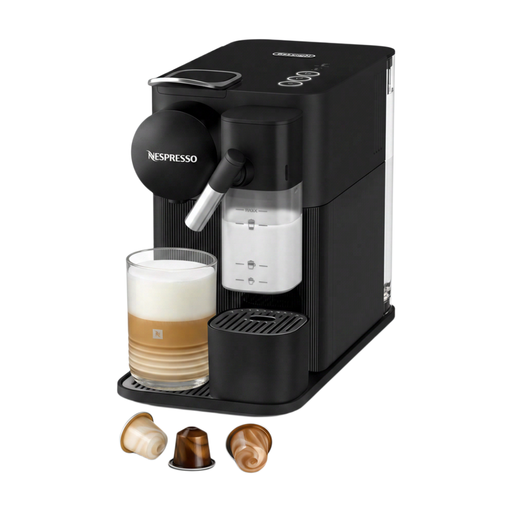 Image unavailable
A good fit if you’re looking for a capsule machine with an integrated milk system for drinks such as latte macchiato; check that Nespresso Original suits your choice of capsules.
The product name lists Nespresso Original and a 1.0 l tank. The Consumentenbond describes Original, Vertuo and Dolce Gusto as different capsule systems.
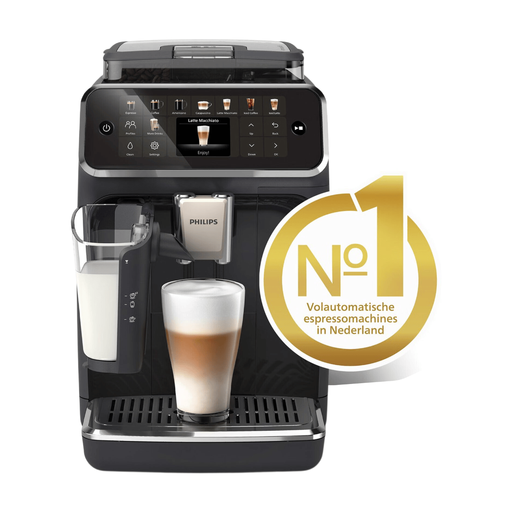 Image unavailable
A good fit if you want a fully automatic machine with LatteGo and few manual brewing steps; check which cleaning steps are needed for the milk components.
The product name lists 20 drinks, a ceramic grinder, 12 settings, AquaClean and a 1.8 l tank.
 Image unavailable
A good fit if you’re looking for a fully automatic espresso machine with LatteCrema milk preparation; the product name also mentions a Bean Switch System.
The stated colour is Pebble Grey.
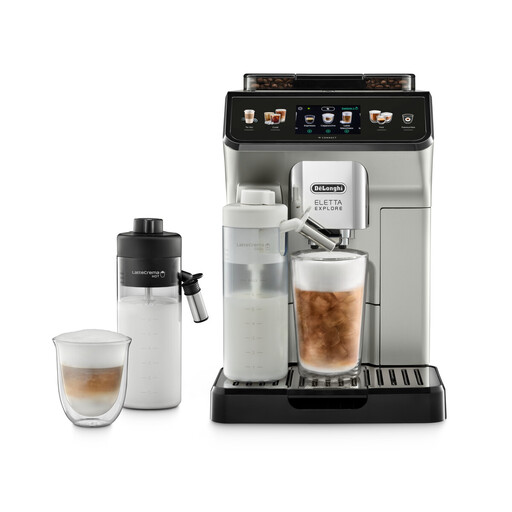 Image unavailable
A good fit if you’re looking for a bean-to-cup machine with a LatteCrema system for coffee and milk-based drinks.
The product name lists 13 drinks and a silver finish.
No. For a caramel flavour, add syrup to the cup first, then pour in the milk and espresso. De'Longhi Coffee Lounge gives this order in a caramel latte macchiato recipe; always follow your model’s manual for its components.
No. The Consumentenbond describes Nespresso Original, Nespresso Vertuo and Dolce Gusto as different systems; an Original capsule won’t fit a Vertuo or Dolce Gusto machine. Check the system before choosing your capsules.
Remove milk residue and follow the cleaning and descaling instructions for the exact model. The Consumentenbond recommends rinsing the water tank daily; replace the water filter if your machine uses one.
It depends on the type of milk. For opened milk with 0% fat, the Voedingscentrum gives a fridge life of one week, and recommends checking, smelling and tasting it afterwards; this isn’t a general storage period for all types of milk or milk alternatives.
Report the fault to the retailer. According to the Rijksoverheid, you’re entitled to a product that is fit for purpose, and there is no fixed statutory warranty period in the Netherlands; what you can expect depends, among other things, on the problem and how the product has been used. A manufacturer’s warranty is separate from your statutory rights.