Which machine is right for you?

Host who keeps decaf separate

You want to make caffeine-free espresso after dinner while others drink regular coffee. The way coffee is added determines how easily you can switch between types for each order. De’Longhi and Nespresso list ground coffee and decaf capsules as options respectively.

Flat white enthusiast

You want control over the milk texture and are happy to carry out a few steps for each cup, or you’d rather opt for automatic milk preparation. De’Longhi, Sage and Siemens describe different milk functions for their specific models.

Host serving several coffee drinkers

You want to serve several milk-based drinks one after another, so you’ll want to consider the controls, refilling and cleaning the milk components. Sage says you can brew espresso and steam milk at the same time with the Dual Boiler; Siemens lists an automatic flat white programme for the TP603E08.

What should you look for?

Portafilter machine with ground decaf

Best if: you want to measure out decaf for each cup and froth the milk yourself.

Bear in mind: brewing espresso and steaming milk involve separate steps for each cup.

Fully automatic machine with a milk function

Best if: fewer manual steps when making milk-based drinks are important to you.

Bear in mind: a flat white programme doesn’t automatically tell you how to add decaf to that particular model.

Capsule machine with separate milk preparation

Best if: you want to choose a suitable decaf capsule for each serving and don’t mind preparing the milk separately.

Bear in mind: capsules must be compatible with your chosen system, and frothing the milk is a separate step.

What to consider What to look for Who is this important for?
Decaf for each cup Check whether the model accepts ground coffee or capsules for your chosen system; also check the instructions for switching between types and cleaning. If I want to serve regular coffee and decaf alongside each other at a dinner party, I want to be able to choose the coffee type for each order. Around 36% of consumers make preparing decaf separately their top priority.
Milk texture Check whether the exact model has a manual steam system or automatic milk preparation. If I want to froth the milk myself, having control over that step matters more to me than one-touch operation. Around 29% of consumers prioritise milk preparation.
Serving several drinks Check which steps you need to carry out for each cup and when you’ll need to refill the water or milk; see whether you can brew espresso and steam milk at the same time. If guests order one after another, I want to know how the steps fit together and how often I’ll need to refill. Around 21% of consumers prioritise the serving workflow.
Cleaning and use Check how to clean the parts that come into contact with milk and which coffee input or capsules the system uses. If I’m making different milk-based drinks for guests, I want to know which parts need cleaning between drinks and afterwards. Around 14% of consumers focus mainly on maintenance and repeat purchases.

Common mistakes when choosing

  • Assuming a flat white button means you can choose decaf

    Siemens lists a flat white programme for the EQ600 TP603E08, but this feature alone doesn’t tell you how to add decaf to this exact model.

    Before buying, check the instructions for adding coffee and switching between coffee types on the exact model.

  • Assuming every decaf capsule will fit

    Nespresso describes decaf capsules within its own range. The capsule must be compatible with the machine’s system.

    Check the machine model and capsule system together, and decide how you want to prepare the milk.

    Capsules are a recurring purchase; you may need a separate milk frother for your chosen setup.

  • Not cleaning milk components between different types of milk

    Milk is an allergen. Using a different type of milk doesn’t automatically make parts that have been in contact with milk suitable for every guest.

    Ask guests about allergies and follow the cleaning instructions for all milk components you’ve used.

Brands to compare

De’Longhi

The Dedica EC685.M EX:4 is a compact manual machine for brewing espresso and steaming milk separately.

  • For this model, De’Longhi lists a width of around 15 cm, an adjustable Cappuccino System and a 1.1-litre water tank.
  • The manual steps are part of the preparation; the specifications listed don’t confirm that you can brew espresso and steam milk at the same time.

Sage

The Dual Boiler, model SES920BSS4EEU1, is a portafilter machine with separate boilers.

  • Sage says this model can extract espresso and steam milk at the same time; it also describes how to make microfoam manually.
  • Milk preparation is still manual, and coffee must be added separately.

Siemens

The EQ600 TP603E08 is a fully automatic machine with a flat white programme and automatic milk preparation.

  • Siemens lists a 1.8-litre water tank and one-touch milk drinks for this model.
  • Before choosing it for this purpose, check how to switch between regular coffee and decaf on this exact model.

Philips

LatteGo models are worth considering if you’re looking for an automatic milk system with accessible components.

  • Philips describes the LatteGo system as having two parts and no hidden tubes.
  • Check the coffee input and drink programmes for the exact machine model; a milk function doesn’t confirm that decaf is easy to add.

Nespresso

Nespresso offers decaf capsules and separate milk frothers.

  • With a compatible capsule, you can choose decaf for each serving.
  • The capsule must be compatible with your chosen machine system; capsules alone don’t prove that a machine can make microfoam or a flat white in one step.

Espresso machines at Joybuy

This selection includes fully automatic machines with different ways to choose your coffee, as well as portafilter machines that use ground coffee and prepare milk separately.
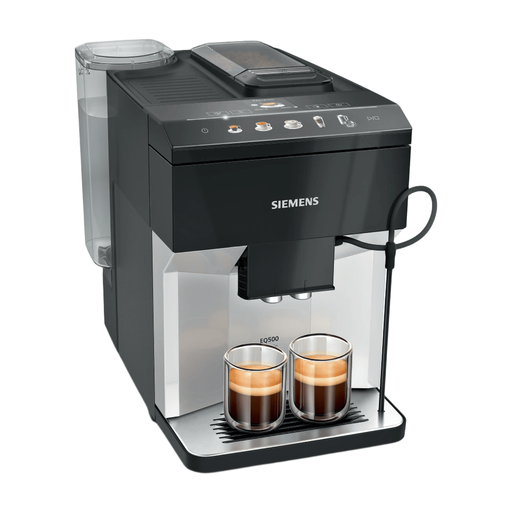
Siemens EQ500 TP511R01 fully automatic espresso machine

Siemens EQ500 TP511R01 fully automatic espresso machine

The separate ground coffee input is useful if you want to add decaf for each serving; milk-based drinks are prepared automatically.

The ground coffee chute is designed for one serving at a time.

View at Joybuy

De’Longhi Rivelia EXAM440.55.G fully automatic espresso machine

De’Longhi Rivelia EXAM440.55.G fully automatic espresso machine

The two interchangeable bean hoppers are useful if you want to switch between types of beans; check that the coffee you plan to use suits your decaf setup.

The product description lists automatic milk preparation and the ability to make two milk-based drinks at the same time.

View at Joybuy

De’Longhi ECAM290.61.SB Magnifica Evo fully automatic espresso machine

De’Longhi ECAM290.61.SB Magnifica Evo fully automatic espresso machine

The listed ground coffee input may be useful if you want to use decaf for each serving; this model prepares milk automatically.

The product description lists a 1.8-litre water tank and a removable milk container.

View at Joybuy
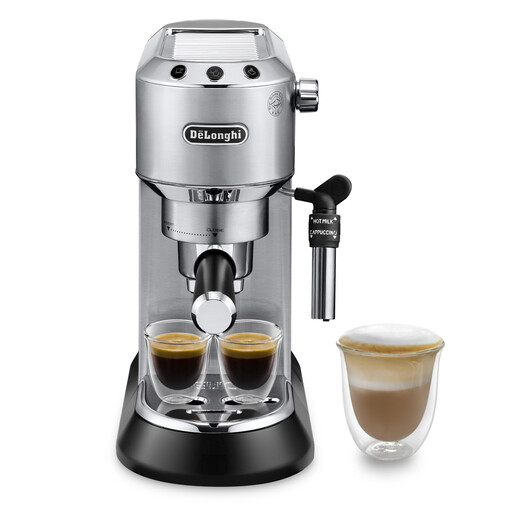
De’Longhi Dedica EC685 espresso machine with manual milk frother

De’Longhi Dedica EC685 espresso machine

Ground coffee and an adjustable steam wand suit anyone who wants to measure out decaf for each cup and froth the milk themselves.

According to the product description, a separate filter is required for E.S.E. pods.

View at Joybuy
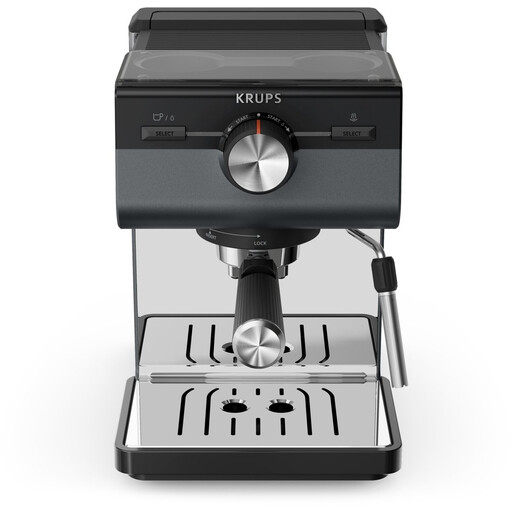
Krups Authentic+ C40 XP384G portafilter espresso machine

Krups Authentic+ C40 XP384G portafilter espresso machine

According to the product description, this machine is suitable for pre-ground coffee and has a built-in steam wand for manual milk preparation.

Clean the steam wand after use, following the instructions, to remove milk residue.

View at Joybuy

Frequently asked questions

Is decaf completely caffeine-free?

No. According to the Netherlands Nutrition Centre, a 125 ml cup of decaf coffee contains around 3 mg of caffeine; this figure isn’t a measurement for every espresso or capsule.

How should I store milk safely for a dinner party?

According to the Netherlands Nutrition Centre, keep pasteurised milk in the fridge at 4 °C. Take out only the milk you’re going to use, and follow the cleaning instructions for the parts of your machine that come into contact with milk.

What should I ask guests who don’t want regular milk?

Ask whether it’s a preference, lactose intolerance or a milk allergy. The Netherlands Nutrition Centre identifies milk as an allergen, so check the ingredients and cleaning requirements for any milk components you’ve used against what your guest tells you.

Should I buy extra cover for an espresso machine?

You don’t need extra cover to have a legal guarantee in the Netherlands: this applies alongside any manufacturer’s or seller’s guarantee. ACM ConsuWijzer explains that the seller is responsible for providing an appropriate solution if, under normal use, the product doesn’t do what you could reasonably expect it to do.
