
Vandaag of morgen in huis

Kwaliteit gegarandeerd

Welkomstaanbiedingen ontgrendelen: GRATIS bezorging | Tot 80% korting | Gratis 30 dagen JoyPlus-proefperiode
Download de app
An ergonomic baby carrier can be useful when going for a walk, visiting the supermarket or travelling on public transport. You keep your hands free while your baby stays close to you. However, not every baby carrier is equally suitable for everyday use.
Marketing terms such as “ergonomic”, “lightweight” and “breathable” only tell you so much. You also need to consider the construction, sizing and usage limits. Below, we explain what to look for, which common pitfalls are often overlooked and which models suit different situations.
A carrier for newborn babies may sound appealing, but a model for babies from around 3 months is not automatically suitable from birth. Always check:
The product information for various Momcozy models specifies a range of approximately 3.18 to 19.96 kg and around 3 to 24 months. This does not mean that every child within this range will fit in the same way. The carrier should fit snugly without restricting breathing or freedom of movement.
An ergonomic baby carrier should support the legs so that the knees are higher than the bottom. This is often referred to as the M-position. A narrow seat that allows the legs to hang straight down may be less comfortable and does not provide the desired positioning.
Also pay attention to back and neck support. With young babies, the face must remain visible and the airway must be clear. A neck support is useful if it is adjustable, but it must never cover the face.
A lightweight carrier is convenient to take with you, but carrying comfort is also determined by the shoulder straps, back fastening and lumbar support. A model weighing approximately 771 grams may be practical, but incorrect adjustment can still put pressure on your shoulders or lower back.
A carrier with lumbar support and crossed X-shaped or back straps distributes weight differently from a simple model with two straight straps. Adjust the straps while standing upright, then check again that your baby is sitting high and close against your body.
Look for a wide, padded seat that supports the legs from knee to knee. An adjustable baby carrier with several width or height settings is practical, as your child can grow considerably in just a few months.
Also check whether the carrier can only be worn facing inwards or offers several carrying positions. According to the product information, the Momcozy models in this selection are designed for front carrying with the baby facing the wearer. This is different from a carrier that allows the baby to face forwards.
A cotton baby carrier feels soft and is generally easy to machine wash. Cotton can feel warmer during summer walks, however. A breathable baby carrier with Air Mesh panels allows more air to circulate and may be more practical in warm weather or indoors.
Pay attention to the difference between a brand claim and a specification that can be checked. “Cooling” or “extra comfortable” is not a fixed standard. According to Momcozy’s product information, the mesh model uses Air Mesh material and has a cooling neck-contact panel. Treat this as product information, not as a guaranteed reduction in temperature.
Before every use:
Always follow the instructions and the stated weight limits. A machine-washable carrier is convenient, but use the recommended wash programme and check the buckles and stitching again after washing.
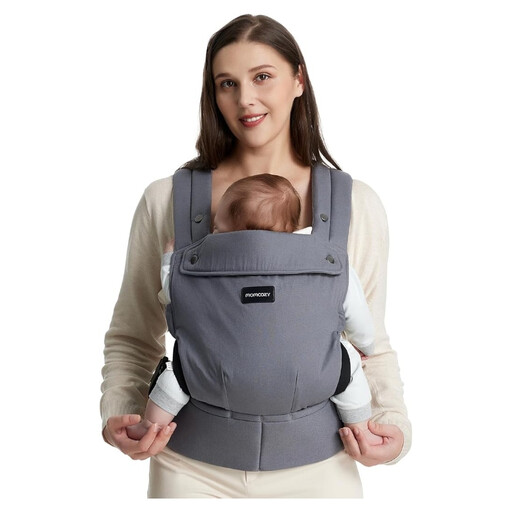
Why it suits this profile: A straightforward front carrier for everyday use, with a stated range of 3.18 to 19.96 kg and machine-washable cotton.
The product information specifies clear minimum and maximum weights, adjustable straps, an M-shaped leg position and a foldable neck support.
100% cotton, approximately 771 grams, front carrying and machine washable according to the product description.
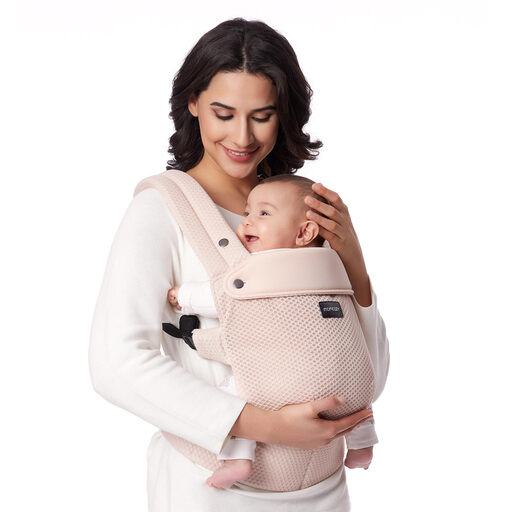
Why it suits this profile: Suitable for parents who often go walking, travel or carry their baby indoors and value an Air Mesh construction.
The model does not simply claim to be “breathable”; it specifies Air Mesh material, three adjustment positions and padded leg openings.
Air Mesh, machine washable, X-shaped back straps, EVA lumbar support and a stated carrying range of 3.18 to 19.96 kg.
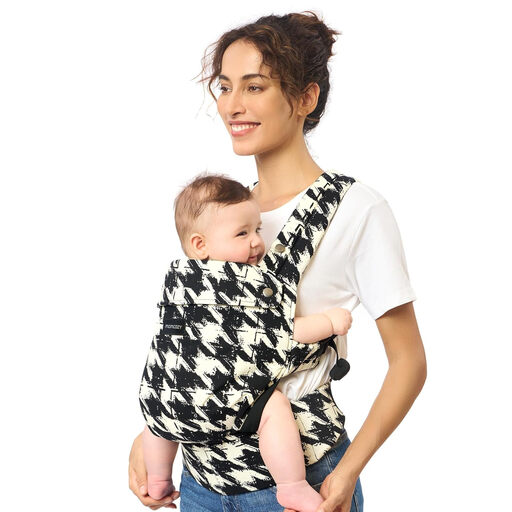
Why it suits this profile: An option for parents who carry their baby regularly and are looking for a combination of crossed straps, a wide seat and adjustable positions.
The stated specifications mention OEKO-TEX Standard 100-certified cotton, a wide seat and three adjustment positions. Check the current instructions before use.
100% cotton, machine washable, X-back, lumbar support and a carrying range of approximately 3.18 to 20 kg according to the product information.
We have put together a complete, up-to-date list of products that fully meet these strict selection criteria and the applicable European safety regulations.
Not every carrier is suitable for this. Check the minimum age, minimum weight and the manufacturer’s instructions. According to the product information, the Momcozy models mentioned are intended for babies from approximately 3 months. Do not use them with a baby who cannot yet support their head independently, unless the instructions explicitly describe a safe newborn configuration.
Its lifespan depends on use, washing and storage. Regularly check the buckles, straps, seams and fabric. Stop using the carrier if you find fraying, tears, loose stitching or a fastening that does not lock properly. Even if your child’s weight is still within the limit, wear and tear may be a reason to replace the carrier.
It can be, provided the child is within the stated weight range and the waist, shoulder and leg support fit properly. A toddler weighs more than a young baby, making sturdy lumbar support and good weight distribution more important. Start by carrying your child for short periods and check that you do not experience any pain or discomfort.
