
Vandaag of morgen in huis

Kwaliteit gegarandeerd

Welkomstaanbiedingen ontgrendelen: GRATIS bezorging | Tot 80% korting | Gratis 30 dagen JoyPlus-proefperiode
Download de app
Anyone who works from home, studies or spends long days in the office soon discovers that not every office chair remains comfortable over time. An ergonomic office chair should not only feel comfortable when you first unpack it, but also suit your height, desk and way of working.
Marketing copy can sometimes make the choice more difficult. Terms such as “ergonomic”, “premium” and “all-day comfort” mean little without verifiable specifications. Use these points to compare models in a practical way.
A fixed curve in the backrest will not suit every user. During longer working days in particular, an incorrect position can become uncomfortable. Check whether the lumbar support can be adjusted for height, depth or tilt. An office chair with adjustable lumbar support gives you more ways to tailor the chair to your sitting position.
An office chair with a tilt function can be useful during a break, but not every chair makes it clear which positions the backrest can be locked in. Look at the tilt range and whether tension adjustment is included. A range such as 90° to 135° tells you more than the description “rocking function” alone.
A high backrest, headrest or wide seat can be comfortable, but also takes up space. Measure the available space under your desk beforehand. Fold-up armrests are useful if you want to slide the chair fully under the desktop. Also check the minimum and maximum seat height so that your feet can rest flat on the floor.
An adjustable office chair should offer a sufficient range for your height. Product information usually lists the overall dimensions and seat height. Pay attention to the following:
For example, the GTIMEX chair with a 150 kg weight capacity lists a seat 50 cm wide and 53 cm deep, with a recommended user height of 155 to 185 cm. Information like this is more useful than a general claim about ergonomics.
An S-shaped backrest can follow the natural shape of your back, but the fit varies from person to person. With an office chair that has a headrest, check whether the headrest can be adjusted up, down or by angle. A headrest is particularly relevant if you regularly lean back; when typing with concentration, the correct desk height is at least as important.
Also check whether the backrest can be locked in a working position. The GTIMEX chair with a tilt of up to 135° lists a lock at 90° and adjustable resistance. According to the product description, the grey GTIMEX version has a tilt of up to 125°, a seat height of 43 to 53 cm and fold-up armrests.
A mesh office chair generally allows more air to circulate than a fully upholstered backrest. This can be practical in a warm home office. A thick foam cushion may provide more cushioning, but comfort is subjective.
Always check the maximum static weight capacity and compare it with your own weight plus any additional load. An office chair rated up to 150 kg does not automatically have the same construction as a model rated up to 120 kg. According to the product information, the GTIMEX chair with headrest has a weight capacity of 150 kg. The JOYFURNOS models list 120 kg. Treat these figures as product specifications, not as a guarantee of a particular service life.
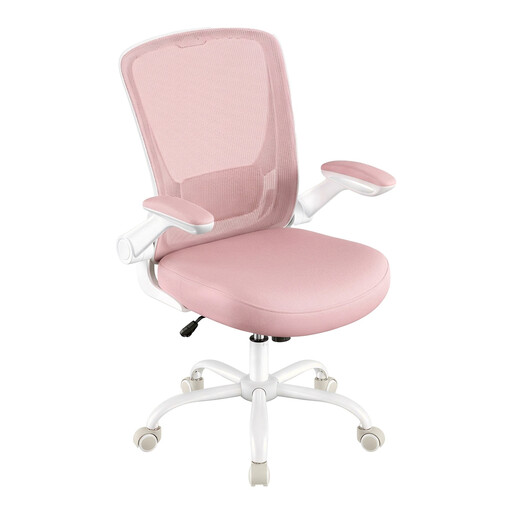
Why it suits this profile: This model combines adjustable seat height and lumbar support with fold-up armrests. That makes it practical for a compact home office or student bedroom.
The adjustable components mean you are not limited to a fixed back curve or fixed seat height. The product information also lists a tilt range of 90–105°.
Seat height of 103–110 cm as the overall chair height, fold-up armrests, mesh material and a stated static weight capacity of 120 kg.
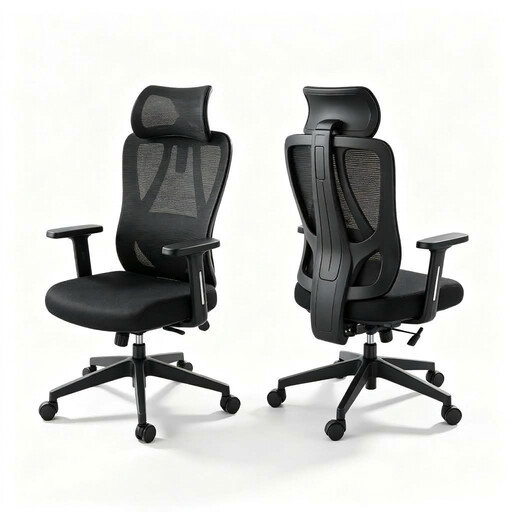
Why it suits this profile: If extensive adjustability is important to you, this model offers multiple lumbar support settings and a wide headrest.
The product description specifies 4D lumbar support, a tilt range of approximately 105° to 140° and a cushion around 10.5 cm thick. This allows you to compare the features in concrete terms.
Dual-mesh backrest, 4D lumbar support, 2D headrest, integrated armrests and a TUV Level 4 gas lift listed in the product information.
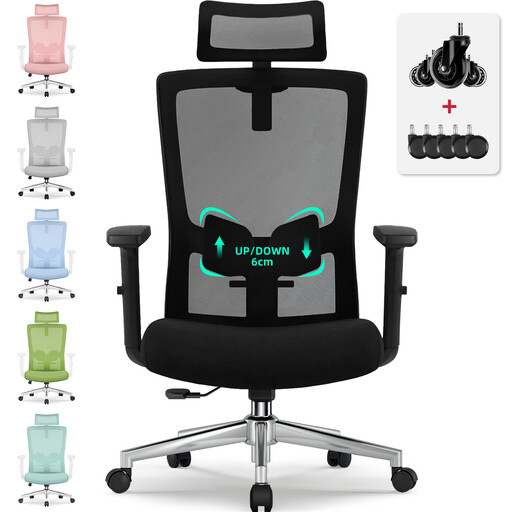
Why it suits this profile: This is an option for users looking for an office chair with a headrest, a generous tilt range and a higher stated weight capacity for everyday work and breaks.
The description lists separate adjustability for the lumbar support and headrest, as well as a lock at 90°. This makes the working and resting positions clearer than a general tilt claim.
Maximum stated weight capacity of 150 kg, seat measuring 50 × 53 cm, mesh backrest, headrest and tilt of up to 135°.

Why it suits this profile: The combination of a swivel base, mesh material and fold-up armrests is well suited to a bedroom, study or home office where space needs to be used efficiently.
The chair has an adjustable seat height of 46–54 cm and a tilt range of 90–105°. The fold-up armrests help you position the chair under the desk.
Dimensions of 62 × 62.4 cm, adjustable lumbar and head support, 8 cm foam cushion and a stated weight capacity of 120 kg.
We have put together a complete, up-to-date list of products that fully meet these strict selection criteria and the applicable European safety requirements.
An adjustable office chair only works properly when it is set up correctly. Follow this order:
A swivel office chair makes it easier to move around your desk. However, check that the castors are suitable for your flooring. On a wooden or laminate floor, a protective mat can be especially practical.
Its lifespan depends on how often it is used, weight, materials and maintenance. Product descriptions do not always state a fixed lifespan. Therefore, check the warranty, attachment points, gas lift and castors. Tighten the screws regularly and clean mesh or upholstery with a soft, slightly damp cloth.
In addition to the purchase price, maintenance and possible floor protection are the main considerations. A chair does not use electricity. Costs may arise from replacing castors, the gas lift or armrests. Check beforehand whether replacement parts and service information are available.
That depends on your working posture. If you mainly type while leaning forwards, you may use the headrest very little. For reading, meetings or rest breaks, an adjustable headrest can be practical. Make sure the headrest’s height and angle suit your height.
