
Editor with limited ports
You want to edit text without an extra power adapter, and need to check whether Bluetooth, a receiver or a cable will work with your computer. Logitech and Trust describe keyboards with different connectivity options.


Start by choosing a keyboard layout and hand position that feel comfortable for your editing work, then check the connectivity and power requirements of the exact version. Bluetooth can free up a computer port if your device supports it, but a wireless keyboard still needs batteries or recharging. A wired model doesn’t need keyboard batteries, but it does use a computer port. A single-piece keyboard is easier to position, while two separate halves give you more flexibility.
You want to edit text without an extra power adapter, and need to check whether Bluetooth, a receiver or a cable will work with your computer. Logitech and Trust describe keyboards with different connectivity options.
You type longer passages and want to choose between a single-piece design and two separately positionable halves. R-Go Tools and Kinesis describe models with separate halves; a different keyboard shape is no substitute for breaks or a suitable workstation.
You often switch between your text and mouse, and want to check the keyboard’s width, navigation keys and the position of any numeric keypad in advance. BakkerElkhuizen’s S-board 840 No Hub is one example of a compact, wired keyboard.
First, decide which connection will work with your computer and how many ports you want to use. Then compare the keyboard shape, the keys you need for editing and the space left for your mouse.
| What to consider | What should you check? | Who is this important for? |
|---|---|---|
| Connection and power | Check Bluetooth support, the type of USB port, and whether the version uses a receiver, batteries or recharging. | If I have few free ports, I want to know which port or power source the keyboard needs. Around 33% of consumers put connectivity first. |
| Hand position | Check whether the keyboard has a fixed wave shape, a fixed split design or separately positionable halves. Also check which wrist rest is included. | During longer editing sessions, I want to choose a shape that suits my working posture, without expecting the keyboard to make breaks unnecessary. Around 27% of consumers prioritise hand position. |
| Text-editing keys | Check how easy it is to reach the arrow, Home/End, Delete and function keys on the exact language layout. | If I do a lot of proofreading and navigation through a review, I want my usual editing keys to be easy to reach. These keys are the main concern for around 20% of consumers. |
| Desk space and mouse position | Measure the available space and compare the dimensions, including the wrist rest and the room needed for any separate keyboard halves. | On a small desk, I want enough room to use my mouse beside the keyboard. Around 20% of consumers prioritise available desk space. |
A wireless model may use Bluetooth, but a USB receiver still takes up a computer port. The connection mode and power requirements vary by version.
Before buying, check how the exact version connects and whether it needs batteries or recharging.
With a fixed split keyboard, you can’t adjust the distance between the halves independently.
Choose a design that allows the setup you want, and check that the halves can genuinely be positioned separately.
On a compact layout, some functions may be on an Fn layer. A keyboard may also have navigation keys that you want to reach directly while editing.
Check that the exact layout includes the arrow, Home/End, Delete and function keys you use regularly.
For screen-based work, Arboportaal recommends varying your activities, taking microbreaks and using a workstation that suits you.
Consider the keyboard as part of your workstation, and continue to take breaks and vary your working posture while editing.
Wave Keys has a fixed wave shape, while ERGO K860 has a fixed split design.
The wireless version of Split Break v.2 is designed for those looking for separately positionable halves and Bluetooth.
Freestyle2 Blue is a Bluetooth version with positionable halves; mWave is a different model with a fixed shape.
Keyra is a single-piece keyboard that Trust lists as connecting via Bluetooth and a USB receiver.
The PERIBOARD-612 has a fixed ergonomic split design and, according to Perixx, can connect via Bluetooth or a 2.4GHz receiver.
This selection includes compact, wireless and wired keyboards for different writing setups. Check each version to make sure its connection, layout and keys suit your computer and editing work.
 No image available
A good fit if you’re looking for a foldable Bluetooth keyboard for a mobile phone or tablet; check that it works with your device and word processor.
The product name describes a rechargeable version with an aluminium body and magnetic stand.
 No image available
An option if you’re looking for a keyboard with a mouse included and a choice of Bluetooth or USB receiver; check that the US layout suits the way you work.
The product description lists a rechargeable battery, three adjustable height settings and quiet scissor-switch keys.
 No image available
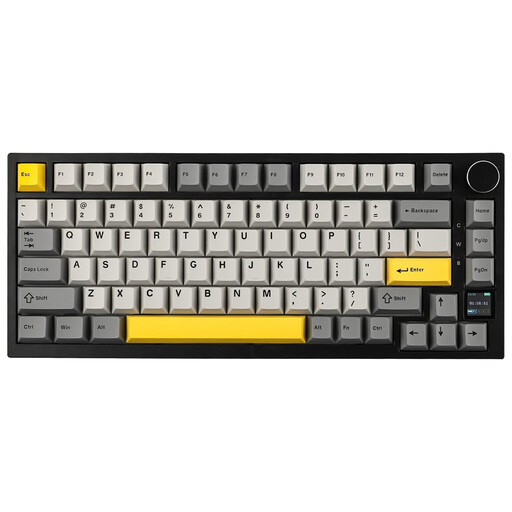
A good fit if you want a compact keyboard layout with easily accessible arrow and function keys; check that the US layout suits your preference.
The product information lists an 82-key layout, Bluetooth 5.1, a rechargeable battery and USB, Bluetooth or 2.4 GHz connectivity.
 No image available
A compact wired option if you want to free up desk space; check that the 60% layout has all the keys you need for editing text.
The product information lists a detachable USB-C cable and optical switches.
 No image available
A good fit if you have a small workspace and want a wired connection; check that the US layout and compact key arrangement suit your editing work.
The product information lists 61 keys, no numeric keypad and a wired USB connection.
Not necessarily: the Bluetooth and receiver versions we reviewed use batteries or a rechargeable battery. Check the power requirements of the exact model; a USB receiver also uses a computer port, and recharging may temporarily require a connection.
Start with a position that feels relaxed for your hands and arms, then gradually adjust the separate halves. Take regular breaks from screen work; this workstation advice doesn’t mean a keyboard prevents or treats any symptoms.
Check what’s included with the exact version, such as batteries, a receiver and any separate ergonomic accessories. According to the Dutch government, online purchases from a business generally come with a 14-day cooling-off period; your statutory rights if a product is faulty are separate from any manufacturer’s warranty offered.
For employees who work with a screen for more than 2 hours a day, the screen and keyboard must not be attached to each other, according to Arboportaal. If you use a laptop, you must therefore be able to use a separate screen or keyboard. This conditional workstation rule is not a general purchase requirement for every individual consumer.