
Anyone who writes long texts
If you write or edit for long periods, you may want to focus on a comfortable hand position and having enough variety in your tasks. TNO stresses that a suitable workstation alone isn’t enough.


A one-piece wave keyboard suits anyone who writes a lot and values a familiar layout. A keyboard with two separate halves gives you more scope to adjust the distance and angle between them. Check the layout, connection and space available for your mouse before choosing. A keyboard won’t solve distracting reflections from a window: Arboportaal recommends arranging your workspace so that you face parallel to the window.
If you write or edit for long periods, you may want to focus on a comfortable hand position and having enough variety in your tasks. TNO stresses that a suitable workstation alone isn’t enough.
If you switch between documents, comments and applications while writing, look for a familiar key layout and shortcuts that work with your computer. Logitech and HP describe these features for specific keyboard models.
If you move your screen and workspace to deal with bright daylight, a keyboard that fits on your desk alongside your screen and mouse can be useful. Arboportaal recommends positioning yourself so that you face parallel to the window.
When to choose it: if you edit a lot of text and value a largely familiar layout more than adjustable, separate halves.
Trade-off: it stays as one piece on your desk, but you can’t adjust the distance between the halves independently.
When to choose it: if you want clearly separated key groups without having to set up two separate pieces.
Trade-off: the halves of the Logitech ERGO K860 can’t be adjusted independently; RTINGS describes this model as larger than the Wave Keys.
When to choose it: if you want to set the distance and angle between your hands yourself and have enough space for both halves.
Trade-off: check the specific layout, connection and whether it depends on particular software; an unfamiliar layout may take time to get used to.
| What to consider | What should you check? | Who is this important for? |
|---|---|---|
| Hand position when typing for long periods | Compare the shape and adjustment options. If possible, try it out to see whether it feels comfortable to type on. | When I write for a long time, I want a position that feels comfortable for my hands. Around 40% of consumers put hand position during extended typing first. |
| Layout and shortcuts | Check the physical layout and whether the programming features you want work with your computer. | When editing, I want familiar keys and shortcuts that suit the way I work. Around 30% of consumers prioritise layout and editing tasks. |
| Desk space beside a window | Check that your keyboard, screen and mouse all fit, and consider the viewing direction you want in relation to the window. | When I adjust my workspace to cope with bright daylight, I want to leave enough room for my screen and mouse. Desk space and window position are the main concern for around 20% of consumers. |
| Connection and devices | Check the connection, any receiver and compatibility with your computer for the exact version you’re considering. | When I switch between devices, I want to know whether the connection works with my computer. Around 10% of consumers give device connectivity top priority. |
A different keyboard shape doesn’t remove the challenges of working at a screen for long periods. TNO also highlights the importance of variety and breaks.
Choose a keyboard based on the hand position that suits you, and combine a well-arranged workspace with plenty of variety.
A different physical layout can make typing and editing feel less familiar.
Before buying, check the full model code and key layout of the version you’ve chosen, not just the product family name.
An unsuitable layout can make editing more difficult.
A wide keyboard or two separate halves can take up space you also need for your screen and mouse.
Consider the entire desk setup. If daylight is distracting, Arboportaal recommends positioning yourself so that you face parallel to the window.
Offers both wave keyboards and a fixed split model in one piece.
The Split Break is designed for anyone who wants to set up two separate keyboard sections.
The HP 680 Comfort is a wave keyboard with programmable keys and wireless connection options.
The PERIBOARD-335 is a compact mechanical option with a curved, split key frame.
The Freestyle2 is an option if you want to adjust the distance and angle between two keyboard halves.
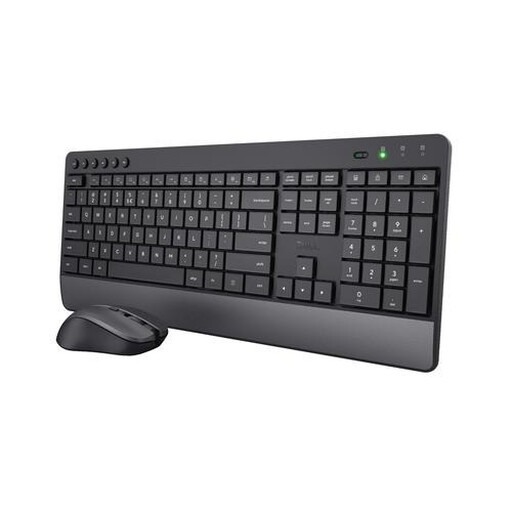
This Joybuy selection is a wireless keyboard and mouse set with an integrated wrist rest, for anyone looking for support at the keyboard during longer writing sessions.
 No image available
The integrated wrist rest may suit anyone looking for support at the keyboard during longer typing sessions.
US/QWERTY layout; keyboard and mouse in one set; wireless connection via USB receiver; quiet keys and media keys; black.
No, a keyboard won’t prevent reflections or glare. Arboportaal recommends positioning yourself so that you face parallel to the window. Choose your keyboard based on hand position and the desk space available, too.
Position the halves at a distance and angle that feel comfortable for your hands and shoulders. Check the language layout and connection beforehand, and allow time to get used to an unfamiliar layout.
Not as a general product category. Arboportaal outlines workplace requirements for employees who work at a screen for more than two hours a day, including that the screen and keyboard must not be attached to each other. When using a laptop, it must be possible to use a separate screen or keyboard; the rules apply to the relevant working situation.
When you buy online from a business, you often have 14 days to change your mind; the Dutch government notes that terms and exceptions matter. In addition, according to ACM ConsuWijzer, you’re entitled to a product that, under normal use, does what you could reasonably expect. There is no single fixed time limit for this in the Netherlands.
For the exact version, check whether you need a cable, batteries or a receiver, whether software is required and which accessories are included. Also check that the connection and any programmable features work with your computer.