Who is this relevant to?

Student writing long assignments

If you regularly write longer pieces, being able to vary the position of your hands and arms may be worth considering. The Arboportaal notes that working at a screen can involve repetitive movements and static strain; a keyboard is no substitute for breaks or a suitable workstation set-up.

Writer with a small desk

You may need to fit a keyboard, mouse and laptop on the same work surface. So compare the full dimensions and layout, not just the width.

Student in a shared room

If you need to be considerate of your housemates, key noise matters. The product information available does not provide comparable noise measurements to rank the models on this basis.

What should you look for when choosing?

Compact and curved

A good fit if: you have limited space and want to try a fixed keyboard shape. The Logitech Wave Keys has a wave-shaped design with a palm rest; the Kensington KB675 EQ has no number pad.

Trade-off: the shape is fixed. Also check the keyboard’s depth and the layout of the version you’re considering.

Fixed split or broad curve

A good fit if: you type in one place, don’t mind a cable and want to try a different hand position. The Perixx PERIBOARD-512 has separate key zones in a single casing; the CHERRY KC 4500 ERGO has a curved key field.

Trade-off: the key zones on a one-piece keyboard cannot be moved independently. Perixx gives the dimensions as 485 × 236 × 44 mm; check that your laptop has the required connection.

Two separate halves

A good fit if: you want to choose the distance and angle between your hands, and have room to position both halves. The wired R-Go Split Break consists of movable halves.

Trade-off: adjusting the set-up and getting used to it takes time; according to the manual, R-Go Break software controls the break light. Check compatibility and the specific version.

What to consider What should you check? Who should pay particular attention?
Typing posture Compare a wave-shaped design, fixed split key zones and separate halves; check whether your hands can rest comfortably. If I write long assignments, I want to choose a shape that suits my hands and workspace. Around 29% of consumers give typing posture top priority.
Desk space Measure both the width and depth with your mouse and laptop in their usual places; decide whether you need a number pad. If I have limited workspace, I want to leave enough room for my mouse and laptop. Around 21% of consumers focus first on the desk space available.
Cost and requirements Check which connection your laptop has and whether you need an adapter; compare the total cost for your set-up. When choosing a keyboard for my student room, I only want to pay for features I’ll use there. Around 21% of consumers put the purchase cost first.
Key noise If possible, try the exact version in a similar environment; don’t assume it’s quiet based on a description alone. If I share my room, I want to be considerate of my housemates while typing. Around 14% of consumers make key noise their top priority when choosing.
Layout and connection Check the key labels and regional layout, the operating system, and the Bluetooth or USB connection available. If I type a lot of punctuation, I want a layout that suits the way I work and a connection supported by my device. Around 15% of consumers choose based on layout or connection first.

Avoid common buying mistakes

  • Assuming an ergonomic label proves that discomfort will go away

    A product description does not prove that a product will have a medical effect in your situation. The Arboportaal also highlights repetitive movements, static posture and workstation set-up.

    Choose based on the shape and your workspace, vary your screen-based tasks and don’t treat a product specification as medical advice for persistent discomfort.

  • Measuring only the keyboard’s width

    A palm rest and mouse take up space too. A keyboard that fits on paper may therefore be awkward to use on your desk.

    Measure the available width and depth with your mouse and laptop in their usual positions.

  • Assuming every version has the same layout

    The versions on offer may differ in their keyboard layout and connection. The wrong layout can make typing punctuation or connecting to your laptop more difficult.

    Before buying, check the images and specifications for the exact version you’ve chosen, including its layout and the port it requires.

Brands to compare

Logitech

The Wave Keys is a compact wireless model with a wave-shaped design; the ERGO K860 has a fixed, split curved shape.

  • Logitech lists Bluetooth and an included Logi Bolt receiver for the Wave Keys.
  • Neither of these models has independently adjustable halves. Ergonomic benefits described on product pages are manufacturer claims, not proof of a medical effect.

Perixx

The PERIBOARD-512 has fixed, split key zones and a cable, making it suitable for a set-up with a compatible USB-A connection.

  • Perixx lists a 1.8 m USB-A cable and dimensions of 485 × 236 × 44 mm.
  • The casing takes up relatively more room on a small desk; also check the layout of the version you’re considering.

CHERRY

The KC 4500 ERGO is a wired model with a curved key field and integrated palm rest.

  • CHERRY lists a 1.8 m cable and key functions that can be customised using optional software.
  • CHERRY’s claims about reducing discomfort are not independently established treatment outcomes.

R-Go Tools

The Split Break is designed for people who want to position two halves separately and use a break indicator.

  • The manual confirms that the halves can be moved and that R-Go Break software controls the light.
  • Check compatibility with your computer and the specific version.

Kensington

The Pro Fit Ergo KB675 EQ TKL combines a compact layout without a number pad with wireless connection options.

  • Kensington lists Bluetooth and a 2.4 GHz USB-A receiver.
  • Kensington states that Windows 11 on Arm is not currently supported. The manufacturer has designed it for small to medium-sized hands; check for yourself whether it feels comfortable.

Keyboards at Joybuy

This selection at Joybuy includes compact and larger keyboards, as well as sets with different connections. Check that the layout, dimensions and connection suit the way you write; product descriptions alone don’t show which model is more ergonomic or quieter.
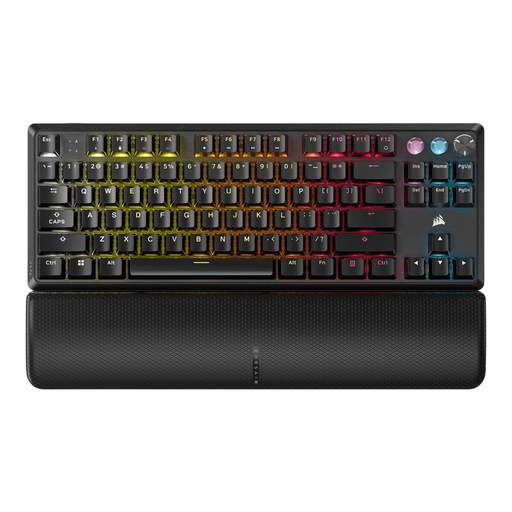
Corsair K70 PRO TKL Magnetic-Mechanical Gaming Keyboard, US QWERTY, MGX v2, Black

Corsair K70 PRO TKL Magnetic-Mechanical Gaming Keyboard, US QWERTY, MGX v2, Black

The TKL layout omits the number pad; make sure you check the US QWERTY layout before buying.

The product information mentions a detachable, padded wrist rest. The keyboard is wired.

Joybuy

AULA WIN60HE 60% wired gaming keyboard

AULA WIN60HE 60% Wired Gaming Keyboard

The wired 60% format is a compact option if you’re short on desk space.

Check which keys are missing compared with a larger layout and whether the connection is compatible with your computer.

Joybuy
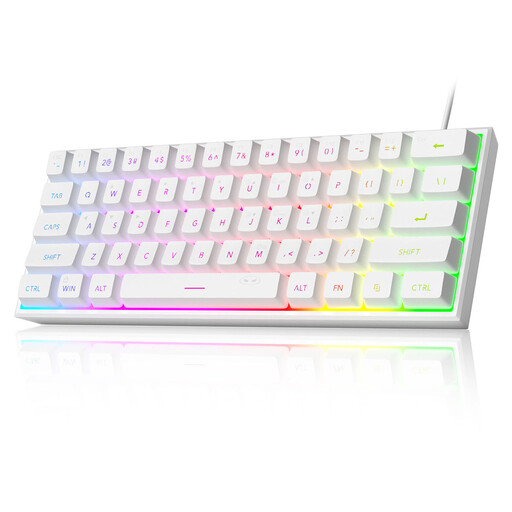
MageGee TS91 60% wired keyboard, US QWERTY, 61 keys, white

MageGee TS91 60% Wired Gaming Keyboard, US QWERTY, 61 keys, white

With a wired connection and 61 keys, this compact layout is suited to a desk with limited space.

This version has a US QWERTY layout; check that it suits the punctuation you use for your assignments.

Joybuy
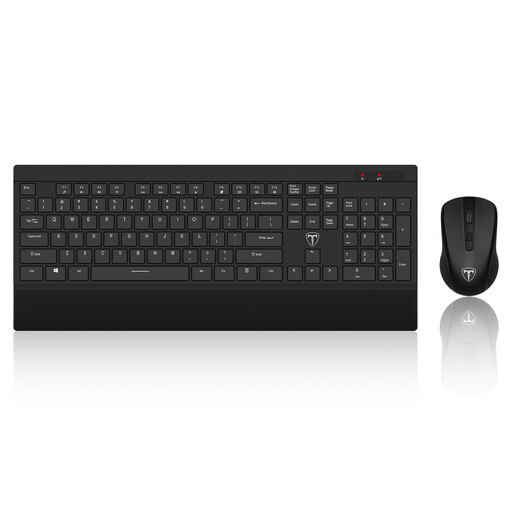
ET Silent wireless keyboard and mouse combo, US QWERTY

ET Silent Wireless Keyboard and Mouse Combo, US QWERTY

This wireless keyboard and mouse set is an option if you want to choose both devices together.

The title lists a US QWERTY layout. Check the layout and whether you need the USB receiver; a product name is not a comparable measurement of key noise.

Joybuy
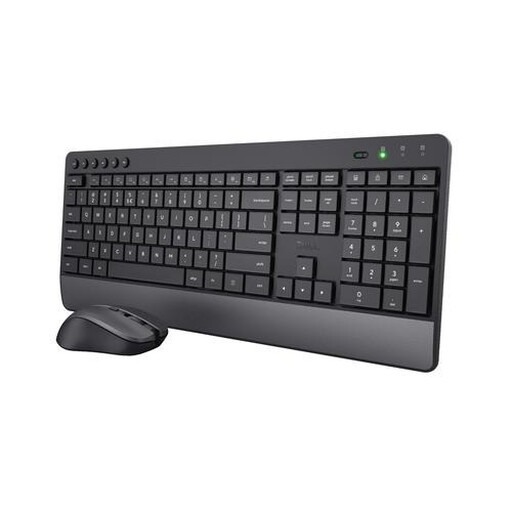
Trust Trezo Comfort wireless keyboard and mouse set, US QWERTY, black

Trust Trezo Comfort Wireless Keyboard and Mouse Set, US QWERTY, Black

The product name describes this wireless set as having a full-size layout with a number pad.

The product name mentions quiet keys and a palm rest; check the US QWERTY layout and whether the larger layout will fit your desk.

Joybuy

Frequently asked questions

Is an ergonomic keyboard enough to prevent discomfort when typing for a long time?

No, that hasn’t been proven for your situation. The Arboportaal also highlights repetitive movements, static posture and the set-up of your entire workstation. Vary your tasks and don’t treat manufacturers’ claims as a guarantee that discomfort will go away.

How do I connect a wired keyboard to my laptop?

First check the ports available and the connection used by the exact version. The PERIBOARD-512 uses USB-A; the manual for the wired R-Go Split Break describes USB-C and an included adapter for USB-A.

How do I use the break indicator on the R-Go Split Break?

According to the manual, R-Go Break software controls the light, which changes colour to remind you to take breaks. The light does not measure whether your posture is healthy.

What are my rights if a keyboard I bought online isn’t suitable or is faulty?

For online purchases from a business, you generally have 14 days to change your mind in the Netherlands, according to the Dutch Government. You’re also entitled to a product that is fit for purpose; if something is faulty, contact the seller. The cooling-off period for distance purchases is separate from your rights if a product is faulty.

Do health and safety rules require a student to use a separate keyboard in their own room?

Not simply because they’re a student. The screen-work rules referred to here cover employers’ obligations to employees. According to the Arboportaal, for employees who work at a screen for more than two hours a day, the screen and keyboard must not be attached to each other under the conditions specified. This is not a general legal requirement for every student in their own room to buy a separate keyboard.
