
Editor with limited desk space
You switch between typing and using the mouse while polishing a review, and want to leave room for notes. OSHA identifies a keyboard without a built-in number pad as one way to free up more space for the mouse.


Start by considering how much room your keyboard, mouse and any notes take up together. OSHA notes that a keyboard without a built-in number pad can leave more space for your mouse. If you mainly want to adjust the angle of your hands, an adjustable split model may be a better fit, provided both halves fit on your desk. Also check the layout and connection of the exact version.
You switch between typing and using the mouse while polishing a review, and want to leave room for notes. OSHA identifies a keyboard without a built-in number pad as one way to free up more space for the mouse.
You want to try different hand positions during longer typing sessions. Compare a curved keyboard with a model that lets you position each half separately, and measure the desk space you’ll need beforehand.
You often move around sentences and use keyboard shortcuts. In that case, the position and accessibility of editing, navigation and function keys may matter more than choosing the smallest possible keyboard.
A good fit if: you often switch between text and the mouse while editing, and desk space is limited.
Bear in mind: a straight layout doesn’t offer the separate positioning options of two independent halves; if you enter lots of numbers, you may need a separate number pad.
A good fit if: you want a familiar-looking layout with an integrated wrist rest, and the full depth fits on your desk.
Bear in mind: you can adjust your hand angles less independently than with two separate halves; a manufacturer’s comfort claim is no guarantee against discomfort.
A good fit if: you want to set the distance and angle of each half yourself and have enough room to do so.
Bear in mind: positioning the halves further apart takes up more desk width; also check the connection, language layout and any tilt accessories available for the version you’re considering.
A good fit if: you regularly enter numbers as well as edit text, and a built-in number pad is important to you.
Bear in mind: compare its actual width with a model without a number pad, and check that you can keep your mouse close by.
| Factor to consider | What should you check? | Who might find this more important? |
|---|---|---|
| Room for your mouse and notes | Measure the usable width and depth of your whole setup, including the wrist rest, mouse and papers. | If I want to leave room for my mouse and notes while editing, I look at the overall footprint first; around 36% of consumers prioritise saving space. |
| Adjusting your hand position | Compare a fixed layout with separate halves, and check that both halves fit in the position you want. | During longer typing sessions, I want to be able to adjust my hand position to suit my workspace; around 29% of consumers prioritise adjustable hand placement. |
| Key layout for editing | Check the language layout and the position of the arrow, Home/End and Delete keys, as well as commonly used shortcuts. | When I’m revising lots of sentences, I want editing and navigation keys to be easy to reach; around 21% of consumers prioritise editing keys and layout. |
| Connection and working routine | Check the connection and any receiver or software requirements for the version you’ve chosen, and allow for breaks in your work. | If I mainly need a suitable connection and a practical working routine, I check these before buying; around 14% of consumers prioritise these points. |
A curved design, separate keyboard halves and a model without a number pad each offer different positioning options. A compact model may still have a number pad, too.
Measure your full setup, including your mouse and papers. Compare how your hands sit with each layout, rather than relying on product labels alone.
A model may be available in wired and wireless versions, or with different language layouts. The short model name doesn’t always make it clear which version you’ll receive.
Before buying, check the full model name, physical key layout, connection and what’s included in the box.
Keyboard and mouse positioning, along with your overall workspace setup, still matter. Kinesis warns that a keyboard isn’t a medical treatment and can’t guarantee that it will resolve or prevent discomfort.
Assess your whole workspace and build breaks into your routine; don’t treat manufacturers’ comfort or health suggestions as medical guarantees.
The S-board 840 and UltraBoard 950 V2 are compact, wired options to compare if mouse space and editing keys matter to you.
The Compact Break is designed for compact typing; the Split Break is a separate option that allows adjustable positioning.
The Type Mini has a smaller footprint, while the Type Midi retains a number pad for those who use one.
Wave Keys has a curved design with a wrist rest, described by Logitech as compact; the ERGO K860 is a different, fixed-split design.
The Freestyle2 is an option if independently repositionable keyboard halves matter more to you than the simplest possible compact setup.
These Joybuy picks are compact keyboards for anyone weighing up desk space against layout, connection and ease of use. Check the exact version of each product and the position of the keys you use while editing.
 No image available
The compact 60% layout may be worth considering if you want to free up desk space; check beforehand that the key layout suits your editing work.
Wired connection; the product name lists Hall Effect magnetic switches and RGB lighting.
 No image available
The set includes a keyboard and mouse; its tenkeyless layout may suit you if you want to leave space beside the keyboard.
Listed width: 287 mm. Connects via Bluetooth or USB receiver; three adjustable height settings.
 No image available
The 60% layout is a compact option to compare if you want to free up desk space; check that the key layout suits your editing work.
Wired connection; stated width: 294,6 mm. This version has a US International layout.
 No image available
The foldable design may suit you if you want to put your keyboard away after use; check that its size works for your workspace while you’re typing.
Bluetooth, 63 keys and an integrated touchpad. Folded: 152 × 97 × 12 mm; unfolded: 305 × 98 × 8 mm. The product description lists computers as a supported device.
 No image available
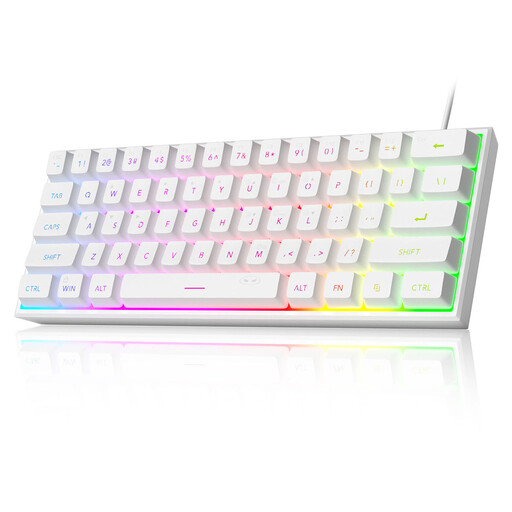
The layout without a number pad can free up space beside the keyboard. Bear in mind that it doesn’t have a separate number pad.
Wired connection, US QWERTY layout and membrane design, according to the product description.
No. A model without a built-in number pad can leave more room for your mouse, while separate halves give you more ways to adjust your hand angle. Compare these features with your posture and the desk space available.
Place the keyboard directly in front of you and keep the mouse close by. Also consider space for papers or a document holder, and adjust your chair and work surface so you can work comfortably, keeping your wrists as straight as possible while typing.
According to R-Go, the Compact Break’s LED indicator is controlled by R-Go Break software. Before buying, check the software requirements for your computer and the keyboard version you’ve chosen.
When you buy online from a business, you generally have a 14-day cooling-off period, subject to exceptions, according to the Dutch government. If a product is faulty, you should be able to seek a solution from the seller. Also check the terms of the specific offer; the cooling-off period and help with a faulty product are separate matters.
The Dutch government’s guidance doesn’t specify a particular ergonomic keyboard model. According to Arboportaal, for employees who work with a screen for more than 2 hours a day, the screen and keyboard must not be attached to each other; when using a laptop, it must be possible to use a separate screen or keyboard. These rules for employees don’t necessarily apply to every individual buyer.