
Editor who types for long periods
Wants to choose a hand position that suits longer editing sessions, without treating an ergonomic design as a medical solution.


Start with what matters most to you: a split design if you want to position your hands differently, a compact model if you need to keep space for your mouse, or keys specifically described as quiet if colleagues sit nearby. Manufacturers highlight the shape and comfort benefits of their designs, but the Cochrane review of ergonomic interventions in office work found no clear evidence that any one specific keyboard prevents discomfort.
Wants to choose a hand position that suits longer editing sessions, without treating an ergonomic design as a medical solution.
Prioritises quiet keystrokes and considers this separately from keyboard shape and typing feel. Trust describes the keys on the Keyra and Ody II as quiet.
Wants to keep space for a mouse and checks that the layout and connection suit a shared or changing workspace.
First decide whether hand position, keeping the noise down for colleagues, text navigation or connecting to a changing workspace matters most to you.
| What to consider | What to look for | Who is this important for? |
|---|---|---|
| Hand position when typing for long periods | Compare a fixed split with one that can be adjusted, and check the dimensions against your workspace. | If I do long editing sessions, I want a shape that suits the way I position my hands. Around 36% of consumers prioritise hand position. |
| Typing noise for colleagues | Look for an explicit description of the keystrokes and, where possible, assess the sound in your own workspace. | When colleagues sit nearby, I want to avoid disturbing them unnecessarily while I type. Around 29% of consumers prioritise keeping things quiet for colleagues. |
| Layout and text navigation | Check the physical keyboard layout and the positions of the keys used by your editing software. | When making lots of edits, I want familiar punctuation, arrow keys and shortcuts close to hand. Around 21% of consumers prioritise text navigation. |
| Connection to your workspace | Check which USB ports are available and whether Bluetooth or a USB receiver is permitted on your office computer. | If I move between workstations, I want to know in advance how to connect the keyboard. Around 14% of consumers prioritise workspace flexibility. |
Manufacturers describe the benefits of their designs, but the Cochrane review found no clear evidence that any one specific keyboard reliably prevents discomfort for all office workers.
Consider the shape and fit as part of your overall workspace and the variety of tasks you do. Don’t rely on a product claim to address ongoing discomfort.
The BakkerElkhuizen S-board 840 has no separate numeric keypad, despite the manufacturer referring to an integrated numeric section.
Check your usual editing tasks, shortcuts and number entry before choosing a size.
Descriptions of quiet keys are manufacturers’ claims; they don’t provide comparable sound measurements for your office environment.
Try the keyboard yourself where possible, and check the applicable returns policy beforehand.
Logitech’s ERGO K860 has a fixed split design, while the Wave Keys has a wave-shaped design and connects via Bluetooth or the included Logi Bolt receiver.
Trust describes the Keyra as split and quiet, and the Ody II as a keyboard with a conventional layout and quiet keys.
The S-board 840 is a compact, wired option for an editing workspace where mouse space matters.
According to the manufacturer, the R-Go Split Break v2 consists of two separate sections that can be positioned independently.
The PERIBOARD-429 is a compact, wired model with a scissor-switch mechanism.
This selection includes wireless models with different layouts, from compact keyboards to full-size models. Above all, check that the keyboard layout and connection type suit your shared workspace.
 No image available
May suit you if you’re looking for a wireless option for a shared workspace; check that you’re comfortable with the US English layout.
The product name specifies a wireless connection via RF and Bluetooth.
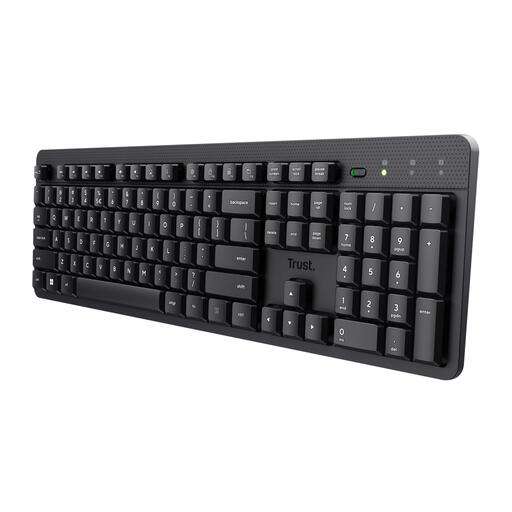 No image available
May suit you if you want a conventional layout and a numeric keypad; Trust describes the keys as quiet.
The product name specifies a USB receiver and a US QWERTY layout.
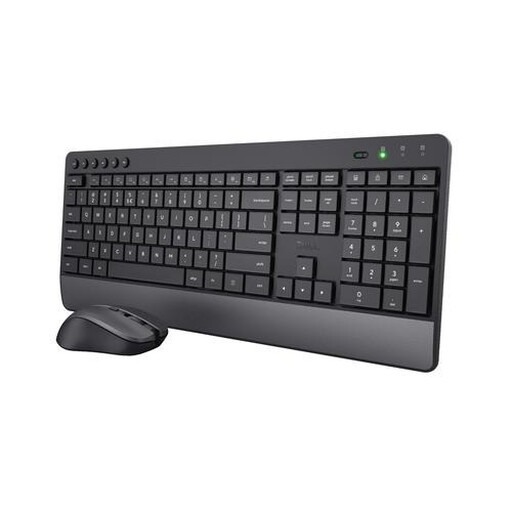 No image available
May suit you if you’re looking for a mouse as well as a keyboard; the product name describes the keys as quiet and mentions a wrist rest.
The product name specifies a wireless set with a US QWERTY layout.
 No image available
May suit you if you’re looking for a full-size layout with a numeric keypad; check that the US QWERTY layout works for you.
The product name specifies a wireless keyboard with a scissor-switch mechanism and multi-device support.
 No image available
May suit you if desk space matters; check that the compact layout has enough keys for your editing work.
The product name specifies a wired connection and RGB lighting. The product information gives the layout as US QWERTY.
No. You can choose based on your hand position, available space and what you’re used to. The Cochrane review of ergonomic interventions in office work found no clear evidence that any specific keyboard prevents arm or neck discomfort.
A description such as ‘quiet’ isn’t a comparative sound measurement. Trust uses this description for the Keyra and Ody II; try the keyboard yourself where possible and consider your own workspace.
Check the physical keyboard layout, your operating system, the USB ports available and whether Bluetooth or a USB receiver is permitted on your office computer. Connection options vary by model and version.
According to Arboportaal, for employees who work at a screen for more than two hours a day, the screen and keyboard must not be attached to each other. A separate screen or keyboard must be usable in this situation; what that means depends on the actual working environment.
For a standard online consumer purchase, you generally have a 14-day cooling-off period after delivery, subject to exceptions explained by ACM ConsuWijzer. If a product used normally doesn’t meet what you could reasonably expect, you may also be entitled to a legal guarantee; the retailer is your point of contact.